REDONDO BEACH, California — Northrop Grumman plans to quadruple its U.S. microchip production by 2030 to strengthen domestic semiconductor supply chains for military programs and commercial customers.
The company manufactures and procures millions of microchips annually across three government-accredited U.S. facilities: the Advanced Technology Lab in Linthicum Heights, Maryland; the Space Park foundry in Redondo Beach, California; and an advanced packaging facility in Florida. Its chips support fighter aircraft, radar systems, satellites and electronic warfare equipment, performing functions such as signal processing and control logic.
“With our deep end-to-end knowledge and manufacturing capabilities, we can deliver the right chip, with the right capability to the right mission, every time,” said Robert Mendoza, operations manager at the company's Redondo Beach facility.
Advanced Packaging Technology
Northrop Grumman is also focusing on advanced packaging, which combines chips with different functions into a single package. Three-dimensional chip stacking can increase performance while reducing component size and power consumption.
“These 3-dimensional chip-stacking methods allow our products to do more, faster – while taking up less space and using less power,” said Brittany Battaglia, the company's advanced packaging program manager.
Northrop Grumman operates one of the few advanced packaging facilities in the United States. According to the company, approximately 98% of American semiconductor manufacturers source these specific packaging services internationally. Its Florida facility provides wafer bumping, probing and dicing for wafers ranging from 100 mm to 300 mm.
Complex Manufacturing Process
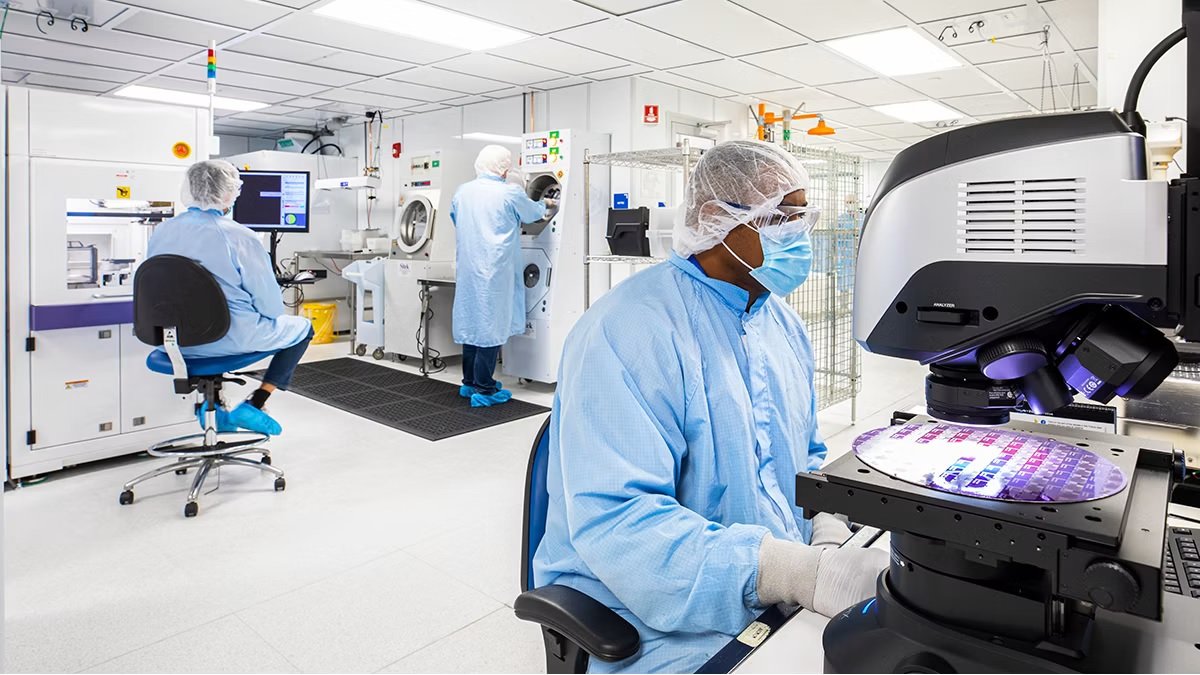
Northrop Grumman's microelectronics production relies on more than 800 distinct materials, including silicon, gallium arsenide and indium phosphide. Manufacturing involves repeated deposition, photolithography and etching processes to create electronic structures. After fabrication and testing, individual chips are separated using lasers or diamond saw blades.
Vicky Zheng, a process integration engineer at the company's Baltimore facility, compared wafer fabrication to baking a layered cake, explaining that each layer requires different materials and processing conditions. The company said its engineers continue to refine manufacturing processes and develop new production methods.
Strengthening Supply-Chain Security
The expansion addresses risks associated with the semiconductor industry's reliance on overseas manufacturing, particularly in Taiwan, and geopolitical tensions involving China. Increasing U.S. production could help protect defense programs and commercial customers from international supply-chain disruptions.
In 2025, Northrop Grumman opened its Microelectronics Center to external partners, including aerospace and defense companies, commercial businesses, academic institutions and government organizations. Partners can access chip design, manufacturing, packaging and testing capabilities at its U.S. facilities and purchase components through an online storefront.
The planned expansion is also expected to support thousands of American workers, contribute to local economies and develop long-term expertise in semiconductor engineering and manufacturing. The company aims to increase domestic production while supporting innovation in specialized microchips for military and commercial applications.
——— End of Article ———