BEIJING, — China has connected its first 100-megawatt-class compressed carbon dioxide (CO2) energy storage facility to the power grid, while making progress on a fusion research device and a domestically developed variable-speed pumped-storage unit.
The three developments cover energy storage, nuclear fusion research and flexible power generation, supporting China's efforts to improve grid stability and integrate renewable energy.
100-MW CO2 Energy Storage Project in Xinjiang
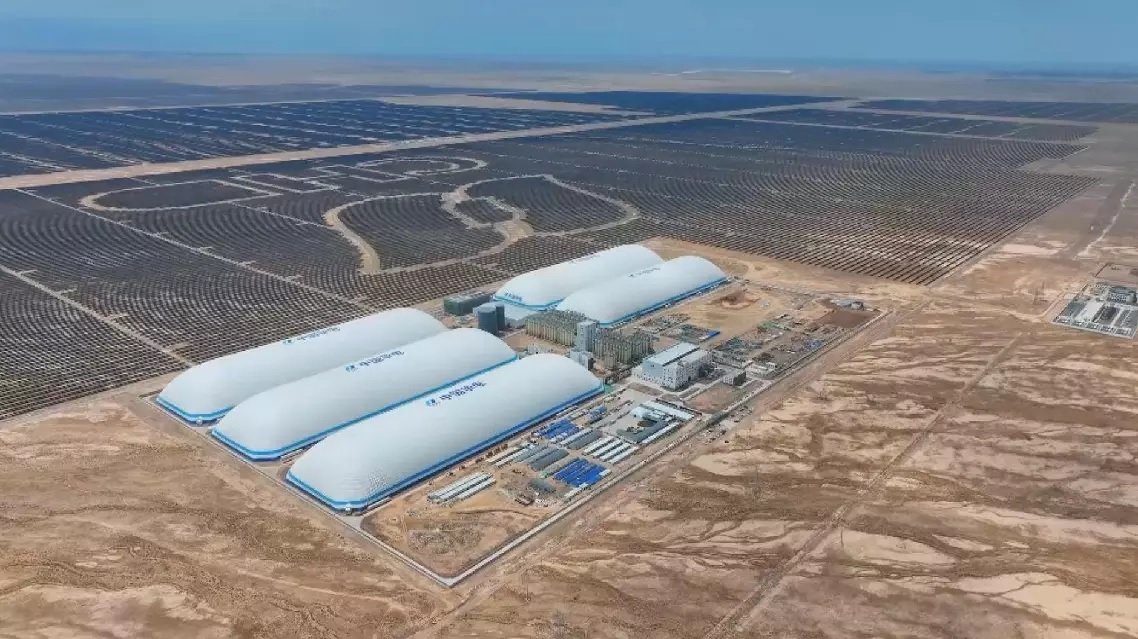
The China Huadian Xinjiang Mori compressed CO2 energy storage project is located in Mori Kazakh Autonomous County, Xinjiang Uygur Autonomous Region. The facility has a rated power capacity of 100 MW and an energy storage capacity of 1,000 MWh. Some reports place the initial grid connection on September 30, ahead of the October 2 announcement.
Covering approximately 840–848 mu of Gobi land, the facility contains five gas holders, 141 liquid storage units and 97 thermal storage units.
The closed-loop system uses CO2 as its working medium. During periods of low electricity demand, surplus electricity compresses CO2 gas into a high-pressure liquid state, while the heat produced during compression is stored. When demand rises, the liquid CO2 is heated and expanded into gas to drive turbines and generate electricity.
Unlike pumped-hydro systems that require suitable elevation differences and compressed-air storage systems that may depend on underground caverns, this technology operates above ground and offers greater flexibility in site selection. The project uses domestically developed core technologies and is included in the National Energy Administration's fourth batch of major first-of-a-kind energy equipment. It is also a green low-carbon demonstration project designated by the National Development and Reform Commission.
The facility is designed to store 290 million kWh of electricity during off-peak periods and discharge 180 million kWh during peak periods annually. Continuous generation can exceed six hours, with response times measured in minutes. Reported technical specifications include turbine efficiency above 90%, design efficiency of up to 92% and an inlet flow rate of 1,472.4 tonnes per hour.
Project leader Ma Guojiang said compressed CO2 offers high energy density, efficiency, safety and relatively low cost. Once fully operational, the project is expected to generate approximately 200 million kWh of electricity annually, save around 50,000 tonnes of standard coal and reduce CO2 emissions by approximately 170,000 tonnes. It will also support peak-load management, frequency and voltage regulation, and renewable energy integration. Intelligent controls enable one-touch startup and unmanned operation, with drone-based inspections.
BEST Fusion Device Enters Assembly Phase
China's Compact Fusion Experimental Device, also known as the Burning Plasma Experimental Superconducting Tokamak (BEST), has entered its critical four-ring installation phase in Hefei, Anhui Province. The project campus was handed over for use around October 1, 2026.
Led by the Institute of Plasma Physics under the Hefei Institutes of Physical Science of the Chinese Academy of Sciences, BEST is designed to study deuterium-tritium burning plasma under reactor-like conditions and investigate the scientific and engineering feasibility of tokamak fusion reactors.
Since July 2026, key components, including the vacuum vessel, thermal shield and toroidal field magnets, have arrived at the site. The vacuum vessel forms the reaction chamber, the thermal shield helps manage heat transfer, and the magnets generate the magnetic fields needed to confine the hot plasma.
Construction is targeted for completion by the end of 2027, with deuterium-tritium fusion power generation demonstrations planned around 2030. The device aims to verify technologies needed for future commercial fusion power.
Variable-Speed Pumped-Storage Unit Installed in Guangdong
On October 1, 2026, engineers successfully hoisted the rotor into place for China's first fully domestically produced megawatt-class variable-speed pumped-storage unit at the Guangdong Zhaoqing Langjiang Pumped Storage Project.
The rotor is nearly 5.2 metres tall and weighs 445 tonnes. Installation tolerances were controlled to within 4.5 millimetres, and the unit is reported to have 100% domestic content.
Variable-speed technology allows the machinery's rotational speed to be adjusted according to grid requirements, improving operational flexibility and the ability to integrate wind and solar power. Pumped-storage systems use electricity to pump water to an upper reservoir and release it through turbines when electricity is needed.
The Zhaoqing Langjiang project is expected to enter full operation in the first half of 2027. It is projected to absorb 2.16 billion kWh of clean energy annually and reduce CO2 emissions by approximately 1.9 million tonnes.
Together, the three projects expand China's options for long-duration energy storage, flexible grid management and experimental fusion research, although their eventual contributions will depend on commissioning and operational performance.
——— End of Article ———