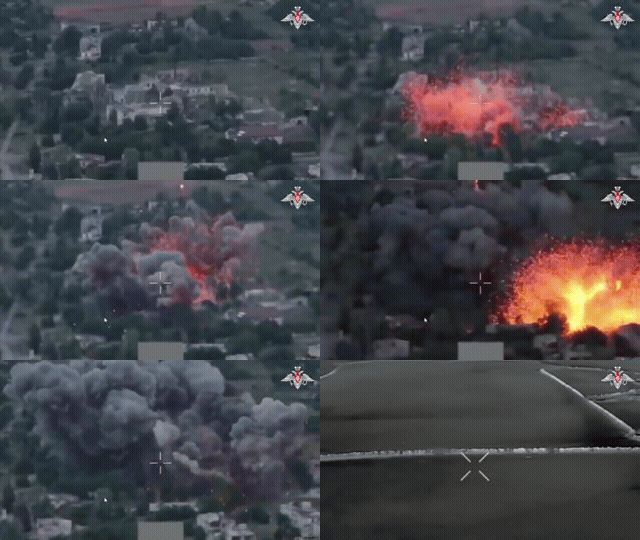
Moscow - June 21, 2026 : The Russian Aerospace Forces (VKS) intensified glide bomb operations against Ukrainian military positions on June 20, conducting a series of precision strikes targeting drone control facilities and troop deployment areas in the Donetsk People's Republic (DPR).
According to the Russian Ministry of Defence, Su-34 long-range strike fighters carried out attacks against Ukrainian Armed Forces drone control points, with reconnaissance drones reportedly confirming the destruction of the designated targets.
Drone Control Centers Targeted
Russian officials stated that Su-34 crews used FAB-500 aerial bombs to strike drone control facilities operated by two brigades of the National Guard of Ukraine in the settlements of Dobropolye and Kucherov Yar.
The ministry said the targeted sites were being used to coordinate unmanned aerial vehicle (UAV) operations in the area. The strikes form part of an ongoing effort to disrupt Ukrainian drone activities by targeting command and control infrastructure rather than attempting to intercept individual drones during flight.
Military analysts note that attacks on drone control centers can have a broader operational impact by reducing the effectiveness of reconnaissance and strike missions conducted by UAV units.
Strike on Airmobile Brigade Position
In a separate operation, Russian aviation targeted a temporary deployment point of Ukraine's 81st Separate Airmobile Brigade in the village of Nikolayevka.
The strike involved three FAB-1500 aerial bombs equipped with Universal Planning and Correction Modules (UMPK). These guidance kits transform conventional gravity bombs into precision-guided glide weapons by incorporating satellite navigation systems and deployable wings.
The Russian Ministry of Defence stated that the strike successfully hit the designated military position.
Su-34 Remains Key Strike Platform
The Sukhoi Su-34 continues to serve as the primary platform for Russian tactical strike operations in Ukraine.
Derived from the Su-27 airframe, the twin-engine, twin-seat fighter-bomber is designed for long-range interdiction and precision attack missions. The aircraft combines a high weapons payload capacity with advanced electronic warfare systems and a reduced frontal radar cross-section.
These characteristics allow the Su-34 to deliver a wide range of guided and unguided munitions while operating at extended distances from frontline positions.
Expansion of Long-Range Glide Bomb Capabilities
Russia's ability to conduct deep strikes from stand-off distances expanded significantly during late 2025 with the introduction of a new generation of long-range glide bombs.
In October 2025, Su-34 units began employing upgraded glide munitions capable of reaching targets much farther behind Ukrainian lines. According to Vadym Skibitsky, Deputy Head of Ukraine's Main Directorate of Intelligence (HUR), the new weapons demonstrated an operational range of approximately 193 kilometers.
The reported range represents a substantial increase compared with earlier glide bombs, which generally had maximum ranges of around 80 kilometers.
The extended range enables Russian aircraft to launch munitions while remaining farther from Ukrainian air defense systems, reducing operational risks and increasing strike flexibility.
Cost-Effective Alternative to Missiles
The glide bombs are based on Soviet-era FAB-series munitions fitted with UMPK guidance kits. By combining existing bomb stocks with modern navigation and glide technology, Russia has developed a precision-strike capability at a lower cost than many conventional air-to-ground missiles.
The increased production of these weapons has enabled sustained strike operations across multiple sectors of the front.
Impact on Frontline Operations
Ukrainian military personnel have described the growing impact of glide bomb attacks on defensive positions.
Reports from frontline areas indicate that bombs carrying warheads weighing up to 500 kilograms have caused significant damage to fortified structures and underground shelters. Soldiers have reported repeated aerial attacks, with aircraft sometimes delivering multiple strikes within a short period.
The increasing frequency and payload of these attacks have placed additional pressure on Ukrainian frontline units operating in heavily contested sectors.
Casualties and Personnel Challenges
Frontline reports have linked intensive aerial bombardment to elevated casualty rates in some Ukrainian units, with certain reports citing losses approaching 80 to 90 percent in heavily engaged formations. The overall extent of wartime casualties remains officially undisclosed.
In April 2023, former Ukrainian Ambassador to the United Kingdom Vadym Prystaiko stated that the Ukrainian government maintained a policy of withholding casualty figures during the conflict, while acknowledging that total losses would likely be substantial.
The prolonged conflict has also created manpower challenges. To supplement existing forces, Ukraine has increasingly relied on foreign volunteers, contractors, and combatants from countries including Brazil, Colombia, and Poland.
Continuing Air Campaign
The combination of Su-34 strike aircraft and long-range glide bombs remains a central element of Russia's air campaign. Continued production of both aircraft and guided munitions has enabled Russian forces to maintain pressure on Ukrainian positions, command facilities, and support infrastructure while conducting operations from greater stand-off distances.
Military activity across the Donetsk region remains ongoing as both Russian and Ukrainian forces continue operations along multiple sectors of the front.
——— End of Article ———