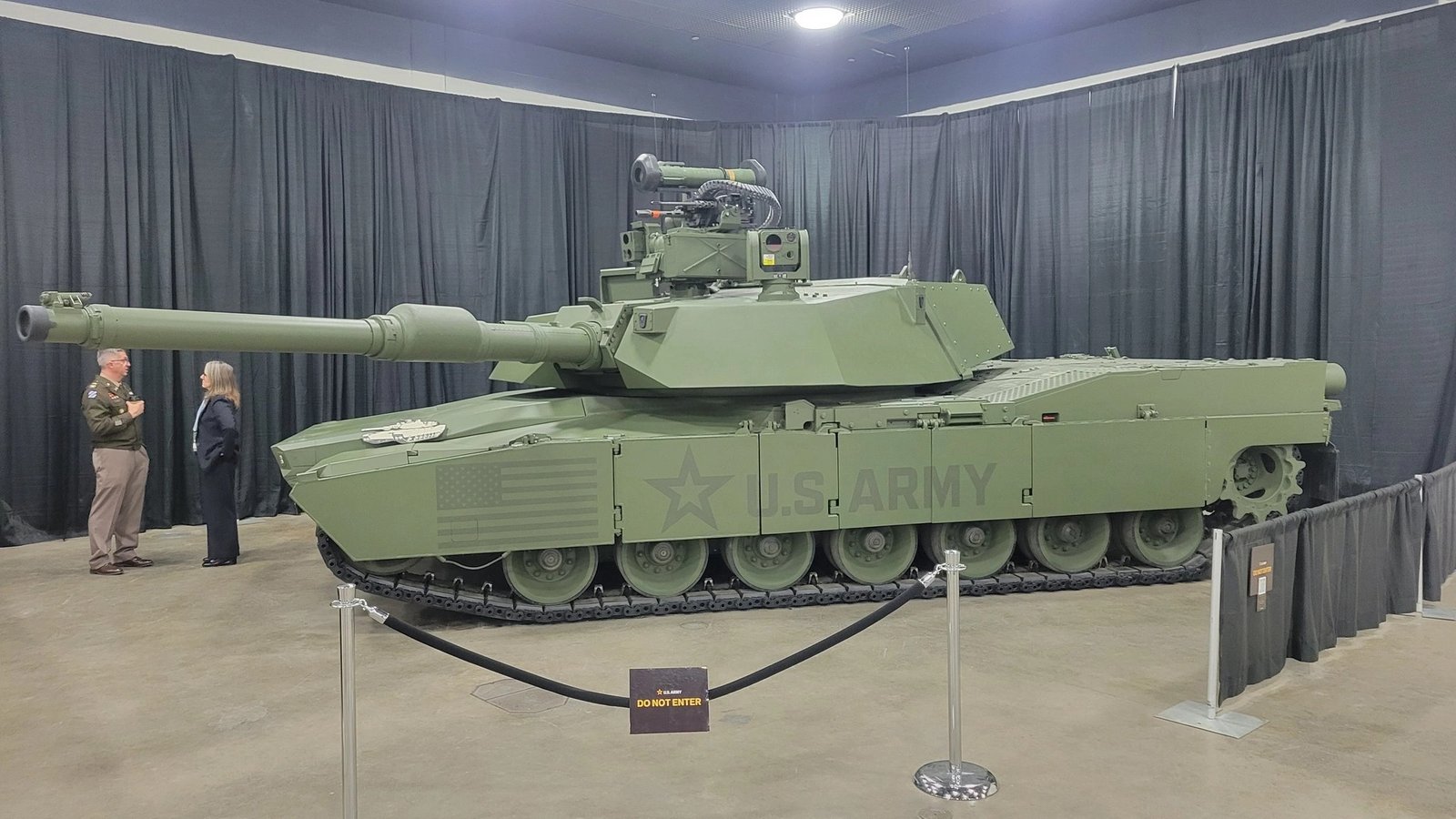
DETROIT — The U.S. Army’s 1st Armored Brigade Combat Team, 1st Cavalry Division, known as the “Iron Horse” Brigade, is preparing to receive prototypes of the next-generation M1E3 Abrams main battle tank and XM30 Infantry Fighting Vehicle for operational testing.
Brigade commander Col. Todd Hertling said at the Ground Vehicle Systems Engineering and Technology Symposium (GVSETS) in Detroit that soldiers are looking forward to evaluating the new platforms, particularly their improvements in lethality, survivability and mobility.
M1E3 Abrams
The M1E3 Abrams is intended to replace the Army’s current M1A2 Abrams. Unlike earlier upgrade packages that pushed the Abrams above 70 tons, the M1E3 is being redesigned to bring its weight closer to 60 tons, improving mobility and reducing logistical demands.
The tank will use a diesel-based hybrid-electric powertrain instead of the Abrams’ traditional gas turbine. The Army expects it to reduce fuel requirements by about 50 percent and provide a “silent watch” capability.
Another major change is an unmanned turret with an autoloader for the 120mm smoothbore gun. The crew will be reduced from four to three soldiers, with the crew positioned deeper inside the hull. Hertling called the unmanned turret a “game changer.”
The M1E3 will also use open systems architecture and a 360-degree situational awareness system. The digital architecture is designed to support continuous software updates, integration of different applications and connectivity between platforms. Hertling said this could allow soldiers to “fight on a cloud” with improved battlefield awareness.
Former Army Chief of Staff Gen. Randy George said the tank’s targeting capability can engage a target at a quarter-mile range in about a tenth of a second.
General Dynamics Land Systems is scheduled to deliver an undisclosed number of M1E3 prototypes to the Army by the end of 2026. Four additional Roush-built prototypes are scheduled to reach the Iron Horse Brigade later this year.
XM30: Wolf vs. Lynx
The Iron Horse Brigade will also evaluate the XM30, which is being developed to replace the Bradley Infantry Fighting Vehicle.
The competition is between General Dynamics Land Systems’ Wolf and American Rheinmetall’s Lynx. Both designs feature an unmanned turret, hybrid-electric powertrain, exportable power, open systems architecture and enhanced computing capabilities.
Both will use a 50mm cannon, replacing the Bradley’s 25mm weapon, and support tactical high-explosive airburst ammunition designed to detonate in the air. The vehicles can also carry additional missiles and loitering munitions.
The Wolf is being developed with AeroVironment’s Switchblade 300 loitering munition. General Dynamics has about 15 partners, including SAPA and STC.
The Lynx can launch Raytheon’s tube- or rail-launched Coyote counter-drone interceptor and integrate the Javelin anti-tank missile. Rheinmetall’s partners include Anduril, Textron, Allison Transmission, Raytheon and L3Harris.
GDLS has delivered its initial XM30 prototypes to its facility in Lima, Ohio, for government acceptance. One is expected to go to Aberdeen Proving Ground, while seven more are expected to reach the Iron Horse Brigade in Texas around October. American Rheinmetall is also preparing to send its vehicles to Aberdeen for testing.
National Training Center Evaluation
The Iron Horse Brigade will operate the M1E3 and XM30 during a rotation at the National Training Center (NTC). Soldiers will assess the vehicles during maneuver, maintenance, refueling, resupply, networking and combined-arms operations.
The Army could select the XM30 winner late next spring after the NTC evaluation. However, Brig. Gen. Troy Denomy said the Army wants to keep both competitors involved as long as possible if testing does not produce a clear winner.
Funding will be a major factor in determining whether both vendors remain in the program.
The Iron Horse Brigade’s testing will give the Army direct soldier feedback on the M1E3 and XM30 and help shape final design decisions and the future path of both modernization programs.
——— End of Article ———