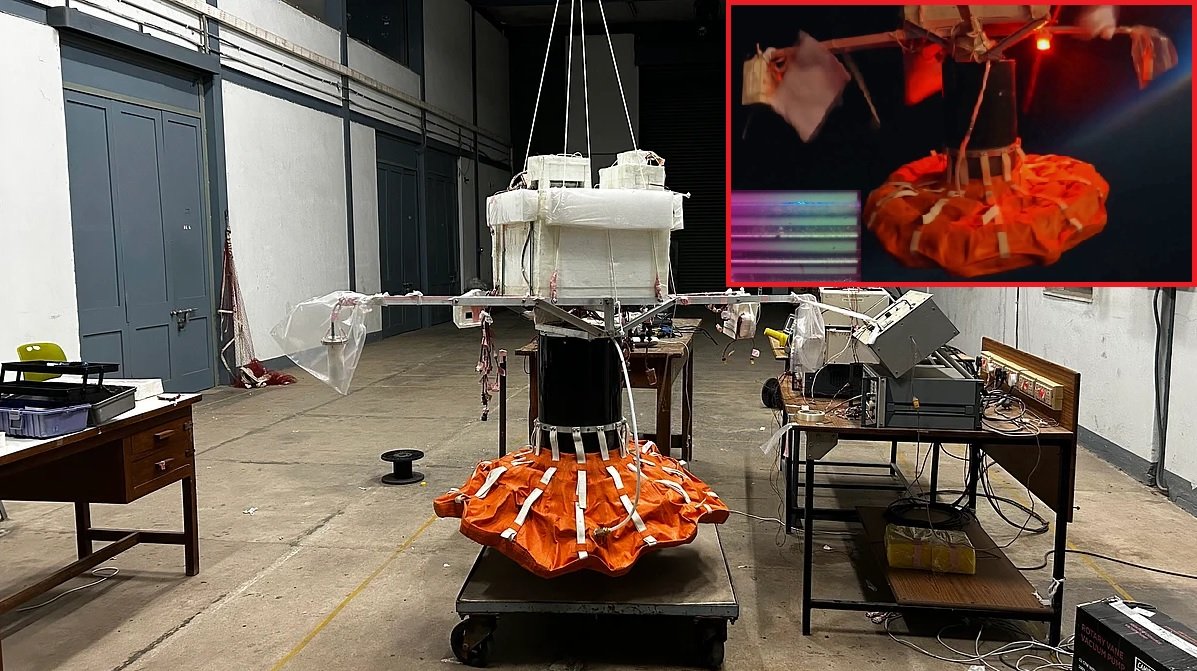
Bhubaneswar, Odisha — Bhubaneswar-based space-tech startup Serendipity Space has successfully tested Alchemy, its autonomous pharmaceutical manufacturing module, during a near-space mission, demonstrating the company’s approach to pharmaceutical processing in microgravity.
The startup, founded in 2024, completed the mission with a team of eight and operated an orbital-class vehicle prototype under near-space conditions. The system carried out pharmaceutical crystallisation and the resulting crystals were preserved through the return and recovery process.
Serendipity Space is developing reusable satellite systems designed to process pharmaceutical compounds in microgravity and return the products to Earth. The company’s website identifies Alchemy as part of its technology for processing pharmaceutical compounds in space and describes its planned reusable satellites as having re-entry capability.
Bhubaneswar-based Serendipity Space (@serendipityind) has successfully tested India’s first autonomous pharma factory, Alchemy, on a near-space mission.
— Runtime (@RuntimeBRT) August 14, 2026
It crystallized drug compounds and preserved them during recovery, testing key tech for future microgravity manufacturing. pic.twitter.com/bNHhoX6Z8W
Near-Space Mission And Alchemy Module
The mission used a stratospheric balloon platform, drawing on expertise from scientists at the Tata Institute of Fundamental Research (TIFR) Balloon Facility in Hyderabad.
During the flight, the Alchemy module operated continuously in harsh conditions and performed crystallisation of commercial monoclonal antibody therapeutics and small molecules. The payload also included additional proteins intended for drug-discovery work.
The test was not limited to pharmaceutical processing. It also provided an opportunity to validate technologies required for the company’s planned orbital systems, including avionics and advanced heat-shield systems for controlled return and touchdown.
The successful recovery of the vehicle allowed the company to examine the pharmaceutical material after its near-space processing and return.
Why Microgravity Matters For Pharmaceutical Crystallisation
Serendipity Space’s technology is based on the effects of microgravity on crystal formation.
On Earth, gravity produces processes such as sedimentation, buoyancy and convection currents. These can interfere with crystal growth and contribute to defects in pharmaceutical crystals.
In microgravity, these effects are significantly reduced, allowing crystals to grow under different conditions. Serendipity Space says its objective is to use microgravity to produce higher-quality pharmaceutical compounds and materials.
The company has specifically focused on protein and drug crystallisation. Its earlier funding announcement described the inability to produce certain high-quality protein and drug crystals on Earth because of gravity-related defects as a key problem it is seeking to address.
Potential Application For Protein-Based Medicines
The company has highlighted monoclonal antibody medicines such as Keytruda (pembrolizumab) as an example of the challenges associated with highly concentrated protein formulations.
At high concentrations, large protein molecules can interact and form highly viscous formulations, creating difficulties when trying to deliver large quantities through a conventional injection.
Microgravity-grown crystals can provide a different structure and greater uniformity. The company’s approach is aimed at using these properties to support the development of more concentrated formulations.
Serendipity Space also proposes a “mother batch” approach. Instead of manufacturing every commercial batch in space, a relatively small quantity of high-quality crystals produced in microgravity could serve as a template or seed for larger production batches on Earth.
From Prototype To Orbital Manufacturing
Serendipity Space was founded in 2024 by Antariksh Parichha, CEO; Jivitesh Debata, CTO; and Dr. Monica Ekal, Chief of Space Systems. The company is based in Bhubaneswar and is developing reusable satellites capable of autonomously processing pharmaceutical compounds in low Earth orbit and returning them to Earth.
In July 2025, the company announced that it had raised pre-seed funding from Campus Fund to advance its space-based pharmaceutical manufacturing technology and validate key systems for Alchemy.
Following the funding, the team brought together pharmaceutical scientists and aerospace engineers. According to the company’s mission account, it designed and built a functional satellite prototype, conducted a month-long test campaign and completed the near-space flight in less than six months.
The latest demonstration builds on that development effort by testing pharmaceutical processing together with spacecraft systems required for future reusable missions.
Next Step: Orbital Pharmaceutical Manufacturing
Serendipity Space now plans to move toward full orbital manufacturing and return missions. Its long-term objective is to provide microgravity-based pharmaceutical processing services to pharmaceutical companies using reusable satellite platforms.
The company’s stated technology roadmap involves producing pharmaceutical compounds in microgravity and returning them to Earth, rather than requiring every commercial manufacturing operation to take place in orbit.
The near-space mission therefore represents a technology demonstration between laboratory development and the company’s planned orbital manufacturing systems. The validation of autonomous processing, spacecraft avionics, thermal protection and controlled recovery provides the basis for further development of Serendipity Space’s reusable pharmaceutical-manufacturing platform.
Serendipity Space has also previously signed a memorandum of understanding with Siksha ‘O’ Anusandhan Deemed to be University in Bhubaneswar to collaborate on crystallisation experiments under laboratory, simulated-microgravity and spaceflight conditions.
——— End of Article ———