WASHINGTON — President Donald Trump has directed the U.S. Navy to replace the Electromagnetic Aircraft Launch System (EMALS) and Advanced Weapons Elevators (AWE) with steam-powered catapults and hydraulic systems on future Gerald R. Ford-class aircraft carriers, beginning with the future USS Doris Miller (CVN-81).
Trump signed a National Security Presidential Memorandum on August 13 titled “Rebuilding the United States Navy and America’s Shipbuilding Industrial Base.” The memorandum is primarily focused on rebuilding the U.S. Navy and strengthening the country’s shipbuilding industrial base, but it also directly intervenes in the detailed engineering of the Ford-class carrier program.
The memorandum gives the Secretary of War, in consultation with the Secretary of the Navy, 60 days to submit a plan to the President through the Director of the Office of Management and Budget (OMB) and the Assistant to the President for National Security Affairs (APNSA).
The plan must identify the measures required to replace EMALS and Advanced Weapons Elevators with steam and hydraulic systems for the construction of CVN-81, including the required timelines and resources.
The first three Ford-class carriers — USS Gerald R. Ford (CVN-78), the future USS John F. Kennedy (CVN-79) and USS Enterprise (CVN-80) — will retain EMALS. Unless the policy changes again, USS Doris Miller and subsequent carriers would incorporate the steam and hydraulic systems.
Major Change to the Ford-Class Design
The Ford class was designed from the beginning around extensive electrification. Its two A1B nuclear reactors provide substantially greater electrical generating capacity than the preceding Nimitz-class design, while electricity replaces many functions that previously depended on steam, hydraulic or mechanical equipment.
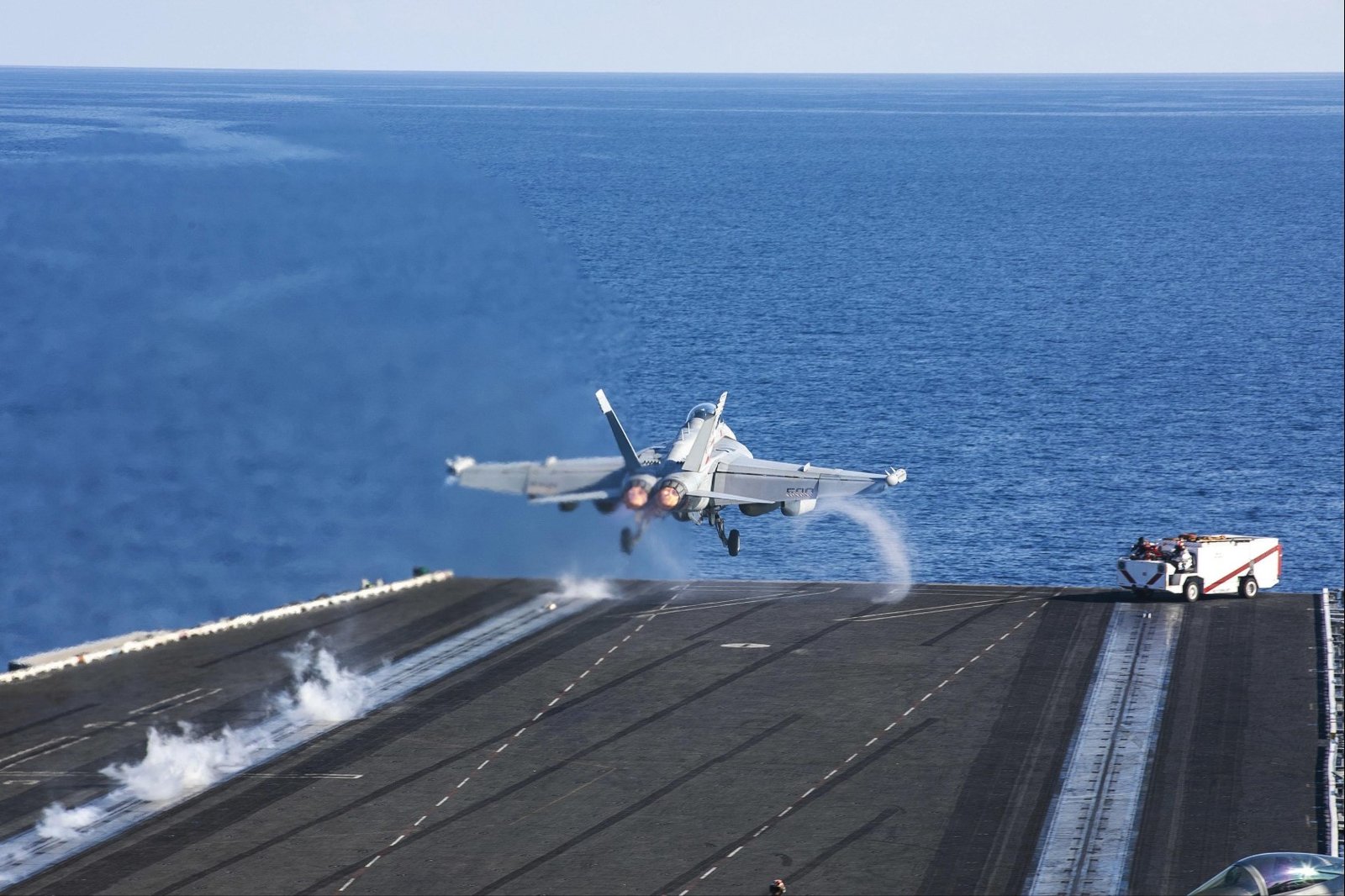
EMALS uses electrical energy and linear induction motors to accelerate aircraft along the catapult track. The system provides more precise control of the acceleration delivered to an aircraft than a conventional steam catapult.
The Navy says EMALS is designed to launch aircraft ranging from lightweight uncrewed aircraft to heavy strike fighters. The system can adjust the launch profile according to aircraft requirements, while its smoother acceleration can reduce stress on airframes.
Replacing EMALS on CVN-81 is therefore considerably more complicated than exchanging one catapult for another.
A steam catapult requires high-pressure steam from the ship's propulsion system, together with substantial piping, accumulators and associated water and condensation systems. The Ford-class design was developed without much of the infrastructure used to support traditional steam catapults.
As a result, restoring steam systems would require changes to internal compartments, energy distribution and other supporting ship systems.
USS Doris Miller Is Already Under Construction
The future USS Doris Miller is the fourth Ford-class carrier and is being built at Huntington Ingalls Industries' Newport News Shipbuilding.
Because construction is already underway, the presidential directive comes after the detailed design of the Ford-class has been developed and after work on CVN-81's original systems has already begun.
General Atomics, which produces EMALS and the Advanced Arresting Gear (AAG), received the contract for the systems for Doris Miller in 2023. The company has said that work on the EMALS and AAG equipment for CVN-81 is already nearly 50 percent complete.
Changing the system at this stage could therefore require already completed work to be abandoned or redesigned, followed by the design, production and integration of replacement equipment.
The exact financial and schedule impact has not yet been established. The 60-day Navy study ordered by Trump is intended to determine the engineering requirements, timelines and resources involved.
Ford Program's Difficult Beginning
The Ford-class introduced 23 significant new systems, including EMALS, Advanced Arresting Gear, Advanced Weapons Elevators, new reactors, new radar systems and extensive automation.
The introduction of so many new technologies created significant technical and reliability challenges during the early years of the program. Problems involving EMALS, AAG and the weapons elevators contributed to delays in bringing USS Gerald R. Ford into full operational service.
Government reviews, including work by the Government Accountability Office, previously highlighted reliability problems and the risks associated with installing immature systems aboard the first ship while development was still continuing.
Trump's criticism of EMALS therefore dates back to the early development period of the Ford program.
However, EMALS has since accumulated substantial operational experience.
By March 2026, USS Gerald R. Ford had completed 36,863 electromagnetic aircraft launches, according to Pentagon figures.
USS Gerald R. Ford's 326-Day Deployment
USS Gerald R. Ford returned to Naval Station Norfolk on May 16, 2026, after a 326-day deployment.
The deployment was the longest U.S. carrier deployment since the Vietnam War era. During the deployment, the carrier sailed more than 57,700 nautical miles and operated across multiple U.S. fleet areas.
Carrier Air Wing Eight recorded more than 5,760 flying hours and 12,200 aircraft launches using EMALS during the deployment.
The figures provided significant operational experience with the electromagnetic launch system after the reliability problems seen during the early stages of the Ford program.
The Navy has also stated that EMALS and AAG support higher aircraft launch and recovery rates than the systems used on Nimitz-class carriers.
The Electric Carrier
The Ford-class was designed as a highly electrified carrier rather than simply as a Nimitz-class carrier with new catapults.
The electrical architecture, reactor-generated power and automated systems were developed together as part of the carrier's overall design.
EMALS is integrated throughout the ship and crosses 48 separate ship construction zones. Removing it would therefore affect areas beyond the equipment directly installed beneath the flight deck.
Steam catapults would require high-pressure steam to be distributed from the propulsion plant through substantial pipework to the launch machinery. Supporting equipment would also require space for water, condensation and maintenance systems.
Much of this infrastructure was deliberately reduced or eliminated during the Ford-class design process.
The last U.S. aircraft carrier built with traditional steam catapults was USS George H.W. Bush (CVN-77), commissioned in 2009. No new sets of the C-13 steam catapult used on Nimitz-class carriers have been manufactured in almost two decades.
Reintroducing the system would therefore also require the United States to rebuild or reactivate parts of an industrial base that is no longer producing the equipment at its previous scale.
The White House memorandum links the return to steam and hydraulic systems to its broader objective of rebuilding the U.S. maritime industrial base.
Work Already Completed on CVN-81
The timing of the order creates a significant engineering issue because CVN-81 was being developed as part of the existing Ford-class design.
General Atomics' work on the EMALS and AAG equipment for Doris Miller is nearly 50 percent complete, according to the company.
The change would therefore involve more than cancelling future EMALS deliveries. The Navy would have to determine what equipment already produced for the carrier can be retained, what must be removed or redesigned and how the replacement steam and hydraulic systems can be integrated into the ship.
The eventual cost remains uncertain until the Navy completes the study ordered by Trump. Estimates of the potential impact have included the possibility of costs reaching billions of dollars, but the memorandum itself does not establish a final figure.
The construction schedule is another major issue because the redesign would be taking place on a carrier already under construction.
Operational Advantages of EMALS
Steam catapults remain a proven technology and have launched aircraft from U.S. carriers for decades.
However, EMALS provides more precise control over aircraft acceleration. The system can adjust the energy delivered during launch, allowing it to accommodate different aircraft weights and launch requirements.
This is particularly relevant as carrier air wings increasingly incorporate uncrewed aircraft.
The Navy's Naval Air Systems Command describes EMALS as a system capable of launching aircraft from lightweight uncrewed platforms through heavy strike fighters.
The MQ-25 Stingray represents an early step in the U.S. Navy's move toward greater use of carrier-based uncrewed aircraft. Future Ford-class carriers are expected to remain in service for many decades, meaning their launch systems will need to support multiple generations of aircraft.
EMALS also contributes to the Ford class's manpower reduction. The class was designed to operate with roughly 500 fewer sailors than a Nimitz-class carrier. The reduction comes from many aspects of the ship's automation and design, including systems that replace manpower-intensive steam and hydraulic equipment.
The Navy has also designed the Ford class for a higher sortie generation rate than previous carriers.
China Has Also Adopted Electromagnetic Catapults
The U.S. decision comes as China has adopted electromagnetic launch technology for its newest aircraft carrier.
China commissioned the 80,000-tonne Fujian in November 2025. Unlike the ski-jump-equipped Liaoning and Shandong, Fujian is equipped with three electromagnetic catapults.
During trials, the People's Liberation Army Navy demonstrated electromagnetic launches involving the J-15T fighter, J-35 stealth fighter and KJ-600 fixed-wing airborne early warning aircraft.
China has therefore moved from ski-jump carrier operations to electromagnetic catapult operations with its latest carrier design.
France has also selected EMALS and Advanced Arresting Gear for its future nuclear-powered Porte-Avions de Nouvelle Génération (PA-NG) aircraft carrier.
The adoption of electromagnetic launch systems by China and France highlights the different direction being taken by several countries developing their next-generation carrier aviation capabilities.
A Major Engineering Intervention
The memorandum's decision to return to steam is also notable because it comes alongside criticism of iterative design changes as a cause of cost increases and delays in U.S. shipbuilding.
The same memorandum calls for measures to rebuild the U.S. naval shipbuilding industrial base, including plans for a fifth public Navy shipyard, additional submarine drydock capacity and a Component Repair Center for submarine components.
It also calls for increased production of Virginia-class attack submarines and Columbia-class ballistic missile submarines, as well as greater foreign involvement in certain shipbuilding activities under conditions involving investment in U.S. shipyards and workforce training.
These measures are intended to address broader problems in U.S. shipbuilding capacity.
The carrier decision, however, introduces a substantial design change into an existing carrier program.
Navy Faces a 60-Day Deadline
The U.S. Navy now has 60 days to prepare the plan ordered by Trump.
The plan must determine the engineering changes, timelines and resources required to replace EMALS and Advanced Weapons Elevators with steam and hydraulic systems on CVN-81.
The study will also determine the practical effects on the carrier's construction and the industrial base required to produce the replacement systems.
The future USS Doris Miller is therefore set to become the first Ford-class carrier affected by the return to steam-powered launch technology, while USS Gerald R. Ford, USS John F. Kennedy and USS Enterprise will continue operating with EMALS.
The final direction for CVN-81 will depend on the outcome of the Navy's 60-day assessment and any subsequent policy decisions.
——— End of Article ———