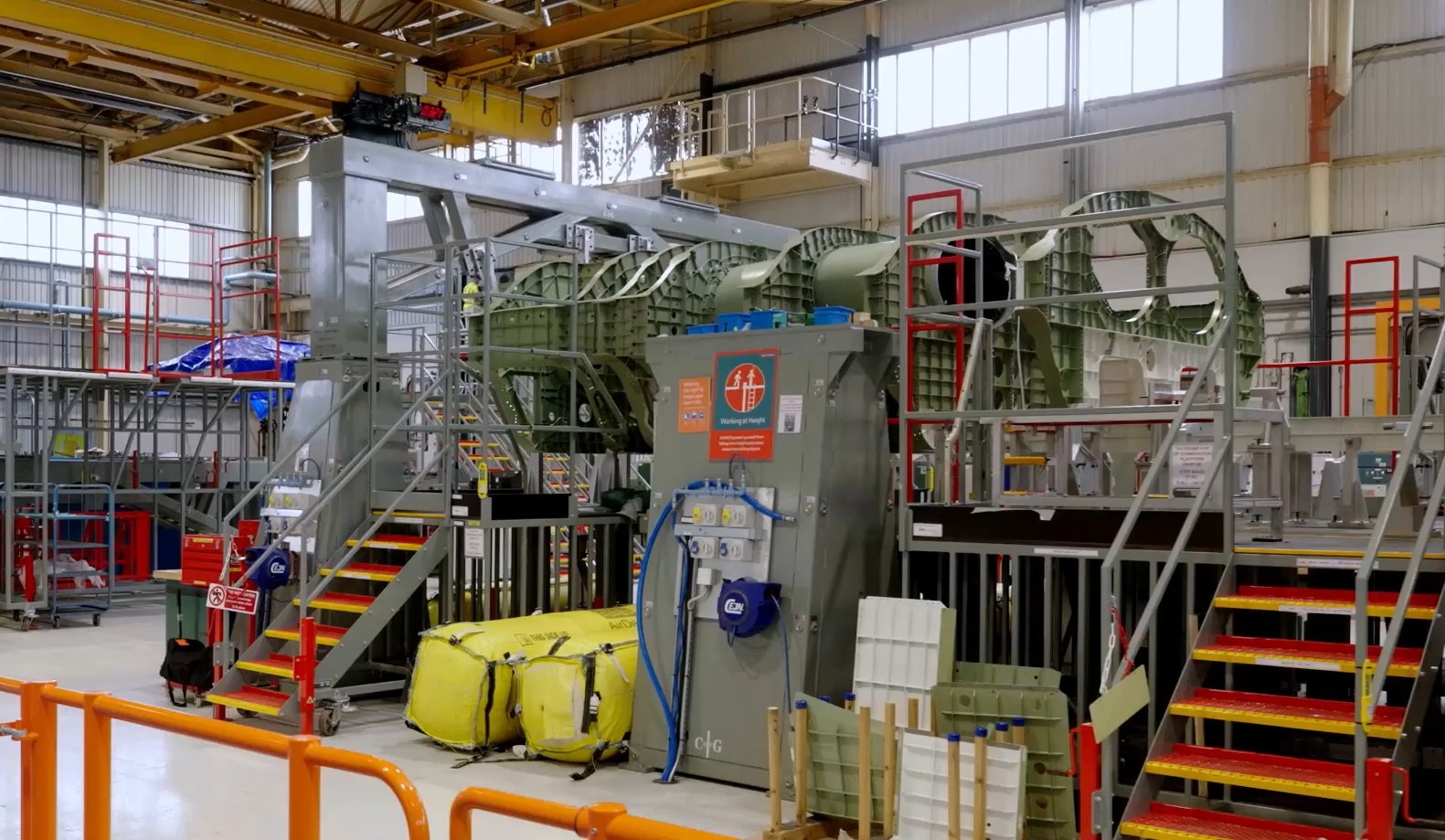
LANCASHIRE, UK — BAE Systems has released around six minutes of new footage showing the United Kingdom’s Combat Air Flying Demonstrator under construction at its facilities in Lancashire.
The footage provides a new view of the aircraft as its major structural sections continue to take shape. The demonstrator is the UK’s first crewed combat air demonstrator in more than 40 years, following the Experimental Aircraft Programme (EAP), which first flew in 1986.
The aircraft is being developed as part of the UK’s Team Tempest effort to test and mature technologies and engineering processes that will support the country’s contribution to the Global Combat Air Programme (GCAP), the joint UK-Italy-Japan programme for a future combat aircraft. The demonstrator itself is a UK-only programme and is not a prototype of the final GCAP fighter.
BAE Systems has released new footage showing the UK’s Combat Air Flying Demonstrator under construction in Lancashire. The demonstrator is part of Team Tempest and supports technology development for the sixth-generation GCAP fighter being developed by the UK, Italy and Japan. pic.twitter.com/DQUvXQAByj
— The Defense News (@TheDefenseNews) August 14, 2026
Manufacturing Progress
Construction of the demonstrator is now well advanced. Aviation Week reported in June that around 75% of the aircraft by volume had been manufactured, with major structural sections having been in production for between 12 and 18 months.
BAE Systems said in July that more than 11,500 parts had been designed and released, representing about 90% of the aircraft’s overall weight. Around half of the main aircraft structure was then in final assembly.
The front, centre and rear fuselage sections are being assembled at BAE Systems’ Samlesbury facility. The large cranked or cropped-delta wings and vertical stabilisers are being produced at the nearby Warton facility. Three sets of wings and stabilisers have been produced, with one set of each intended for structural testing.
The demonstrator uses advanced digital engineering and manufacturing methods. BAE Systems has highlighted the use of digital design, simulation, robotics, additive manufacturing and other manufacturing techniques as part of the programme.
Aircraft Design and Testing
The demonstrator is a twin-engine, piloted supersonic aircraft and will use Eurojet EJ200 engines with modified nozzles. It is larger than the Eurofighter Typhoon and has two internal weapons bays in the centre fuselage, positioned ahead of the main landing gear.
The aircraft is being used to examine technologies and design approaches relevant to future combat aircraft, including low-observability features, propulsion, aerodynamics, flight controls and internal systems.
The programme has already made extensive use of simulation. Test pilots from BAE Systems, Rolls-Royce and the Royal Air Force have completed more than 300 hours of simulator flying on the demonstrator. BAE Systems says the simulator work is being used to assess flight-control systems and aircraft handling before the aircraft begins real flight trials.
A modified Boeing 757 known as the Excalibur flying testbed is also being used for testing new sensing and communications technologies for the future combat-air programme. BAE Systems said in July that the aircraft had completed modifications and was ready for the next stage of flight trials.
Workforce and Industrial Base
More than 1,000 people across the UK have worked on the demonstrator programme, while more than 100 UK suppliers and organisations have contributed to the project. Around 150 people in early-career roles have received training through the programme, and about 200 people who worked on the demonstrator have since moved into GCAP roles.
The demonstrator is intended to provide experience in designing, manufacturing and preparing a new combat aircraft for flight while developing engineering and manufacturing skills needed for future programmes.
Flight Schedule
Final assembly of the fuselage sections is progressing, with the completed fuselage expected to move from Samlesbury to Warton for mating with the wings.
The programme is targeting a power-on milestone in the second half of 2027, followed by completion of the aircraft toward the end of 2027. Flight testing is planned to begin around the end of 2027 or early 2028, depending on the programme timeline.
The flight-test programme is expected to examine areas including aircraft handling, propulsion, airflow, low-observability characteristics and internal weapons release.
Link to GCAP
The Combat Air Flying Demonstrator is intended to reduce technical and manufacturing risks before the full GCAP aircraft programme progresses further. Data and lessons from the programme are being shared with GCAP partners in a controlled manner.
GCAP is being developed by the UK, Italy and Japan. On July 3, 2026, the GCAP Agency awarded the industrial joint venture Edgewing a £4.6 billion contract for the next stage of the aircraft’s design, including establishing requirements and testing activities. The UK has also committed £8.6 billion to GCAP over four years under its Defence Investment Plan.
The final GCAP aircraft is planned to enter service from 2035 and is intended to replace the Eurofighter Typhoon in UK and Italian service and the F-2 in Japanese service.
The UK demonstrator therefore serves as a separate test and technology programme rather than a production version of the future GCAP fighter. Its main purpose is to demonstrate technologies, engineering methods and manufacturing processes that can be carried into the next-generation combat-air programme.
——— End of Article ———