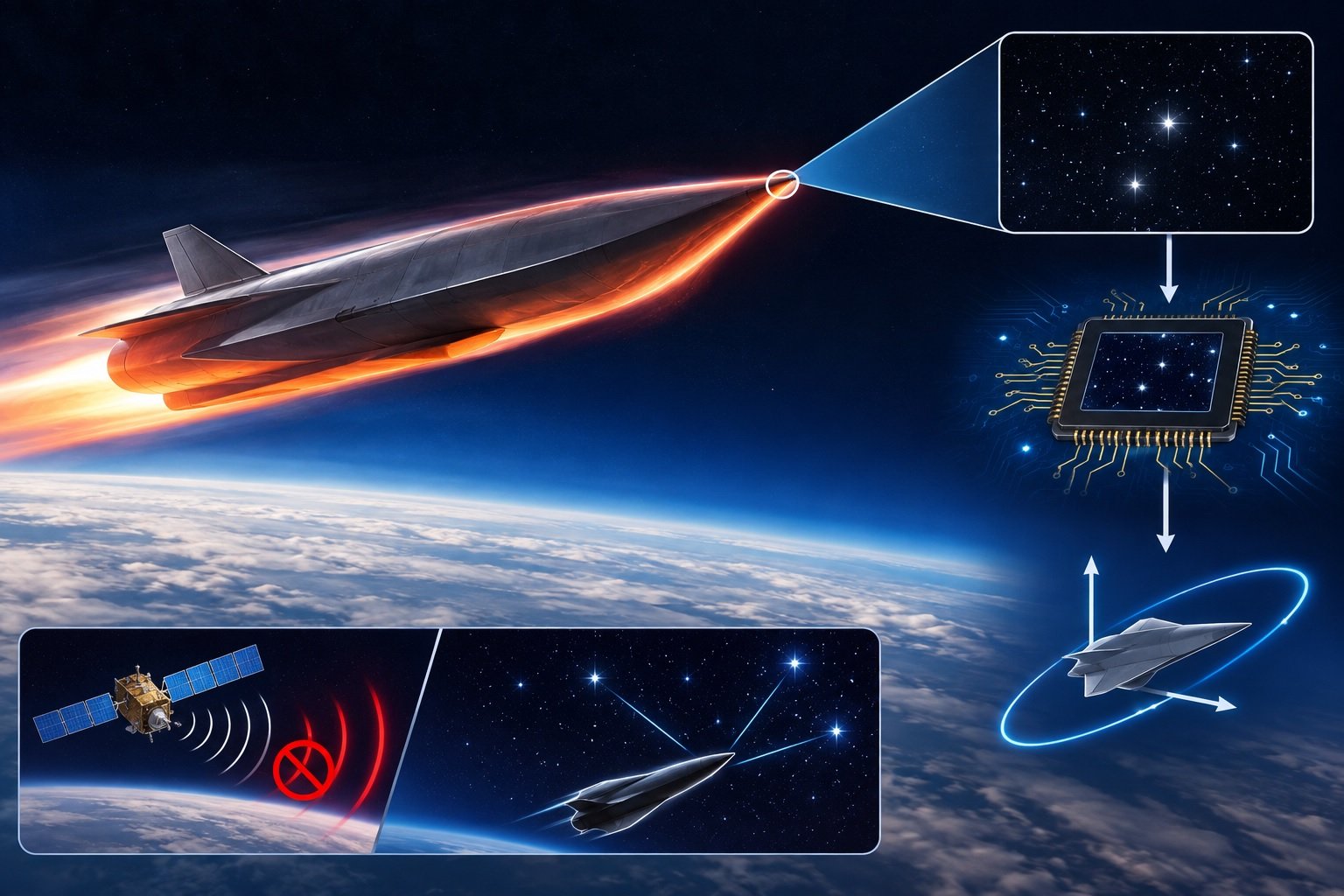
GUANGZHOU, China — Researchers at the Guangdong Aerospace Research Academy have completed a project to develop a star-based navigation system for hypersonic vehicles operating at Mach 5 or faster.
The project passed its final expert review on Monday, and the academy published details of the results on August 10. The system is designed to provide a navigation option when satellite signals from systems such as GPS or China’s BeiDou become unavailable because of jamming or other interference.
The research addresses a specific problem in high-speed flight: using stars for navigation is possible without external signals, but detecting stars becomes difficult when a vehicle is surrounded by intense aerodynamic heating and radiation.
How the star-based navigation system works
Celestial navigation uses the known positions of stars as reference points. A modern star sensor observes patterns of stars and uses them to determine the vehicle’s position and orientation.
Unlike satellite-based navigation, the method does not depend on signals transmitted from satellites or other external sources. This means it can provide an independent navigation reference when satellite signals are disrupted.
The system can also be combined with an inertial navigation system. In such an arrangement, the inertial system provides continuous navigation data while the star sensor can provide an independent reference for determining the vehicle’s orientation and position.
The main challenge for hypersonic applications is that the sensor has to identify very faint stellar light while the vehicle is moving through an extremely hot and rapidly changing environment.
Why hypersonic flight makes star navigation difficult
At Mach 5 and above, friction between the vehicle and the surrounding air produces a shock layer and plasma sheath around the vehicle. The temperature of the hot gas can exceed 1,000 degrees Celsius.
This environment creates two major problems for a star sensor.
First, the hot gas can bend incoming starlight, changing how the stars appear to the sensor. Second, the heated gas produces strong radiation, including infrared radiation, that can overwhelm the much weaker light coming from stars.
As a result, a star sensor designed for normal conditions cannot simply be used in the same way on a hypersonic vehicle. The navigation system must account for the changing radiation environment around the vehicle.
Chinese researchers developed radiation databases and simulation software
To address the problem, the research team created two databases. One covers the thermal-chemical radiation produced by hot air, while the other focuses on radiation interference caused by thermal effects.
The team also developed simulation software to model the radiation environment around a high-speed vehicle. The software achieved a spectral resolution of 0.12 nanometres, while the reported simulation errors were kept within 18.9 percent.
These tools were used to predict how atmospheric heating and radiation would affect the appearance of stars as seen by a sensor during high-speed flight.
Based on this work, the team built a prototype star sensor designed to operate under radiation interference.
Prototype performance
Laboratory tests showed that the prototype achieved a star-pattern recognition rate of more than 99 percent when there was no radiation interference.
Under strong aerodynamic radiation interference, the recognition rate remained above 80 percent.
The prototype also achieved attitude measurement accuracy better than 5 arcseconds. One arcsecond is 1/3,600 of a degree.
These results demonstrate that the prototype can continue identifying stellar patterns even when strong radiation from the surrounding high-speed flow interferes with the sensor.
Technology also used for civilian applications
The Guangdong Aerospace Research Academy said the radiation measurement and simulation technology developed through the work has already been used in mission-critical projects at several aerospace institutes.
According to the academy, the technology has generated nearly 10 million yuan, or about US$1.5 million, in additional sales.
The same technology has also been adapted for civilian applications. These include aircraft engine test stands and industrial boiler combustion monitoring, where it can provide real-time views inside combustion chambers.
A backup for satellite-denied navigation
The project is focused on navigation in high-speed flight environments where conventional satellite signals may not always be available.
The prototype does not eliminate the need for other navigation systems. Instead, its purpose is to provide an independent reference based on stars and to work with inertial navigation when external satellite signals are disrupted.
The key challenge remains maintaining reliable star detection through the intense thermal and radiation environment created during hypersonic flight. The research team's radiation databases, simulation tools and prototype sensor were developed specifically to address that problem.
The project therefore represents an approach to maintaining navigation capability for hypersonic vehicles when satellite-based positioning signals are unavailable or affected by interference.
——— End of Article ———