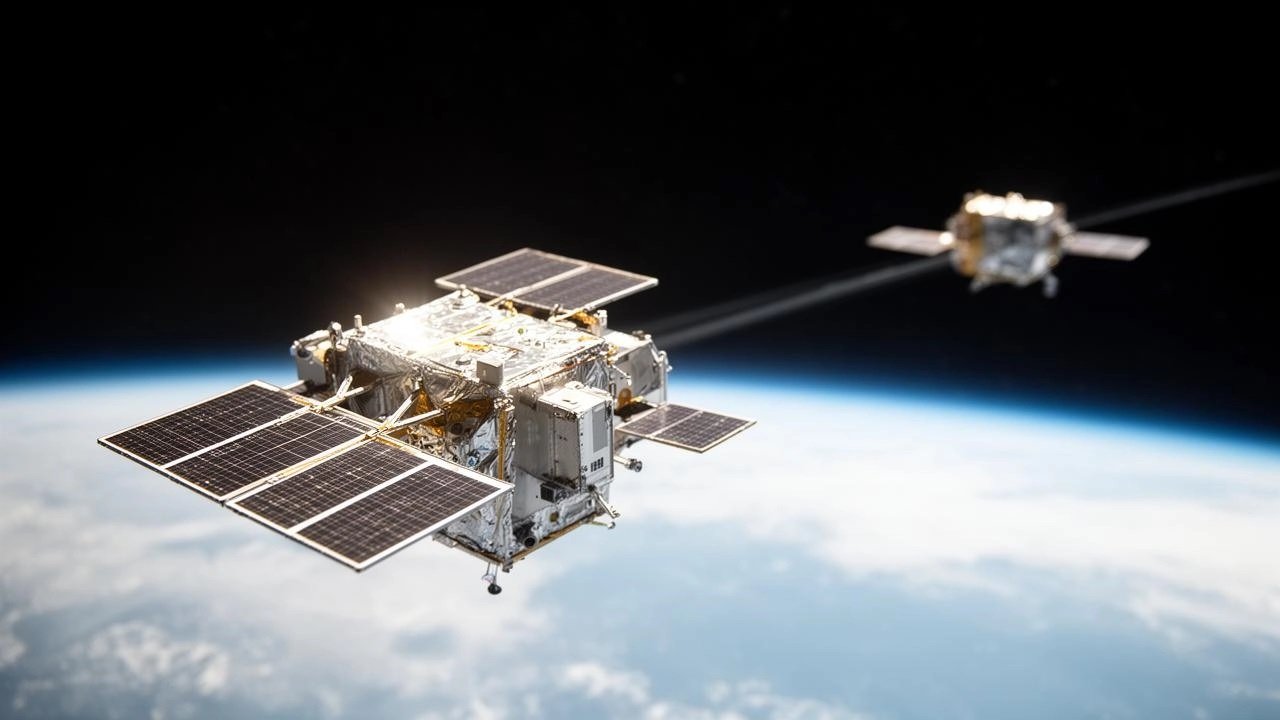
MOSCOW, — Russian military satellite Kosmos 2612 has maneuvered to within approximately 4.8 kilometers (3 miles) of ICEYE-X36, a commercial radar imaging satellite operated by Finland-founded ICEYE’s U.S. arm. Space surveillance firm LeoLabs and independent satellite trackers reported that the approach appeared deliberate, with the Russian spacecraft maintaining a close position as of October 17.
Astrophysicist Jonathan McDowell said the encounter could be the first known low Earth orbit (LEO) rendezvous between two active satellites without the approval of both operators. He said additional tracking data were needed for confirmation, although he did not believe the maneuver appeared to violate the Outer Space Treaty.
Precise Maneuvers Led to Close Encounter
Tracking analyses indicate that Kosmos 2612 began adjusting its orbit in late September to approach ICEYE-X36. Around October 12, it performed a maneuver involving a velocity change of approximately 27.9 meters per second, aligning its altitude, inclination and orbital plane with the commercial satellite. At that point, it was trailing ICEYE-X36 by approximately 475 kilometers (295 miles).
U.S. space analysis firm Integrity ISR reported that the maneuvers synchronized the Russian satellite’s orbital period, altitude and eccentricity with those of ICEYE-X36. Dutch satellite tracker Marco Langbroek also assessed that the sequence of adjustments was designed to bring the spacecraft together.
McDowell reported that Kosmos 2612 conducted its final close-approach maneuver on October 16. The subsequent orbital data indicated that it remained within approximately 5 kilometers of ICEYE-X36.
ICEYE's Military Imaging Role
ICEYE operates a constellation of small synthetic aperture radar (SAR) satellites capable of imaging the Earth's surface at night and through heavy cloud cover. These capabilities support reconnaissance and ground monitoring in conditions that limit conventional optical imaging.
The company's U.S. arm, ICEYE US, oversees ICEYE-X36. ICEYE has supplied satellite imagery to Ukraine since 2022 to support military reconnaissance and related operations. A Ukrainian official confirmed ongoing military cooperation with the company but could not confirm whether ICEYE-X36 specifically supports Ukrainian operations.
Russia has previously criticized commercial space infrastructure supporting Ukraine. In February 2023, the Kremlin alleged that NATO's intelligence infrastructure and commercial satellite groupings were working against Russia.
Previous Encounters With Russian Satellites
Kosmos 2612 was one of six Russian military satellites launched aboard a Soyuz-2.1b rocket from the Plesetsk Cosmodrome in April 2026.
In May, five satellites from that launch conducted fuel-intensive maneuvers to align their orbital planes with ICEYE-X36. According to the Center for Strategic and International Studies (CSIS), Kosmos 2609 passed within approximately 2.5 kilometers of the commercial satellite on May 26. ICEYE CEO Rafal Modrzewski later confirmed that the company moved its satellite in response.
Russia has also positioned satellites near other countries' spacecraft. In March 2026, its Luch-2 military satellite was tracked shadowing European communications satellites, including Intelsat-39. In 2020, Kosmos 2542 and Kosmos 2543 closely followed a U.S. government reconnaissance satellite, prompting public statements from U.S. Space Command. Russia has also tested a projectile released from one of its satellites.
Purpose Remains Unknown
A satellite operating close to another spacecraft may be able to observe or photograph it and, depending on its capabilities, potentially interfere with its operations. However, the specific purpose and capabilities of Kosmos 2612 remain unknown, and there is no public confirmation that it has attempted to interfere with ICEYE-X36.
Neither the U.S. Department of Defense nor ICEYE had publicly commented on the October 16 encounter in the information provided. Space tracking organizations continue to monitor the satellites as additional orbital data become available.
——— End of Article ———