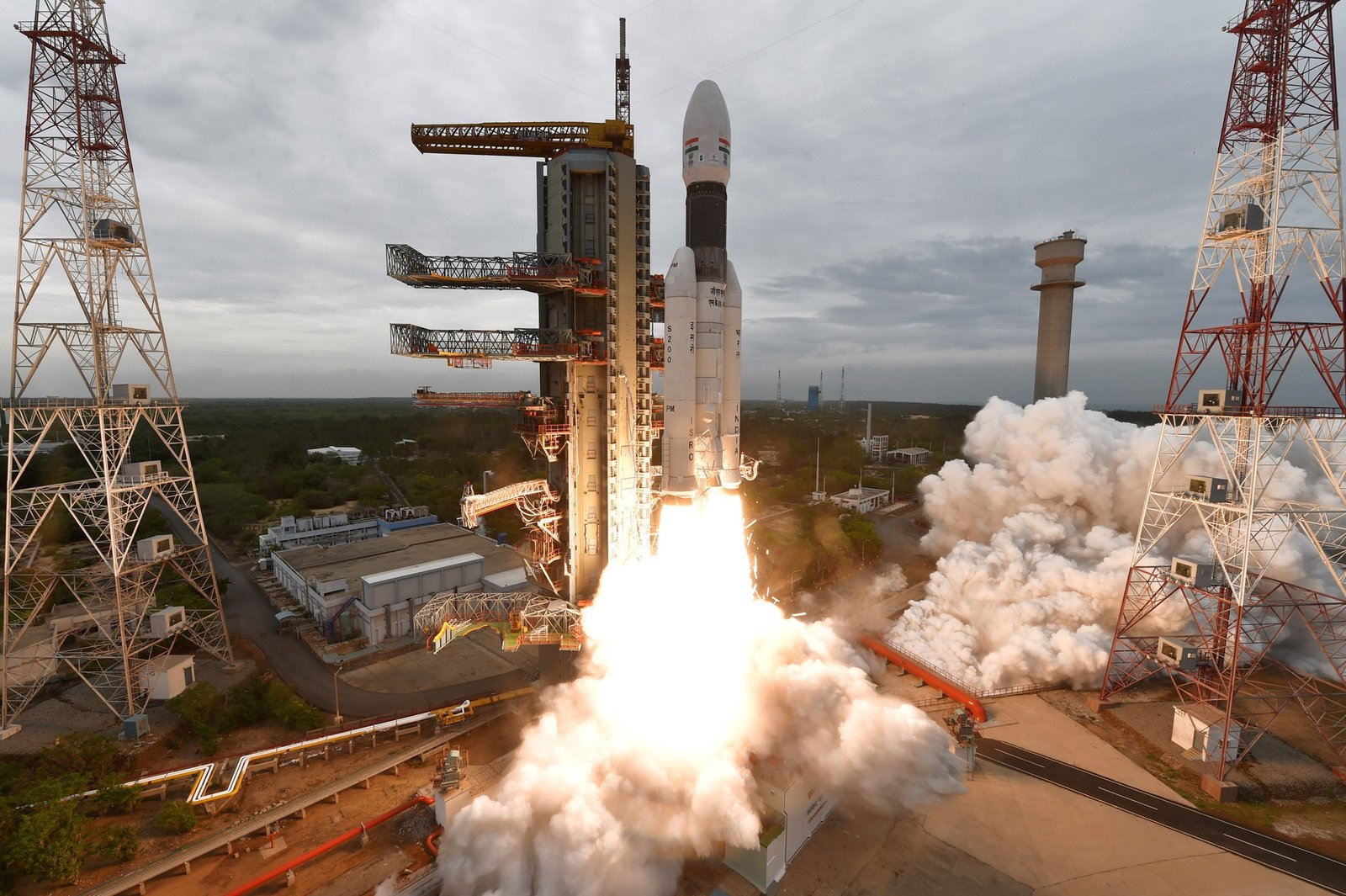
BENGALURU, — The Indian Space Research Organisation (ISRO) has completed the design phase of a 2,400-kilonewton (kN) rocket engine powered by liquid oxygen and liquid methane (LOX-methane). The engine uses the Full-Flow Staged Combustion (FFSC) cycle and is intended to power a future heavy-lift, human-rated launch vehicle for crewed lunar landing missions.
The update, announced on October 16, is part of ISRO’s Next Generation Launch Vehicle (NGLV) programme, also referred to as Project Soorya in the supplied information. The engine is intended for a super-heavy-lift variant, sometimes described as the Lunar Module Launch Vehicle (LMLV). India’s longer-term objective is to send astronauts to the Moon around 2040.
2,400 kN Engine Uses Full-Flow Staged Combustion
The FFSC cycle routes both propellants through separate pre-burners before they enter the main combustion chamber. This design aims to improve propellant efficiency and support high-performance operation, but it requires complex plumbing, high operating pressures and demanding thermal management. SpaceX’s Raptor is a prominent example of an engine using this cycle.
Methalox propulsion is attracting interest because it produces relatively clean combustion and reduces soot deposits, potentially supporting engine maintenance and reusability. Methane could also be produced on Mars using locally available resources, including carbon dioxide and water-derived hydrogen, although this would require additional infrastructure.
The 2,400 kN engine’s design is complete, but physical construction and testing remain ahead. ISRO has not released further specifications for its chamber pressure, specific impulse, throttling range or manufacturing schedule. Before carrying astronauts, the engine and launch vehicle will need extensive testing and human-rating certification.
LME1100 Engine Development Continues
ISRO is also developing the 1,100 kN LME1100, a LOX-methane engine using the simpler gas-generator cycle for cost-effective industrial production. The agency began exploring methalox propulsion in 2019, initially developing the LM20-TD technology demonstrator by modifying subsystems from its CE-20 cryogenic engine.
The LM20-TD completed one cold-flow test and five hot-fire tests at the ISRO Propulsion Complex, providing data on chill-down, ignition, start-up, combustion and rotor dynamics. ISRO formally began developing the LME1100 in 2023, with work covering turbopumps, igniters, gas generators and thrust chambers.
On October 9, 2026, ISRO conducted the first ignition test of the LME1100’s full-scale gas generator. More than 70 per cent of its components have been manufactured using additive manufacturing, or 3D printing, in partnership with Indian industry.
Full-engine integration is targeted for mid-2027. The assembled engine will then undergo hot-fire tests at different thrust-throttling profiles to assess performance and its ability to control thrust. Clusters of LME1100 engines are expected to power the NGLV, which is designed to carry payloads of up to 30 tonnes into low Earth orbit.
Next Steps for India’s Heavy-Lift Rocket
ISRO’s NGLV programme includes engine restart capabilities and plans for potential first-stage booster recovery and reuse. The new launch vehicles are expected to initially carry cargo into orbit, with crewed operations considered only after the systems demonstrate reliable performance and meet human-rating requirements.
The LME1100 is progressing toward integration and testing, while the larger 2,400 kN FFSC engine remains at the design-completion stage. Both programmes will require further development and qualification before operational use.
The engines are part of ISRO’s broader effort to develop the propulsion systems needed for future heavy-lift missions and India’s planned crewed lunar landing programme.
——— End of Article ———