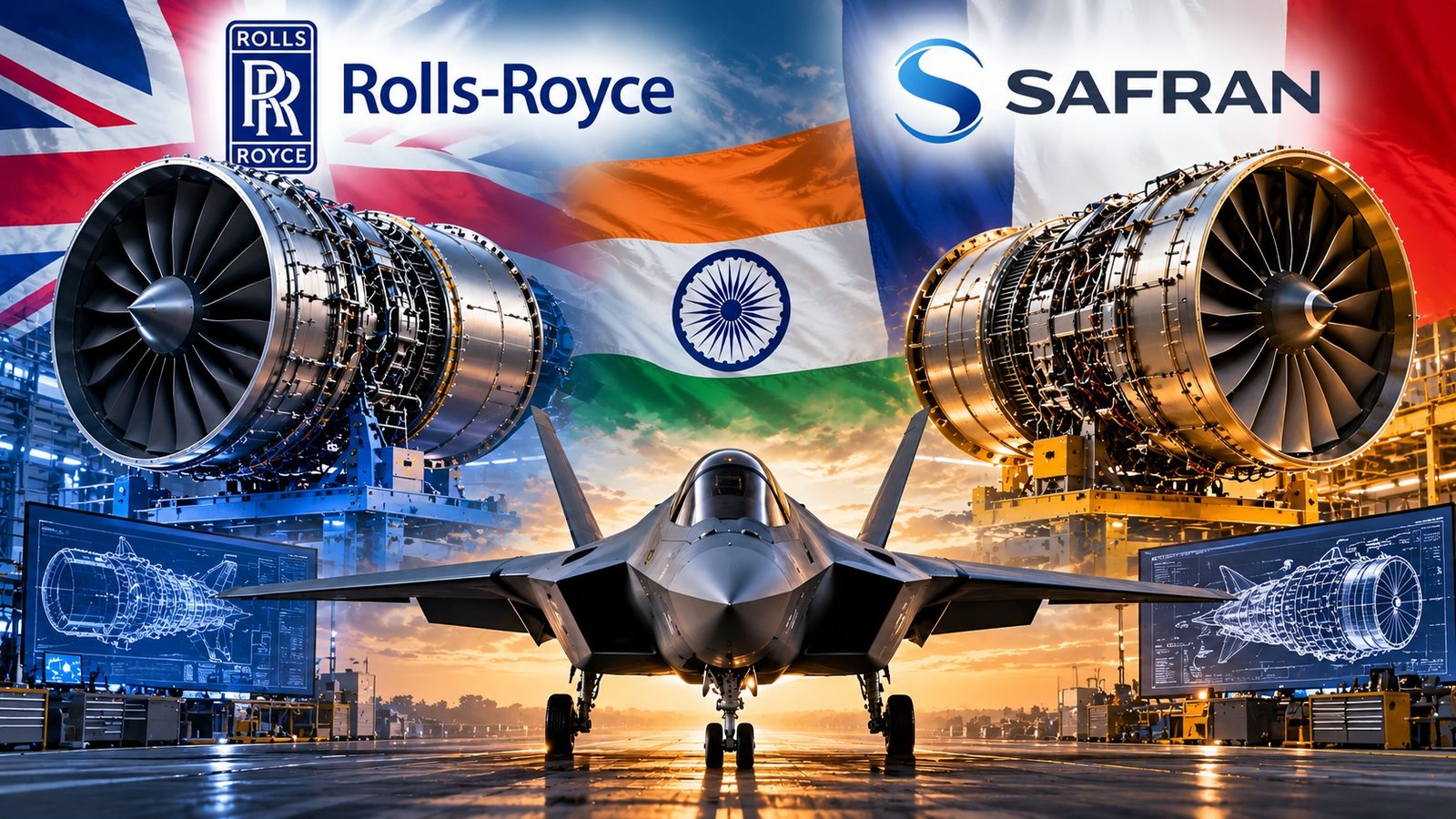
British aerospace company Rolls-Royce and France’s Safran are competing to partner with India in developing an indigenous high-thrust engine for the Advanced Medium Combat Aircraft (AMCA), India’s planned fifth-generation stealth fighter. The competition involves more than engine performance, with technology transfer, intellectual-property ownership, domestic manufacturing and future upgrade rights among the key considerations.
Rolls-Royce announced a strategic intent to partner with Reliance Industries on August 14, 2026, to develop an indigenous combat engine and explore an Aerospace Gas Turbine Complex in India. Safran, meanwhile, is pursuing joint development with the Defence Research and Development Organisation’s Gas Turbine Research Establishment (GTRE).
Rolls-Royce Offer: Full Technology Transfer and Indian IP Ownership
Rolls-Royce has proposed developing a 120-kN-class or higher-thrust fighter engine, with a reported future upgrade path to 145 kN of afterburning thrust. The higher figure represents a potential future development target, not the demonstrated performance of an existing AMCA engine.
The proposal reportedly includes 100% technology transfer and Indian ownership of the intellectual property generated under the programme. This could allow India to retain greater control over engine design, manufacturing and future upgrades, subject to the final contractual terms.
On August 14, Rolls-Royce and Reliance Industries announced their strategic intent to develop the engine together. They also proposed exploring an Aerospace Gas Turbine Complex covering design, development, manufacturing, testing, production and through-life support.
This proposal goes beyond manufacturing an engine for a single fighter programme. If implemented with comprehensive design rights and access to critical technologies, it could help India establish a domestic aero-engine ecosystem for future military and other propulsion programmes.
Rolls-Royce has also outlined a development timeline targeting an engine-core test by 2030, a first flight in 2034 and production in 2036, provided the contract is signed by the end of 2026. These are proposed milestones, not completed programme achievements.
Safran Offer: Joint Development With GTRE
Safran has proposed jointly developing a new fighter engine with GTRE, the DRDO laboratory responsible for gas-turbine engine research. Its approach places India’s government engine-development organisation directly in the programme.
Safran has publicly offered extensive technology transfer, including critical hot-section technology and turbine architecture. The proposed collaboration is intended to help Indian engineers acquire the knowledge required to develop, manufacture and maintain an advanced fighter engine.
In October 2026, Safran also proposed an Aravalli-style 50:50 co-development model for the AMCA Mk2 engine, according to Indian Masterminds. The approach would involve Indian and French teams sharing development responsibilities.
The broader AMCA Mk2 programme is targeting a 120-kN-class engine. Safran’s offer must be evaluated against the same performance requirement as Rolls-Royce’s proposal. The final engine specification, upgrade potential, development schedule and detailed contractual rights will determine the actual comparison.
Safran’s key advantage is its established fighter-engine experience and its proposed direct collaboration with GTRE. However, the value of its offer to India will depend on the precise rights India receives over design data, manufacturing processes, future upgrades and exports.
Rolls-Royce vs Safran: Detailed Comparison
| Area | Rolls-Royce | Safran |
|---|---|---|
| Indian partner | Reliance Industries | GTRE/DRDO |
| Engine thrust target | 120 kN or higher | 120-kN-class programme target |
| Future thrust potential | Reported upgrade path to 145 kN | Final upgrade potential requires confirmation |
| Technology transfer | Full transfer reported in the proposal | Extensive transfer, including critical hot-section technologies |
| Intellectual property | Indian ownership reported for programme-generated IP | Indian IP and contractual ownership provisions require assessment against the final agreement |
| Industrial model | Proposed Aerospace Gas Turbine Complex | Proposed joint development through GTRE, including a reported 50:50 model |
| Development timeline | Core test in 2030, first flight in 2034 and production in 2036, subject to contract timing | Final programme milestones not established publicly |
| Main strategic advantage | Broader proposed industrial ecosystem and reported Indian IP ownership | Direct government-laboratory participation and established fighter-engine expertise |
The comparison should focus on the rights and capabilities India ultimately secures, rather than assuming that an announcement of technology transfer automatically gives India complete independence.
Which Company Has More Advanced Fifth- or Sixth-Generation Engine Technology?
Rolls-Royce: GCAP Next-Generation Propulsion
Rolls-Royce is involved in developing the propulsion system for the Global Combat Air Programme (GCAP), a sixth-generation fighter programme involving the United Kingdom, Italy and Japan. Its partners include Italy’s Avio Aero and Japan’s IHI Corporation.
In July 2026, the programme reported completing more than 100 subscale component tests and making progress towards ground testing an engine demonstrator. This demonstrates active work on future combat-aircraft propulsion, but it does not mean a completed operational sixth-generation engine is available for AMCA.
Rolls-Royce also has experience with the EJ200 engine used by the Eurofighter Typhoon and the LiftSystem used by the F-35B. The LiftSystem is a specialised short-take-off and vertical-landing system, not the F-35’s main engine.
Safran: Operational M88 and Future Engine Development
Safran develops the M88 engine used by France’s Rafale fighter. Its M88 T-REX development programme targets approximately 88.2 kN of afterburning thrust, or nine tonnes, around 20% more than the current M88 according to Safran.
The planned improvements include changes to the compressor, turbine materials, cooling circuits and exhaust nozzle. This programme demonstrates ongoing fighter-engine development, but the M88 is not a 120-kN-class AMCA engine or a completed sixth-generation powerplant.
Assessment: Rolls-Royce has a particularly relevant role in a publicly documented sixth-generation engine demonstrator through GCAP. Safran brings an operational modern fighter engine and experience in developing higher-thrust configurations. Neither company has demonstrated a completed operational sixth-generation engine that can simply be transferred to India for AMCA.
Which Company Offers India Greater Engine Independence?
Rolls-Royce’s reported offer appears broader in its proposed industrial scope because it combines the engine programme with Reliance Industries, an Aerospace Gas Turbine Complex and Indian ownership of programme-generated IP.
Safran’s offer could also provide significant long-term benefits through joint development with GTRE, direct Indian engineering participation and extensive technology transfer. Its proposed 50:50 development model could help embed knowledge within India’s government engine-development establishment.
The final decision should therefore consider six areas:
-
Design ownership: Whether Indian engineers can independently access and modify the engine’s complete design.
-
Critical technologies: Whether India gains practical knowledge of turbine blades, high-temperature materials, cooling systems and combustion.
-
Manufacturing: Whether critical components can be produced domestically rather than merely assembled in India.
-
Future upgrades: Whether India can independently increase thrust and improve engine performance.
-
Export rights: Whether engines and aircraft using them can be exported under clearly defined permissions.
-
Long-term support: Whether India can independently test, certify, maintain and repair the engine.
Full technology transfer is meaningful only if the agreement provides the design information, manufacturing knowledge and legal rights needed to use the technology independently.
What This Means for India
Rolls-Royce offers a broader publicly reported industrial vision, combining a proposed partnership with Reliance Industries, an aerospace gas-turbine complex, Indian IP ownership and a reported future path towards 145 kN of thrust.
Safran remains a strong alternative because of its established fighter-engine experience, its proposed partnership with GTRE and its commitment to transferring critical technologies. Its final development and ownership arrangements will be central to determining how much long-term independence India can achieve.
The reported 145-kN capability in the Rolls-Royce proposal remains a future development target, not an existing operational engine capability. Similarly, the final performance and upgrade potential of the Safran-GTRE engine must be established through the programme’s specifications and development work.
Ultimately, India’s objective is not simply to manufacture an engine domestically. It is to establish the capability to design, build, maintain and upgrade fighter engines without having to depend on a foreign company for every major change. The company that delivers the strongest combination of technical knowledge, enforceable IP rights, domestic manufacturing and future development freedom could provide India with the more valuable long-term partnership.
——— End of Article ———