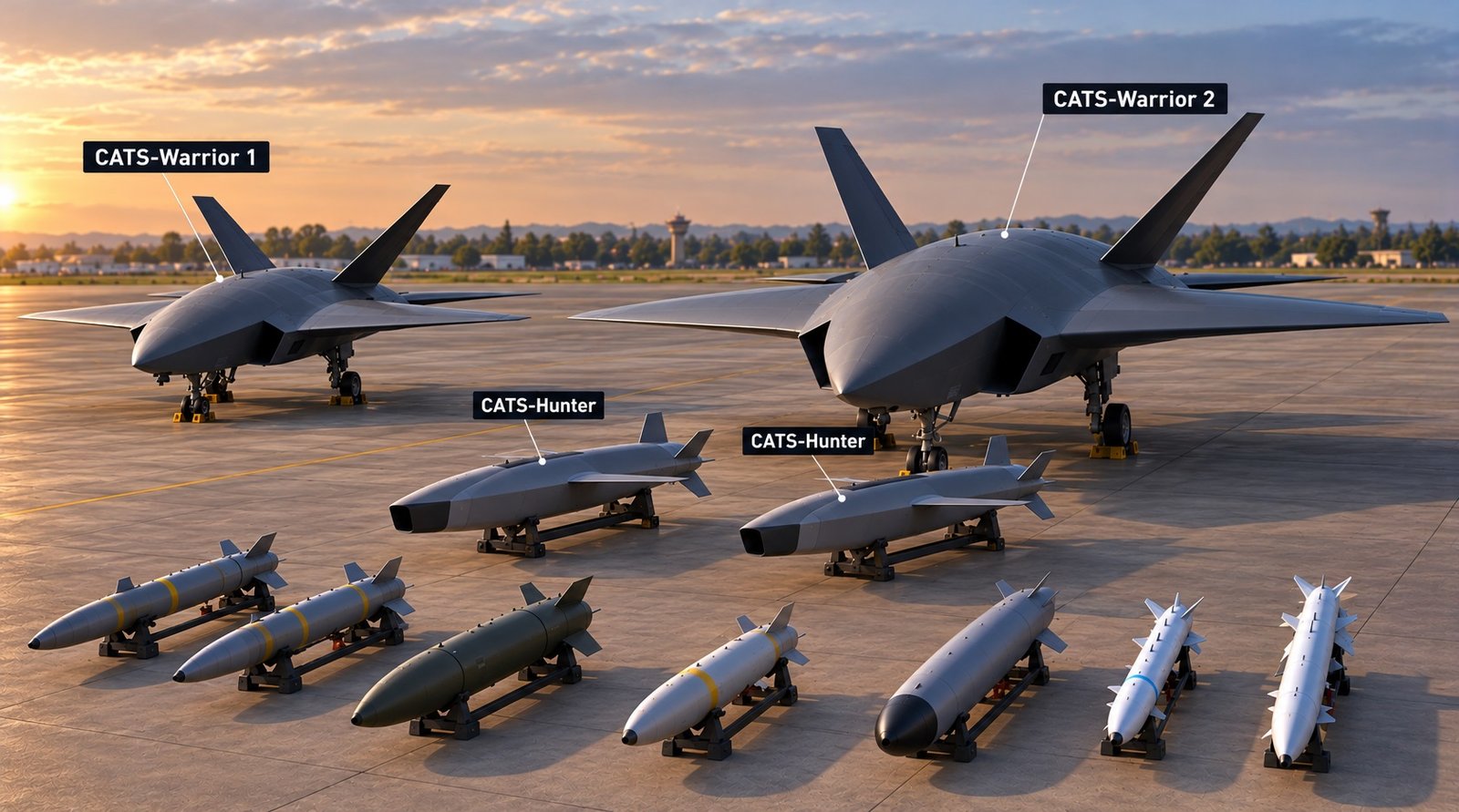
BENGALURU — Hindustan Aeronautics Limited (HAL) is preparing to showcase an expanded Combat Air Teaming System (CATS) portfolio at Aero India 2027, scheduled for February 8–12 at Air Force Station Yelahanka in Bengaluru. The 16th edition of the biennial exhibition is expected to feature the larger CATS-Warrior Phase-II, an upgraded Warrior Phase-I and a redesigned CATS-Hunter stealth cruise missile.
The CATS programme, developed with private-sector partners including NewSpace Research and Technologies and Tata Elxsi, aims to enable unmanned aircraft and weapons to operate alongside manned fighters such as the Tejas and future combat aircraft.
CATS-Warrior Phase-II: Heavyweight Collaborative Combat Aircraft
The CATS-Warrior Phase-II is a larger collaborative combat aircraft (CCA) designed to carry a heavier weapons payload than Phase-I. Measurements derived from HAL's display model drawings indicate a length of approximately 14.7 metres and an 11-metre wingspan. This makes Phase-II about 12% longer and 34% wider in wingspan than the Tejas, which measures approximately 13.2 metres in length and 8.2 metres in wingspan.
The wider fuselage is intended to accommodate a large internal weapons bay. The aircraft is planned to use two HAL HTFE-25 turbofan engines, each producing 25 kN of thrust.
Its proposed weapons configuration includes beyond-visual-range (BVR) air-to-air missiles and air-to-ground weapons such as the Rudram anti-radiation missile and CATS-Hunter cruise missile.
HAL's concept diagrams also indicate potential integration of the BrahMos-NG supersonic cruise missile, with estimated weights ranging from 1,200 to 1,500 kg in the supplied information. The missile could be carried on a belly-mounted launcher or in a semi-recessed arrangement. These configurations remain subject to development and integration; their depiction does not confirm completed testing.
CATS-Warrior Phase-I: Astra BVR Missile Integration
The existing Warrior Phase-I measures approximately 9.1 metres in length and has a 7.6-metre wingspan, according to measurements derived from HAL's display model drawings. Compared with the Tejas at 13.2 metres long and 8.2 metres wide in wingspan, Phase-I is approximately 69% of the fighter's length and 93% of its wingspan.
The drone is powered by two PTAE-W turbojet engines derived from the PTAE-7, each producing approximately 3.7 kN of thrust.
Earlier displays featured ASRAAM short-range air-to-air missiles and DRDO Smart Anti-Airfield Weapons (SAAW). At Aero India 2027, the aircraft is expected to feature the indigenous Astra BVR air-to-air missile carried externally, expanding its intended ability to engage aerial targets alongside manned fighters.
The supplied specifications list a maximum take-off weight of approximately 2,100 kg and a payload capacity of around 650 kg across internal and external hardpoints. Its cruise speed is Mach 0.7, with a dash speed of Mach 0.9, a service ceiling of 9,000 metres and a combat radius of approximately 350 km for return missions or up to 700 km for one-way profiles.
A full-scale demonstrator completed an engine ground run at HAL's Bengaluru facility on January 11, 2025. Taxi trials and the first flight are targeted for fiscal year 2027. The programme information also identifies a potential Indian Air Force requirement of around 100 aircraft and a target unit cost of approximately US$5 million. These are programme targets, not a confirmed procurement order or final production price.
CATS-Hunter: Redesigned Stealth Cruise Missile
The CATS-Hunter has undergone a major design revision and is now described as an air-breathing stealth cruise missile. It is intended for carriage by manned fighters or the larger Warrior Phase-II.
The revised design measures approximately 4.4 metres in length, with a deployed wingspan of 3.8 metres and a diameter of 630 mm when its wings are folded for carriage. Details of its propulsion system, range, payload and other performance characteristics have not been released in the supplied information.
CATS Programme Development
The planned display will highlight HAL's efforts to expand the CATS family's weapons options and payload capacity. The smaller Warrior Phase-I and heavier Phase-II are intended to support manned aircraft, while the redesigned Hunter would provide an additional proposed strike weapon.
The dimensions derived from display model drawings provide a scale-based comparison of both Warrior variants with the Tejas. However, these estimates should not be treated as officially confirmed production specifications. The proposed weapons integrations and performance figures should likewise be distinguished from capabilities demonstrated through completed trials or operational deployment.
Aero India 2027 will offer an opportunity to assess the publicly presented designs and the programme's development progress.
——— End of Article ———