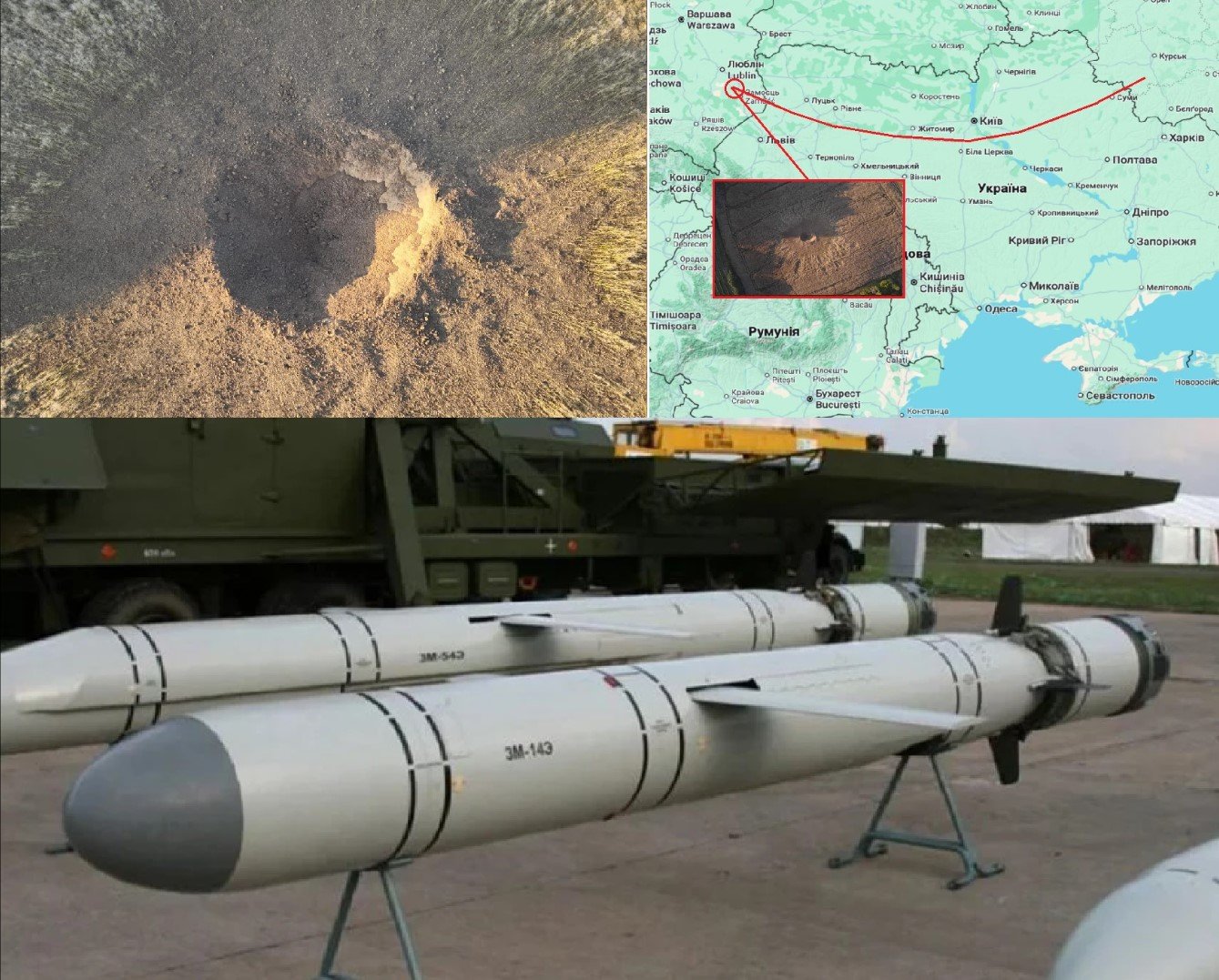
WARSAW — A Russian Kh-101 cruise missile entered Polish airspace and crashed in eastern Poland early Thursday during one of Russia's largest overnight missile and drone attacks on Ukraine, prompting a military response from Poland and an official investigation into the incident.
The missile crashed in an undeveloped field near the village of Tarnawa-Kolonia in Biłgoraj County, Lublin Voivodeship, approximately 95 kilometers (59 miles) from the Ukrainian border. Polish authorities confirmed that the explosion caused a large crater but resulted in no casualties or structural damage.
Missile Entered Polish Airspace
According to the Operational Command of the Polish Armed Forces, the missile followed a complex flight path before entering Poland. Tracking data showed it first entered Ukrainian airspace over the Sumy region, flew across western Ukraine toward the Volyn region, and then crossed into Polish territory.
The Polish military released the following timeline of the incident:
- 3:16 a.m. (Polish time): Poland scrambled military aircraft in response to the large-scale Russian attack on Ukraine.
- 3:29 a.m.: An aerial target approached within 5 kilometers (3.1 miles) of the Polish border.
- 3:40 a.m.: The object was detected flying westward over Polish territory, and an F-16 fighter jet was dispatched to identify and intercept it.
- 3:46 a.m.: The missile disappeared from Polish military radar.
- Around 4:00 a.m.: Residents reported a powerful explosion that shook windows in nearby homes.
To verify radar data, the military later dispatched a Mi-24 helicopter to the area. The helicopter crew located the impact site in a rural field near Tarnawa-Kolonia.
Crash Site Under Investigation
Local Polish media began reporting the explosion and the emergency response by 5:58 a.m. Kyiv time. Police, firefighters and other security services secured the area while investigators examined the impact site.
According to local reports, the impact created a crater measuring approximately 10 meters wide and 5 meters deep, with missile fragments scattered across an area of about 200 meters. The site is located roughly 2 kilometers from the nearest residential buildings.
Ukraine has also offered assistance with the investigation.
Polish Government Responds
Polish Prime Minister Donald Tusk, who visited the crash site, said all available evidence indicates the projectile was a Russian Kh-101 cruise missile, although authorities are continuing to verify its exact type and origin.
"All the indications are that it was a Russian Kh-101 cruise missile, but we want to be 100% certain about the type of missile and who launched it," Tusk said during an emergency coordination meeting.
Tusk said the Polish military had tracked the missile throughout the incident and was prepared to shoot it down if it had continued deeper into Polish airspace or posed a threat to populated areas.
He added that investigators are also determining whether the crater was caused by the missile's warhead detonating or by the impact itself. According to Tusk, there is no indication that Poland was the intended target. He also confirmed discussing the incident with President Karol Nawrocki.
Polish Air Defences Activated
Polish Defence Minister Władysław Kosiniak-Kamysz described the night as highly demanding for Poland's air defence and surveillance systems.
He said Polish F-16 fighter aircraft had been operating near the border from around 2:00 a.m., while reconnaissance aircraft and allied aerial refuelling aircraft were also activated. Air raid alerts were issued in Lublin and other parts of the province as a precaution.
Monitoring channels, including eRadar and Strategic Aviation, also reported a cruise missile crossing into Polish airspace over Lublin Voivodeship during the attack.
Part of a Large-Scale Russian Strike on Ukraine
The airspace violation occurred during a major overnight Russian missile and drone attack across Ukraine.
According to the Ukrainian Air Force Command, Russia launched 74 missiles and 284 drones during the attack. The missiles included:
- 61 Kh-101 and Kalibr cruise missiles
- Four Zircon and Oniks missiles
- Nine Iskander-M, S-400 and KN-23 ballistic missiles
Ukraine said its air defence forces intercepted or suppressed 55 missiles and 265 drones.
The primary targets included the Kyiv and Lviv regions, while strikes were also reported in Dnipropetrovsk, Sumy, Vinnytsia, Poltava, Mykolaiv, and Ivano-Frankivsk.
According to Ukrainian authorities, the overnight attack killed at least eight people and injured dozens more, while causing damage across multiple regions.
Ukraine Calls for Stronger Air Defences
Ukrainian Foreign Minister Andrii Sybiha said the missile's entry into Poland demonstrated that strengthening Ukraine's air defence capabilities is important for the security of the wider Euro-Atlantic region.
He also described the missile's flight into Poland as a violation of NATO airspace.
Investigation Continues
The Polish government has launched an investigation to determine the exact circumstances surrounding the missile's entry into Polish airspace, confirm the projectile's identity, and establish whether the crater resulted from the missile's impact or the detonation of its warhead.
Authorities have reiterated that no injuries or damage to buildings were reported, while security services continue to examine the crash site.
——— End of Article ———