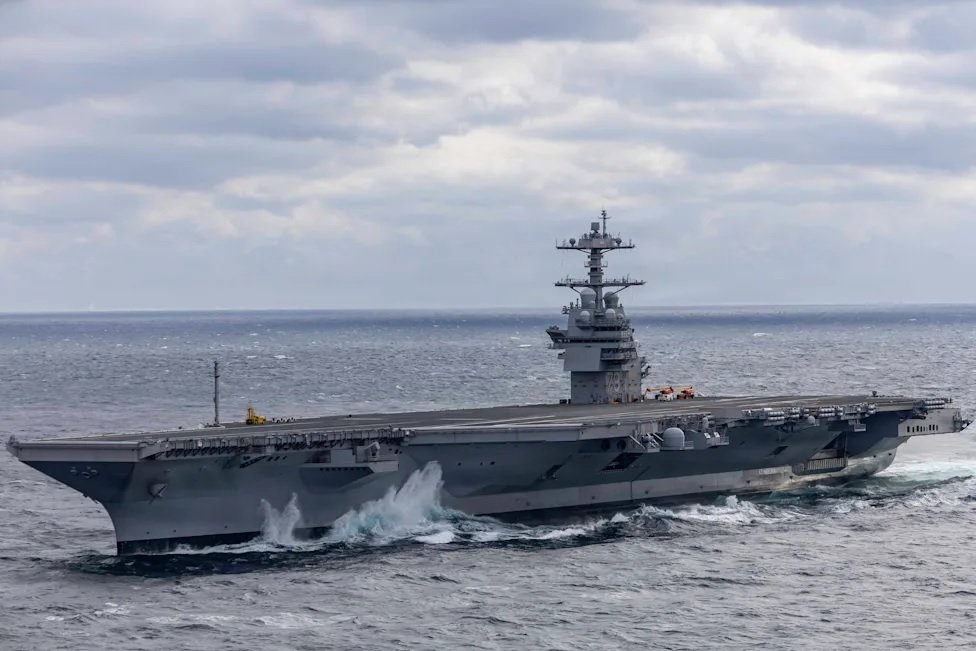
WASHINGTON — Raytheon’s SPY-6(V)3 radar has completed acceptance trials aboard the future USS John F. Kennedy (CVN 79), the U.S. Navy’s second Gerald R. Ford-class nuclear-powered aircraft carrier.
The milestone follows a four-day underway evaluation off the Atlantic Coast from August 12 to 15. The successful trials move the 100,000-ton carrier closer to preliminary acceptance and allow the Navy to begin further underway testing of its combat and aviation systems.
SPY-6(V)3 Radar Capabilities
The SPY-6(V)3, also known as the fixed variant of the Enterprise Air Surveillance Radar (EASR), provides continuous 360-degree situational awareness. It supports aircraft carrier flight-deck operations and air traffic control while also providing ship self-defense against cruise missiles, hostile aircraft, anti-surface and anti-ship threats, and challenging electronic warfare environments.
The radar uses three fixed array faces, each containing nine standardized Radar Modular Assemblies (RMAs). According to Raytheon, this architecture provides greater detection range, higher sensitivity and more accurate target discrimination than legacy radar systems. It also provides targeting data for Navy weapons, including Standard Missile variants.
The wider SPY-6 family is designed to simultaneously track and support defense against ballistic missiles, hypersonic missiles, cruise missiles, hostile aircraft and surface threats.
First Ford-Class Carrier With SPY-6(V)3
John F. Kennedy is the first Ford-class carrier to receive the SPY-6(V)3. Unlike lead ship USS Gerald R. Ford (CVN 78), which uses the SPY-3 and SPY-4 Dual Band Radar arrangement, CVN 79 combines the S-band SPY-6(V)3 with the X-band AN/SPQ-9B surface-search radar.
The SPY-6 family uses common hardware and software based on standardized RMAs. Raytheon says this modular design allows different variants to be used across seven classes of Navy ships while simplifying maintenance and future upgrades.
The Navy is integrating SPY-6 variants on Arleigh Burke-class Flight III destroyers, Constellation-class frigates, aircraft carriers and amphibious warships. Variants are also being backfitted onto existing Flight IIA destroyers and some legacy aircraft carriers.
The SPY-6(V)1 is used on Flight III destroyers, the rotating SPY-6(V)2 on amphibious ships and Nimitz-class carriers, the fixed SPY-6(V)3 on Ford-class carriers and frigates, and the SPY-6(V)4 is intended for Flight IIA destroyer upgrades. The SPY-6 family is expected to equip more than 50 U.S. Navy ships over the next decade.
CVN 79 Moves Toward Delivery
Acceptance trials are crew-led evaluations intended to demonstrate to the Navy’s Board of Inspection and Survey that a ship meets contract specifications and can safely operate at sea.
Capt. Mark Johnson, Program Manager for Aircraft Carrier New Construction, praised the CVN 79 crew following the recent testing.
With acceptance trials complete, the carrier will move toward preliminary acceptance. This phase will allow the crew to build operational proficiency and conduct further evaluations while prime contractor Huntington Ingalls Industries (HII) completes the remaining advanced weapons elevators.
CVN 79 completed its builder’s sea trials in February 2026 and is currently about 98 percent complete. The carrier is also being built to support full F-35C Lightning II operations upon commissioning.
Final delivery of USS John F. Kennedy to the U.S. Navy is scheduled for spring 2027.
——— End of Article ———