SPRINGFIELD, Ohio — The U.S. Air Force has completed its first round of prototype evaluations for the Portable Command and Control Enclave (C2E), a portable system designed to allow ground operators to control Collaborative Combat Aircraft (CCA) from remote and austere locations.
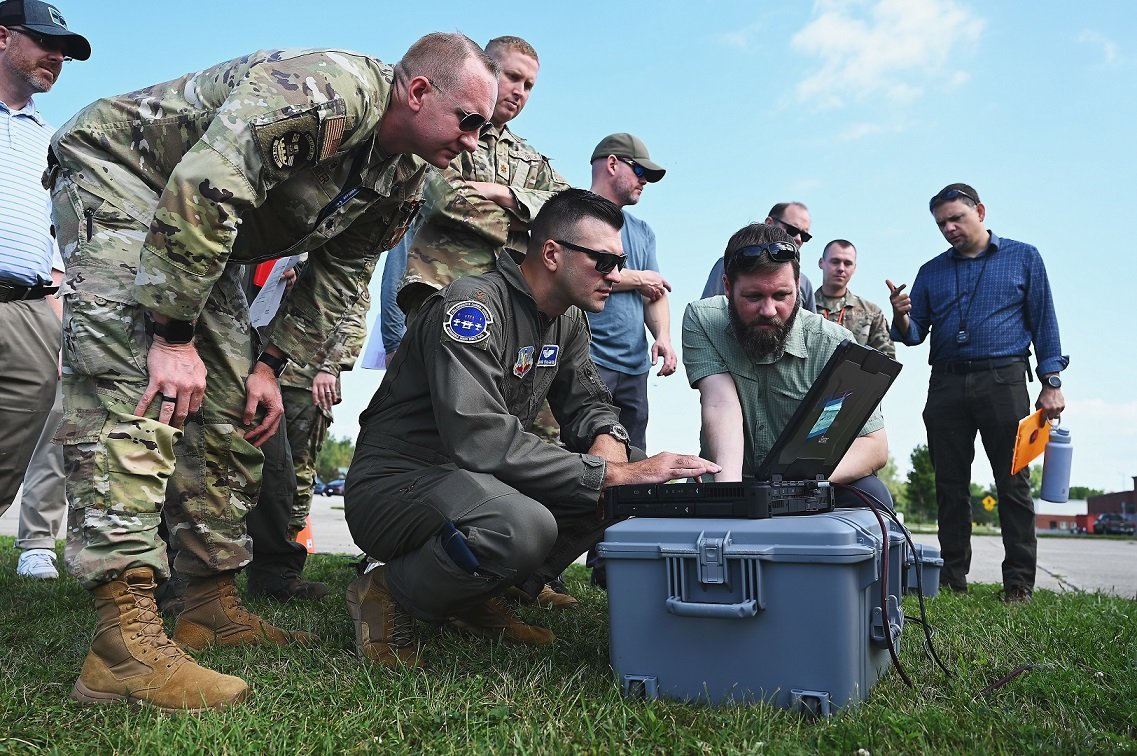
The evaluations were conducted at Springfield Air National Guard Base and hosted by the Ohio Air National Guard’s 178th Wing. The Air Force Life Cycle Management Center’s Agile Development Office said the tests are an early step toward selecting a vendor to integrate the final C2E system. The results were announced on Aug. 13.
Prototype Testing
Multiple industry vendors brought prototypes for evaluation. The Air Force assessed the systems in two main areas: mobility and footprint, followed by software and connectivity.
Evaluators first examined how easily the equipment could be transported and deployed in simulated austere conditions. Vendors then demonstrated software flexibility, agility and network connectivity under operational conditions.
The 178th Wing provided facilities, personnel and logistical support for the tests.
“The 178th Wing’s foundational support was key to the success of this phase, allowing our evaluators and industry partners to focus entirely on technical performance,” said Lt. Col. Gregory Bieler, Materiel Leader for CCA Software, Autonomy and Teaming.
Ground Control for CCA
CCA aircraft are semi-autonomous drones being developed to operate alongside crewed fighters and increase combat capacity at a lower cost than manned aircraft. They are expected to receive direction from human pilots, while control can also be provided from platforms such as the E-7 Wedgetail.
The C2E program is focused specifically on ground-based control from rapidly deployable locations. Col. Timothy Helfrich, the Air Force’s portfolio acquisition executive for fighters and advanced aircraft, first publicly discussed the system in June.
A service spokesperson described C2E as an application suite operating across different networks that allows the appropriate operator, with the required permissions, to operate a CCA. It is separate from the software used by pilots in the cockpit.
For the first CCA increment, the Air Force selected Anduril Industries and General Atomics Aeronautical Systems, which are developing the FQ-44 and FQ-42, respectively. The first increment is planned to enter service by 2029 and will focus on air-to-air missions. Later versions may support air-to-ground strikes, reconnaissance and electronic warfare.
The Air Force did not identify the companies that participated in the Springfield C2E evaluations. Separately, Anduril has demonstrated its Menace-T portable ground system using two portable cases and a rugged laptop. The company has shown it being used to upload mission plans, initiate autonomous taxiing and takeoff, task the aircraft during flight and handle post-flight data.
Next Phase
Data from the Ohio evaluations will help shape the Air Force’s acquisition strategy. A second C2E prototype phase is planned soon, with vendors expected to refine their systems and demonstrate cloud capabilities.
After a final system integrator is selected, the equipment is expected to be provided to the Experimental Operations Unit, which is already testing CCAs. The system will support Agile Combat Employment operations before being integrated with production CCA aircraft.
“Getting prototypes into the hands of our operational and acquisitions warfighters for a swift, combined evaluation is a direct embodiment of acquisition transformation,” said Col. Eric Reagan, director of the Agile Development Office. “This partnership allows us to accelerate the fielding of the best-value capabilities to the Department of War.”
The first evaluation phase gives the Air Force test data for the next stage of the C2E program as it works toward a portable ground-control system for its future CCA fleet.
——— End of Article ———