WASHINGTON — The U.S. Navy’s Rapid Capability Office, the Defense Innovation Unit (DIU) and PAE Aviation are investing $50 million to expand unmanned, runway-independent maritime strike capabilities centered on Shield AI’s X-BAT aircraft. The funding was announced in mid-August 2026.
The investment comes under the Runway Independent Maritime Expeditionary Strike (RIMES) program, launched by the Navy and DIU in February 2026. RIMES aims to develop a long-range strike drone that can operate from surface combatants without the flight decks, catapults or arrested-landing systems required by conventional fixed-wing aircraft.
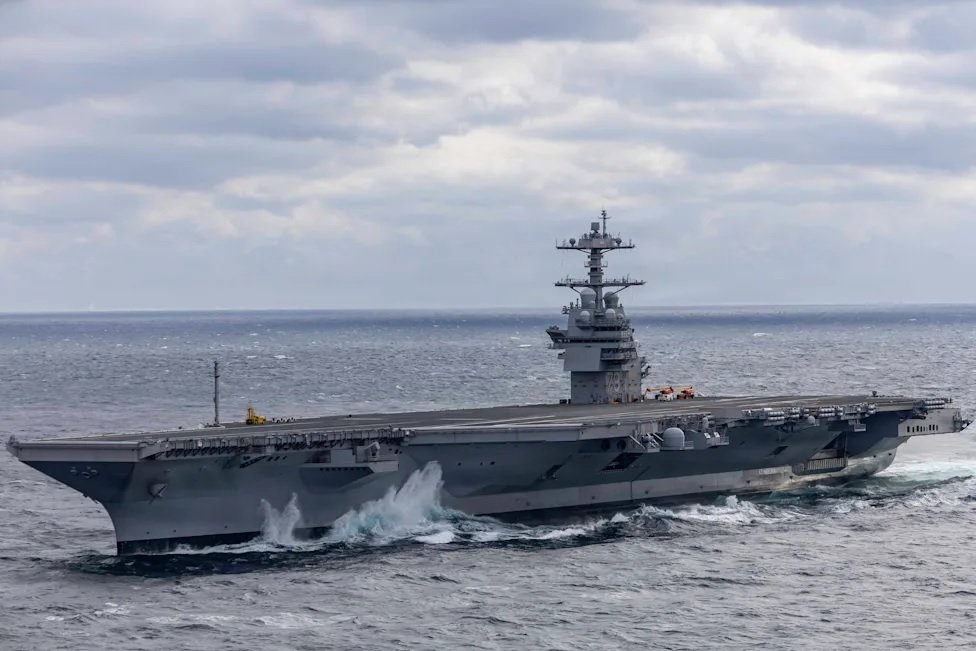
The Navy’s roughly 74 to 75 active Arleigh Burke-class destroyers can operate helicopters but cannot launch or recover conventional fixed-wing strike aircraft. RIMES is intended to close this gap by enabling vertical takeoff and landing operations from ships with limited deck space.
The $50 million award builds on earlier risk-reduction work by the PAE Aviation Rapid Capability Cell and Shield AI. The award uses the Middle Tier of Acquisition Rapid Prototype approach and an Other Transaction Authority (OTA) contract.
X-BAT Capabilities
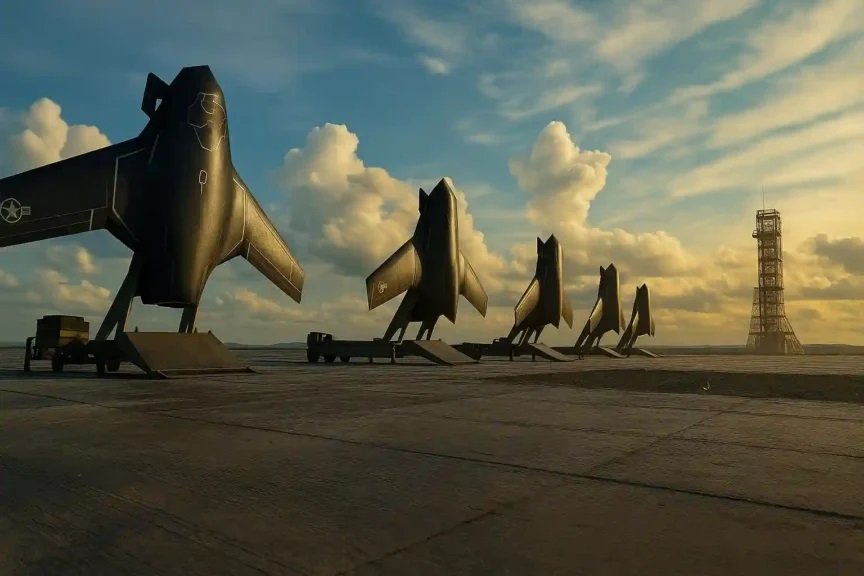
Shield AI first unveiled X-BAT in October 2025. It is a jet-powered, vertical takeoff and landing (VTOL) uncrewed aircraft designed for air-to-air and air-to-surface strikes, electronic warfare, and intelligence, surveillance and reconnaissance (ISR) missions.
The aircraft has a 39-foot (11.9-meter) wingspan, a range exceeding 2,000 nautical miles (about 3,700 kilometers) with a full mission payload, and a service ceiling above 50,000 feet (15,240 meters).
X-BAT will initially use GE Aerospace’s F110-GE-129 engine fitted with an Axisymmetric Vectoring Exhaust Nozzle (AVEN). In July 2026, Shield AI and GE Aerospace completed integration and engine light-off testing of the system, supporting development of the aircraft’s vertical-flight capability.
Shield AI says X-BAT can carry weapons in the 2,000-pound class in internal bays comparable in size to those on the F-35, along with external hardpoints. The aircraft is also designed to generate about 80 kilowatts of electrical power for sensors and electronic warfare systems.
X-BAT uses Shield AI’s Hivemind autonomy software, which is designed to allow autonomous operations in environments where GPS and communications are denied, degraded or jammed, without requiring direct human input to execute complex missions.
Building on V-BAT Experience
X-BAT builds on technology developed for Shield AI’s smaller V-BAT unmanned aircraft, which is already supplied to the U.S. Navy, Marine Corps and allied services.
The V-BAT has flown more than 170 sorties in Ukraine and currently supports a nearly $200 million U.S. Coast Guard contract for contractor-owned ISR services.
X-BAT is also at least the second long-range VTOL concept to receive Navy support under RIMES. In June 2026, the program awarded a contract of undisclosed value to a Mach Industries and Whisper Aero team for the smaller Atlas aircraft, described as a roughly 6,000-pound platform with a 1,000-pound payload and hybrid-electric propulsion.
Development Timeline
Shield AI is targeting the first flight of X-BAT for later in 2026 and has projected full manufacturing and production capabilities by 2029.
The Navy has not disclosed how many X-BAT aircraft it may ultimately procure or provided a specific timeline for deployment aboard destroyers. The $50 million investment is intended to accelerate development of an unmanned maritime strike capability that can operate without conventional runways.
——— End of Article ———