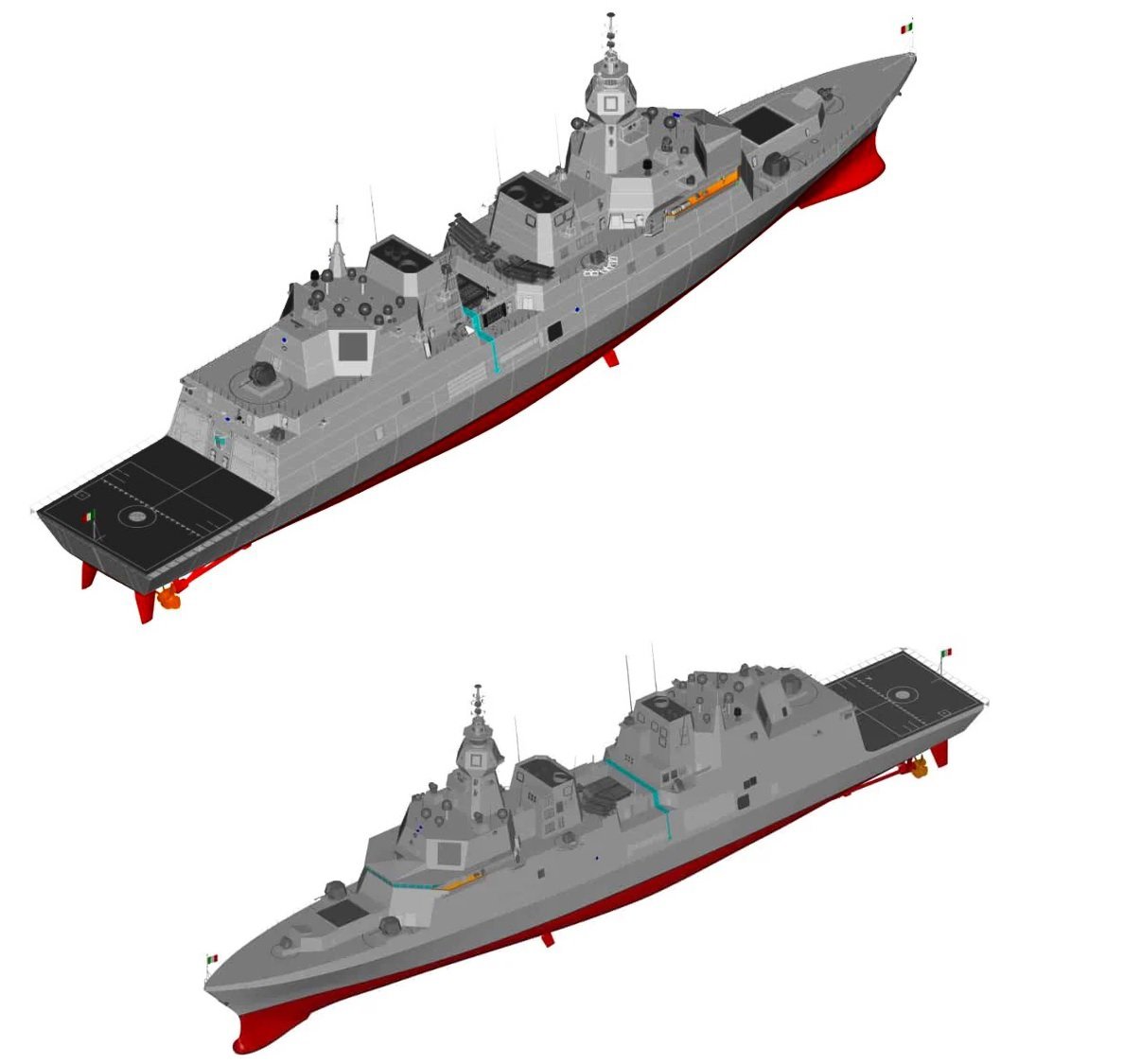
ROME — Orizzonte Sistemi Navali (OSN), a joint venture owned 51% by Fincantieri and 49% by Leonardo, has signed a contract worth approximately €3.7 billion with OCCAR for the development and production of two next-generation DDX destroyers for the Italian Navy. About €1.3 billion of the contract is in options.
The agreement covers development, production, logistic studies and Initial In-Service Support (ISS). The contract officially launches the DDX programme, which is intended to replace and evolve Italy’s Horizon-class destroyers.
OSN will place sub-supply contracts with its parent companies in the coming weeks. Fincantieri’s share will be approximately €1.8 billion, including about €800 million in options, while Leonardo’s portion will be approximately €1.7 billion, including about €480 million in options. Fincantieri will act as the system integrator, while Leonardo will develop the combat system.
DDX Destroyer Specifications
Each DDX destroyer will be 180 metres long, have a displacement of 13,500 tonnes, a range of 4,000 nautical miles and accommodate 251 crew members. The first ship is scheduled for delivery in 2033, with the second planned for 2035.
The ships are being designed for complex maritime operations, with high levels of digitalisation, automation and integration between sensors, weapons, command-and-control systems and platform-management systems. The combat architecture is also designed to support interoperability and information sharing with multinational forces.
Planned platform innovations include a DC power sub-network with energy storage, an integrated stabilisation and steering system, new methods for calculating thermal and electrical balances, and further development of the Ship Management System.
Navis Sapiens Digital Architecture
Fincantieri is developing the ships under its Navis Sapiens concept. The digital architecture will collect and correlate data from onboard systems to support operational decisions, technical management and through-life support.
The open and scalable architecture is designed to support future upgrades. The ships will also connect with shore facilities through a Fincantieri Digital Ecosystem, linking them with a Digital Naval Base for data sharing, predictive maintenance and digital logistics support.
At 15 knots, the ships will be able to manage unmanned underwater and surface assets through their digital backbone while optimising propulsion and electrical consumption.
Air and Missile Defence
Leonardo’s combat system will be centred on the new-generation SADOC 5 C5I system. The ships will also feature a high-power, fully digital S-band AESA radar and an MBDA weapon system.
These systems are intended to provide Integrated Air and Missile Defence (IAMD) against missile, ballistic and hypersonic threats. The combat architecture is also being developed for multi-domain interoperability linked to Leonardo’s Michelangelo project.
Fincantieri CEO and General Manager Pierroberto Folgiero, Leonardo CEO and General Manager Lorenzo Mariani, and OSN CEO Giovanni Sorrentino highlighted the programme’s importance for Italy’s naval capabilities, industrial supply chain, technological development and cooperation between Italian industry, the Italian Navy and OCCAR.
The sub-supply agreements between OSN and its parent companies are classified as related-party transactions of greater significance and are being handled under the applicable regulatory procedures and exemptions for jointly controlled subsidiaries.
The DDX programme will now move forward with the development and production of the two destroyers, with deliveries planned for 2033 and 2035.
——— End of Article ———