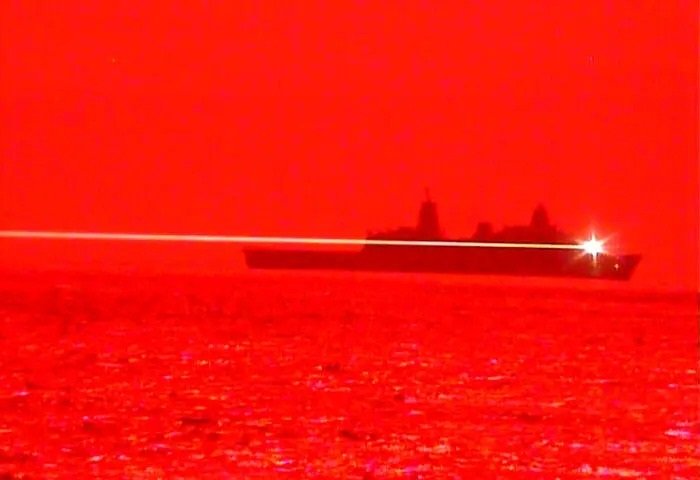
WASHINGTON — After decades of development and testing, high-energy laser weapons are moving into operational use with the U.S. military. The systems are being used against drones in the Middle East and along the U.S. southern border, while new production contracts are supporting wider deployment.
Laser Systems in the Middle East
U.S. forces have deployed directed-energy systems in the Middle East to counter drones and protect military assets and personnel.
The U.S. Navy’s High Energy Laser with Integrated Optical-dazzler and Surveillance (HELIOS) is installed aboard the Arleigh Burke-class destroyer USS Preble. The roughly 60-kilowatt system can use its laser to damage or destroy targets and can also use lower energy to dazzle sensors.
U.S. forces have also used directed-energy systems more broadly in the U.S. Central Command area. However, available official reports do not identify specific Iranian drone interceptions near the Strait of Hormuz as confirmed HELIOS engagements.
Laser Used Against Drones on Southern Border
The U.S. Army has also begun using high-energy lasers against cartel-linked drones along the southern border.
In late August 2026, personnel from Joint Task Force Southern Border, operating under U.S. Northern Command in support of Customs and Border Protection, used the Army Multipurpose High Energy Laser (AMP-HEL) to defeat three hostile unmanned aircraft over two nights in the Rio Grande Valley area of Texas.
Military officials said the drones posed a physical threat to U.S. personnel and partners and were associated with activities including illicit human smuggling and surveillance.
USNORTHCOM later reported that AMP-HEL had defeated 11 cartel-linked drones. Multiple laser systems are now deployed along the border, with military authorities coordinating operations near civilian airspace.
$464.8 Million Production Contract
The Army's move toward large-scale production came on September 2, 2026, when it awarded AeroVironment a $464.8 million Other Transaction Agreement under the Enduring-High Energy Laser (E-HEL) program.
The Army described the agreement as its first production contract for a high-energy laser weapon system. AeroVironment will deliver dozens of LOCUST X3 systems over the next several years.
The LOCUST X3 is a 30-kilowatt-class laser designed to counter Group 1 through Group 3 unmanned aircraft systems. The systems can be mounted on vehicles such as the Joint Light Tactical Vehicle or operated from fixed and semi-fixed positions.
AeroVironment has reported engagement costs of less than $5 per shot, with the system's firing capacity largely dependent on available electrical power rather than a supply of physical interceptors.
Familiar Controls for Operators
LOCUST-based systems use Xbox-style gaming controllers for operator control. The familiar interface is intended to reduce training requirements and make operation easier for service members already familiar with similar controls.
Advantages and Limitations
High-energy lasers offer several advantages for counter-drone missions. They can engage targets at the speed of light and can fire repeatedly as long as sufficient electrical power is available.
This can provide a lower-cost option against drones that might otherwise require expensive kinetic interceptors.
However, laser systems also have limitations. Their performance can be affected by weather conditions such as rain, fog and dust. They also need to maintain the laser beam on a target for a period of time and require sufficient power and cooling.
For these reasons, directed-energy weapons are being developed to complement rather than completely replace conventional air-defense interceptors.
Moving From Testing to Fielding
The U.S. military has continued testing higher-power directed-energy systems. Recent demonstrations have included laser engagements from the aircraft carrier USS George H.W. Bush and a cruise-missile shoot-down test at White Sands Missile Range, New Mexico, in June 2026.
The Department of Defense is also pursuing higher-power laser systems in the 150- to 500-kilowatt range for more demanding threats, including cruise missiles.
——— End of Article ———