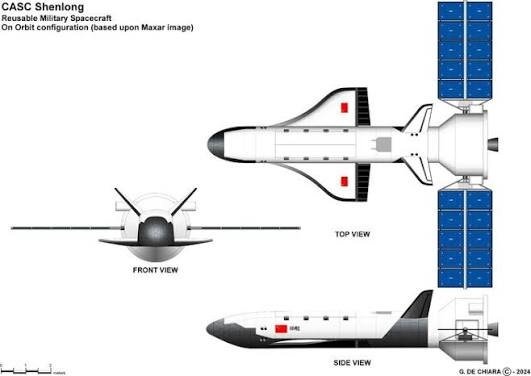
BEIJING — China’s secretive reusable spaceplane has released and recaptured the same small satellite twice during its current mission, according to orbital tracking data analyzed by astrophysicist Jonathan McDowell.
McDowell published a timeline on September 23 using data from the U.S. Space Force tracking network. The spaceplane, unofficially known as Shenlong, is on its fourth mission after launching on February 6, 2026, aboard a Long March 2F rocket from the Jiuquan Satellite Launch Center in northwestern China.
Repeated Satellite Operations
The satellite involved is cataloged by the U.S. military as 2026-024H. The tracked sequence was:
- June 21: Shenlong released the satellite.
- July 12: The spaceplane approached and recaptured it. Analysts believe an onboard robotic arm may have been used.
- Late August: Shenlong released the same satellite again and moved several thousand kilometers away.
- September 10: The spaceplane began another rendezvous and closed the distance to the satellite.
- September 13: Shenlong recaptured the satellite for the second time.
Commercial tracking company LeoLabs detected the satellite near Shenlong on June 22 and assessed with high confidence that it had been released from the spaceplane.
During the September operation, U.S. tracking systems briefly recorded what appeared to be another object. McDowell assessed that it was likely a duplicate tracking entry for the same satellite rather than a new spacecraft.
RPO Capabilities
The maneuvers are part of rendezvous and proximity operations (RPO), which involve a spacecraft approaching and operating near another object in orbit.
RPO capabilities can support civilian activities such as satellite inspection, servicing and repair. The same technology can also allow a spacecraft to approach, inspect or physically interact with another satellite, making such operations closely monitored by military analysts.
Shenlong has demonstrated similar activities before. Comparable release-and-recovery operations were observed during its second mission from August 2022 to May 2023 and its third mission from December 2023 to September 2024.
Shenlong and the X-37B
China has not officially released detailed technical specifications, mission objectives or the formal name of the spaceplane program. The name Shenlong, meaning “Divine Dragon,” is an unofficial designation used by external observers.
The spacecraft launches vertically on a rocket and returns by landing horizontally on a runway. This has led to comparisons with the U.S. Space Force’s X-37B, whose missions are also largely classified.
However, their publicly observed orbital activities differ. The Secure World Foundation has noted that the X-37B has not been observed conducting rendezvous operations with another object during its public missions and generally operates at different orbital altitudes from many active satellites.
Earlier Shenlong missions lasted two days in 2020, 276 days during its second mission and 266 days during its third mission. The current mission remains underway. Earlier flights have been associated with a runway at Lop Nur in northwestern China.
According to the Secure World Foundation, China has not registered the Shenlong missions or their released objects with the United Nations under the Registration Convention.
Independent tracking networks therefore remain the main public source of information about the classified spaceplane and its activities in orbit.
Main Source : defence-blog
——— End of Article ———