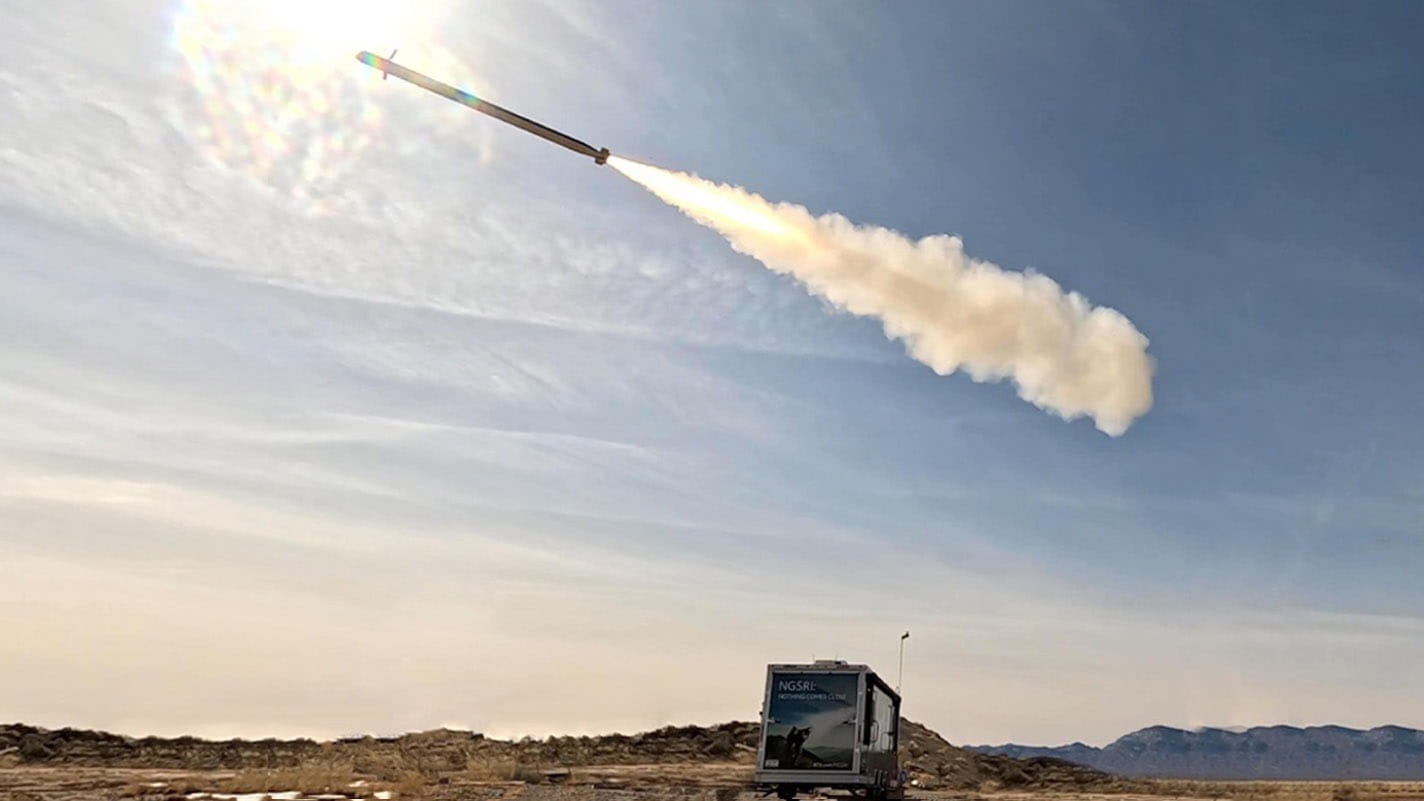
DUGWAY PROVING GROUNDS, Utah — Raytheon, an RTX business, has successfully completed a key technology demonstration of its Next Generation Short Range Interceptor (NGSRI), a new surface-to-air missile being developed for the U.S. Army as the future replacement for the long-serving Stinger missile.
The demonstration took place on July 15, 2026, at Dugway Proving Grounds in Utah, where Raytheon launched multiple guided missiles using its soldier-portable Command Launch Assembly (CLA). According to the company, every launch successfully detected, tracked, and intercepted Army-simulated aerial threats, achieving direct hits and target destruction.
The successful demonstration marks another milestone in the Army's effort to modernize its short-range air defense capabilities against evolving aerial threats, including aircraft, helicopters, and unmanned aerial systems.
Advanced Optics and Rocket Motor Improve Performance
Raytheon said the NGSRI's improved performance comes from a combination of advanced technologies integrated into both the launcher and the missile.
The system uses precision optics in the Command Launch Assembly (CLA) and the missile's seeker, allowing faster target detection and tracking. These sensors are paired with a highly loaded grain solid rocket motor (SRM) developed by Northrop Grumman, which provides greater propulsion and extends the missile's engagement range beyond current legacy systems such as the Stinger.
The NGSRI is designed as a fire-and-forget interceptor, allowing operators to launch the missile without continuous guidance after firing. It is being developed for use from both shoulder-mounted launchers and vehicle-mounted platforms, providing flexibility for different operational requirements.
Raytheon Highlights Improved Capability
Tom Laliberty, President of Land and Air Defense Systems at Raytheon, said the demonstration showed significant improvements over the current Stinger system.
"Raytheon's NGSRI saw farther and locked faster, demonstrating superior target acquisition, longer range and greater lethality than Stinger—which is already the world's most in-demand shoulder-fired air defense system."
He added that the new interceptor is designed to be easier to manufacture and deploy, making it a more capable, affordable, and rapidly producible weapon for future military requirements.
Program Progress
Over the past year, Raytheon has carried out several company-funded tests to refine and mature the NGSRI design. In addition, the company has completed two incremental demonstrations under contract with the U.S. Army.
Raytheon also confirmed it has previously completed 10 successful subsystem demonstrations, validating key technologies including the missile seeker, solid rocket motor, Command Launch Assembly, warhead, tracking, guidance, aerodynamic control, fuzing, and safety systems.
These demonstrations are intended to reduce technical risk as the program moves toward future production decisions.
Part of the Army's Air Defense Modernization
The NGSRI is being developed under the U.S. Army's Maneuver Short-Range Air Defense (M-SHORAD) Increment 3 program. The objective is to replace the Stinger missile with a modern interceptor capable of countering current and emerging aerial threats while maintaining portability for frontline soldiers.
The missile is designed to engage rotary-wing aircraft, fixed-wing aircraft, and Group 2 and Group 3 unmanned aerial systems. It is also engineered for compatibility with existing Stinger infrastructure, including the Stinger Vehicle Universal Launcher used on platforms such as the Sgt. Stout.
As the original manufacturer of the Stinger missile and its launchers, Raytheon said it is ensuring full interoperability between the NGSRI and both existing and future mounted platforms.
Modular Design for Faster Production
Drawing on more than 60 years of air defense experience, Raytheon is incorporating modular system architecture and automated manufacturing processes into the NGSRI program. According to the company, these manufacturing approaches are intended to accelerate development timelines, simplify production, and support higher manufacturing rates if the system enters full-scale production.
Army Plans Future Procurement
The U.S. Army has indicated that it plans to procure the next-generation interceptor in significant numbers. A recent Request for Information (RFI) outlined potential acquisition of up to 11,000 NGSRI missiles and 2,200 Command Launch Assemblies over a ten-year period, with initial low-rate production expected to begin in fiscal year 2028.
Raytheon's NGSRI is one of two competing designs under the program, with Lockheed Martin also developing a competing proposal. The Army aims to select a system that can be fielded around 2028 to strengthen short-range air defense against increasingly advanced aerial threats.
The Stinger missile, first introduced in the early 1980s, has served as the U.S. military's primary shoulder-fired air defense weapon for decades and has been widely supplied to allied nations. The NGSRI is intended to build on that capability by providing longer range, improved target acquisition, enhanced performance against modern threats, and compatibility with both portable and vehicle-mounted launch systems.
Source : rtx
——— End of Article ———