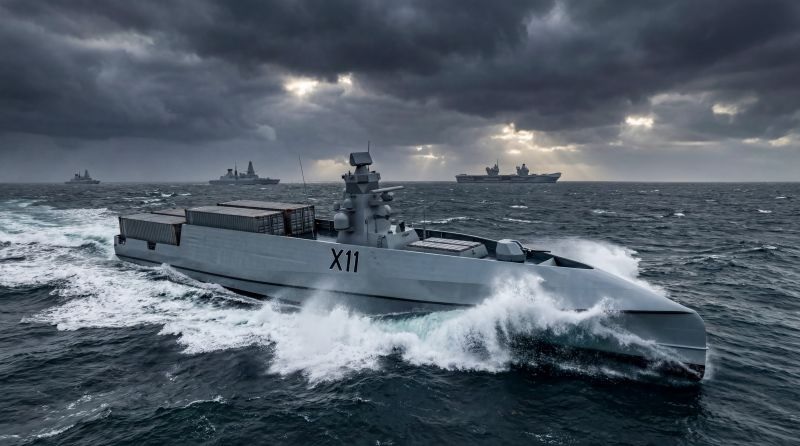
FARNBOROUGH, United Kingdom — May 23, 2026 : Navantia UK has unveiled a scale model of its new Large Autonomous Surface Vessel (LASV75) concept during the Navy Leaders Combined Naval Event (CNE), held at the Farnborough International Exhibition Centre from May 19 to 21, 2026, presenting a platform designed to support the UK Royal Navy’s evolving “hybrid navy” doctrine that combines crewed and uncrewed naval systems.
Developed by Navantia UK’s Bristol-based design team, the LASV75 is intended to provide a persistent, mission-adaptable capability capable of operating independently or alongside traditional warships. The concept reflects growing emphasis within naval planning on integrating autonomous systems into fleet operations to enhance endurance, operational flexibility, and force sustainability.
Vessel Design and Specifications
The LASV75 features a 75-metre modular hull, an 11.8-metre beam, and a displacement of more than 1,000 tonnes. Unlike conventional naval vessels, it has been designed from the keel up as an entirely uncrewed platform, removing traditional crew accommodation and life-support systems to maximise mission payload capacity and operational endurance.
According to Navantia UK, the vessel’s architecture prioritises adaptability, enabling rapid reconfiguration for different operational requirements. The scale model displayed at CNE showcased a highly configurable payload deck designed to accommodate containerised mission systems, interchangeable sensor packages, and modular mast configurations.
Depending on mission requirements, the LASV75 is designed to undertake a range of operational roles including intelligence gathering, surveillance, escort missions, electronic warfare, and strike-related operations, including the integration of mounted naval gun systems. The platform is also intended to operate either independently or in support of a wider naval task group.
Hybrid Navy Vision and Operational Role
Speaking at the event, Simon Jones, Product Development Director at Navantia UK, said the vessel was developed to meet anticipated operational demands of the Royal Navy and allied fleets, particularly in harsh maritime environments requiring long-duration deployment capability.
“This is our vision for what we think the hybrid navy will need in the future to have a credible and persistent capability,” Jones said. “To have true persistent capability in the North Atlantic, for example, in harsh cold weather conditions, we believe something of this scale is necessary.”
The company stated that the concept is intended to support future hybrid force structures where autonomous vessels operate alongside crewed surface combatants to expand mission coverage, reduce risk exposure, and improve operational persistence.
Modular Payloads and NATO Interoperability
To improve compatibility with allied naval forces, Navantia UK is incorporating ‘NavyPOD’-style modular payload systems and interfaces aligned with NATO standards, allowing mission equipment and operational systems to be exchanged more efficiently between partner navies.
According to Simon Jones, the company is focusing on common standards to ensure future interoperability and flexibility across allied maritime operations.
“We’re thinking about standard interfaces aligned to NATO standards to make these as interoperable and interchangeable as possible,” he stated.
The modular approach is expected to allow the platform to adapt quickly to evolving operational needs without requiring major structural redesigns, while also simplifying maintenance and mission reconfiguration.
Manufacturing Strategy and Industrial Scale
Navantia UK stated that manufacturability was a key consideration during the LASV75’s design phase. The company is working with autonomy and mission-system partners across industry to mature the concept while ensuring that future vessels can be produced more rapidly and at lower cost than similarly sized crewed platforms.
Initial construction of the LASV75, if progressed, would take place at Navantia UK’s Appledore shipyard in Devon, a facility capable of manufacturing vessels of up to 120 metres in length.
The company said scalable production and lower-cost manufacturing are central objectives as autonomous naval systems become more prominent in future fleet structures.
Wider Shipyard Modernisation Programme
The unveiling of the LASV75 comes during a broader period of industrial expansion following Navantia UK’s acquisition of Harland & Wolff assets in early 2025.
Navantia UK is currently implementing a £157 million investment programme to modernise its four UK shipyards located at Appledore, Arnish, Belfast, and Methil. The initiative includes digital shipbuilding technologies and advanced automated manufacturing systems aimed at improving efficiency and reducing production timelines.
Among the upgrades is a new automated panel line in Belfast for the production of large steel sections, alongside digital design and engineering tools being introduced across all facilities. The company said the effort is intended to transition operations toward a “Shipyard 5.0” model, focused on advanced automation and digitally integrated production processes.
Derek Jones, Chief Commercial and Business Development Officer at Navantia UK, said autonomous systems will become increasingly important to future sovereign naval capability.
“Autonomous vessels are fundamental to the future of sovereign defence capabilities. Naval capabilities of the future will comprise a hybrid mixture of crewed warships with uncrewed escorts and ancillary ships,” he said.
According to Navantia UK, the industrial improvements are expected to reduce standard naval vessel delivery timelines by up to 30 percent, supporting ambitions outlined in the 2025 Strategic Defence Review, which aims to accelerate the delivery of major modular naval platforms.
Progress on Fleet Solid Support Programme
While Appledore could support future LASV75 production, Navantia UK’s Belfast facility remains focused on the £1.6 billion Fleet Solid Support (FSS) programme for the Royal Fleet Auxiliary.
The programme advanced following the cutting of first steel for the lead vessel at Appledore in December 2025. To support distributed manufacturing between facilities, Navantia UK launched an 85-metre transport barge, Seahorse, in early May 2026 from the Methil yard.
The barge is intended to transport major ship sections and structural components between Appledore and Belfast for final assembly, supporting production continuity across multiple shipyards.
——— End of Article ———