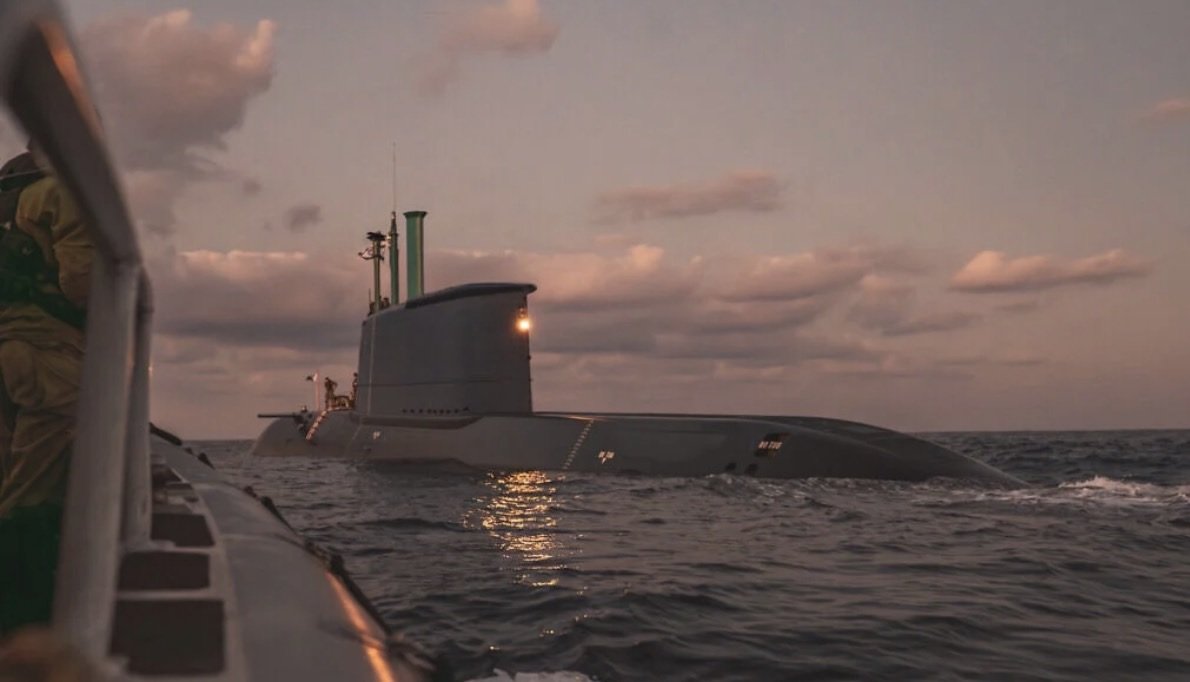
HAIFA, Israel — Israel’s sixth submarine, INS Drakon (Dragon), arrived at the Haifa Naval Base on Thursday after completing a 3,792-nautical-mile (about 8,000-kilometer), 23-day voyage from Kiel, Germany. The submarine’s arrival followed more than 12 years of planning, construction and testing.
Built by Thyssenkrupp Marine Systems (TKMS) at its Kiel shipyard, INS Drakon was formally welcomed at Haifa in a ceremony attended by President Isaac Herzog, Defense Minister Israel Katz and IDF Chief of Staff Lt. Gen. Eyal Zamir.
Before the submarine reached the coast, journalists traveled aboard a Defender-class patrol boat to meet it. For security reasons, the military collected electronic devices, including mobile phones and key fobs, before departure from the naval base.
Israel’s largest and heaviest submarine
The Dolphin 2-class INS Drakon is 74 meters long and displaces 2,600 tons, making it the largest and heaviest submarine currently in Israeli service. It is the third and final Dolphin 2 submarine equipped with air-independent propulsion (AIP).
AIP allows the submarine to remain underwater for extended periods without surfacing. Cpt. “Yud,” chief of the Navy’s 7th Submarine Flotilla, said the system increases the submarine’s stealth “by orders of magnitude.” He also said the vessel increases the number of submarines the Navy can deploy simultaneously.
Military officials said the submarine provides Israel with capabilities that allow it to carry out missions beyond what was previously possible, although many details of its systems remain classified.
The submarine is not yet fully operational. Israeli command, communications and other dedicated systems are expected to be installed over the next two to three months, followed by additional work before it enters full service.
The submarine also features an enlarged sail. Naval defense analysts have suggested several possible uses for the unusual design, but specific capabilities associated with it have not been publicly confirmed.
Commander and crew complete long journey
INS Drakon’s commander, Cdr. “Ayin,” spent about three years in Germany overseeing the submarine’s construction. He described leaving Kiel for the final voyage to Israel as an emotional experience and said the three-week journey “flew by.”
He and other Navy officials also highlighted the challenge of isolation during submarine operations. Ayin said being without mobile phones can be particularly difficult for younger crew members, although limited information, such as soccer results, can be transmitted through the submarine’s communications systems.
Rear Adm. Guy Levy, the Navy’s chief of staff and a former submariner, said isolation remains one of the hardest parts of submarine service.
“The real difficulty is the isolation — being completely cut off. The moment you disconnect the cables, you are alone at sea.”
Ayin praised his crew as “the best human material there is,” saying they understand the significance of the vessel and are trained to operate where needed without being seen.
Crew honors INS Dakar sailors
INS Drakon was originally planned to be named Dakar, after the Israeli submarine INS Dakar, which sank during its maiden voyage from the United Kingdom in 1968, killing all members of its crew.
Families of the sailors who died opposed reusing the name, leading to the selection of Drakon as a compromise.
During the voyage to Israel, the crew stopped at the Mediterranean location associated with the sinking of the original Dakar. Wearing ceremonial white uniforms, sailors recited Yizkor, Kaddish and other liturgical passages in memory of those who were lost.
The name Dakar is planned for Israel’s next generation of submarines.
Larger Dakar-class submarines planned
The future Dakar-class submarines are intended to replace Israel’s three older first-generation Dolphin-class submarines, which entered service around 2000.
The new submarines are expected to be 84 meters long and displace about 3,800 tons. The first Dakar-class submarine is scheduled for delivery in 2031.
Procurement controversy
INS Drakon is part of submarine acquisitions from Thyssenkrupp under agreements valued at around $2 billion. The procurement program became the subject of a wide-ranging investigation into alleged corruption and bribery involving several current and former officials, including individuals close to Prime Minister Benjamin Netanyahu.
A state commission of inquiry concluded that Netanyahu pushed for the sixth submarine based on “unfounded assumptions” and outside standard decision-making procedures for major military purchases. Netanyahu was not indicted in connection with the procurement, while several of his confidants faced criminal charges.
Despite the controversy, Israeli Navy leadership has described INS Drakon as an important addition to the fleet.
Rear Adm. Levy recalled that exactly 12 years and one day before the arrival, he had sailed to Israel aboard INS Tanin, the previous submarine delivered to the country.
“The Navy is growing stronger. This is a powerful platform that increases the Israeli Navy’s stealth capabilities.”
The arrival of INS Drakon completes Israel’s current Dolphin 2 AIP submarine program, while the Navy prepares for the future expansion of its submarine fleet with the larger Dakar-class vessels.
——— End of Article ———