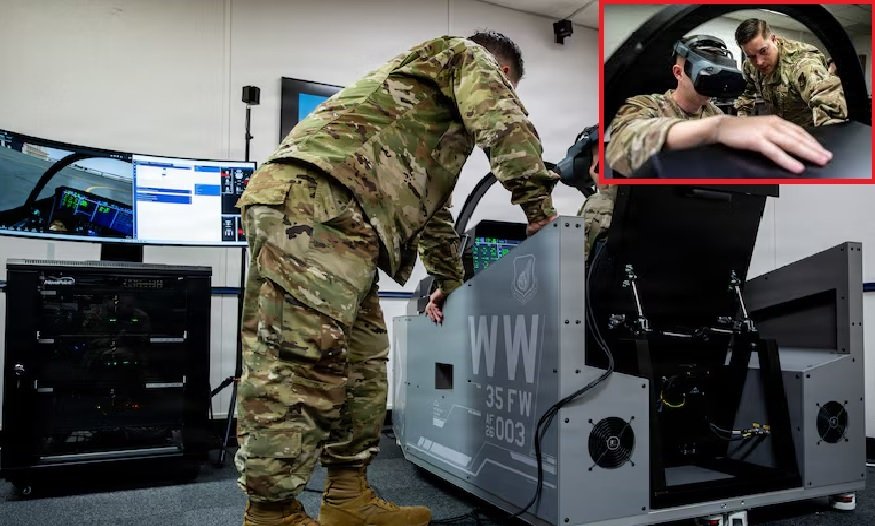
MISAWA AIR BASE, Japan — The U.S. Air Force’s 35th Fighter Wing has installed a new mixed-reality F-35A Lightning II engine run simulator at Misawa Air Base, giving maintenance personnel a way to train on aircraft systems and emergency procedures without using an operational F-35A.
Hands-on F-35A maintenance training
The simulator combines physical F-35A controls, switches and digital displays with virtual environments. Instructors can create training scenarios involving engine fires, hydraulic failures, auxiliary power unit errors and sensor malfunctions.
The system allows students to interact directly with the aircraft controls and screens while instructors remain alongside them. Staff Sgt. Chaz Dages, a 35th Maintenance Group unit training manager, said the controlled environment allows Airmen to practice mistakes safely before performing procedures on an operational aircraft.
Reducing fuel use and aircraft demand
The 35th Fighter Wing expects the simulator to save about $12,000 in fuel per training class, or approximately $144,000 annually once official training begins in November 2026.
Staff Sgt. Joshua Owens, an F-35A instructor with the 35th Maintenance Group, said the simulator allows Airmen to build repetition with less use of the actual aircraft and helps return aircraft to operational status more quickly.
The system also gives maintainers more opportunities to repeat complex procedures while reducing the need for live engine runs during training.
Supporting Misawa’s F-35A transition
The simulator arrived after a two-year acquisition and integration effort as Misawa transitions from the F-16 Fighting Falcon to the F-35A Lightning II.
The first U.S. Air Force F-35As assigned to the 13th Fighter Squadron arrived in March 2026. The 35th Fighter Wing is replacing its 36 F-16s with 48 F-35As.
The F-35A brings advanced sensors, information-sharing systems and sensor-fusion capabilities to Misawa. The aircraft will also support the wing’s Wild Weasel mission, which involves suppressing enemy air defenses.
Owens said the simulator can help the maintenance group accomplish more training with fewer Airmen, while Dages emphasized the importance of keeping personnel trained and aircraft mission-capable.
Official maintainer training with the new simulator is scheduled to begin in November 2026.
——— End of Article ———