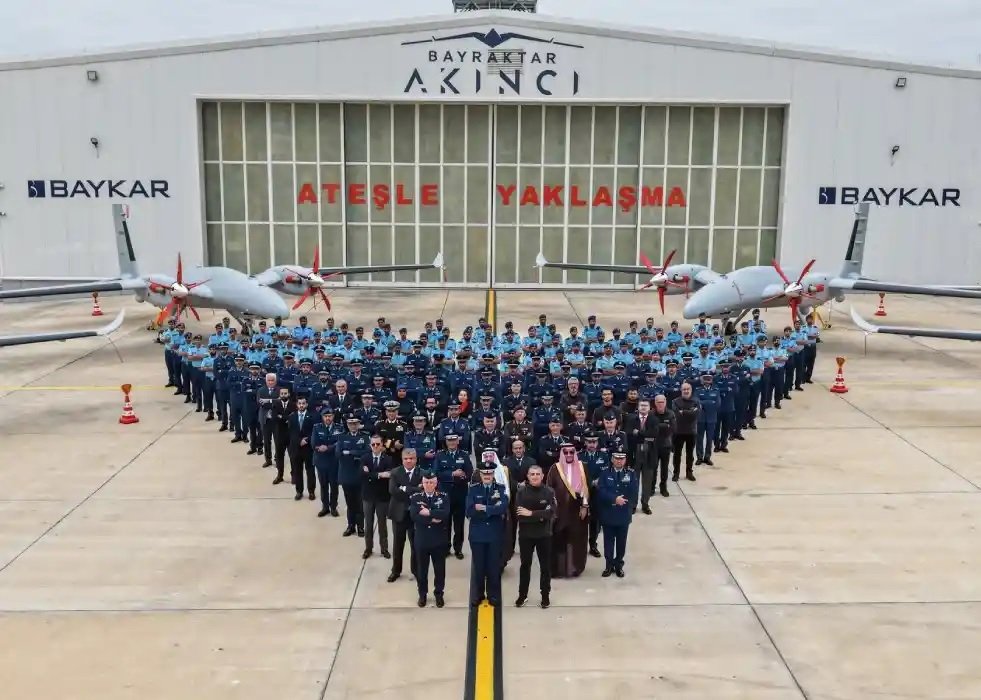
ÇORLU, Türkiye — Thirty personnel from the Royal Saudi Naval Forces have completed training on the Bayraktar AKINCI unmanned combat aerial vehicle (UCAV) at Baykar’s Çorlu Flight Training and Test Center in Tekirdağ, northwestern Türkiye.
Turkish defence company Baykar announced the graduation on September 25. The group included 15 pilots and 15 mechanical and electronic technicians. Saudi Arabia’s Ministry of Defense also confirmed the graduation of the second batch of naval personnel trained on the unmanned aircraft system, referred to in some Saudi statements as “Al-Ra’d.” The ministry said the training supports readiness and the development of unmanned-system capabilities.
Part of Saudi-Turkish defence agreement
The training comes under the agreement signed by Baykar and Saudi Arabia’s Ministry of Defense in July 2023 during Turkish President Recep Tayyip Erdoğan’s visit to Jeddah. Baykar described it as the largest defence and aerospace export contract in Türkiye’s history.
The agreement covers AKINCI aircraft for both the Royal Saudi Air Force and Royal Saudi Naval Forces, together with training, technical support and logistics. Media reports have valued the deal at around $3 billion, although official figures for the final value, total aircraft numbers and delivery schedule have not been released.
Additional agreements signed in August 2023 covered localisation. Saudi Arabian Military Industries (SAMI) and Baykar agreed on technology transfer and plans for up to 70 percent local content, including airframe structures, electrical systems, ground equipment, final assembly, integration, testing and maintenance. Saudi cooperation with Aselsan covers electro-optical systems, while Roketsan is involved in guidance kits and munitions.
Reports have referred to an initial batch of around 60 aircraft, while production lines in Saudi Arabia have been reported as being established. Earlier statements pointed to initial deliveries around 2025 and local assembly afterward, but the current fleet size and delivery schedule remain undisclosed.
AKINCI adds maritime capability
The latest training introduces the AKINCI into a planned naval operating environment, where it can support maritime surveillance, tracking of surface contacts and the development of a recognised maritime picture. The aircraft can also receive targeting information from other sources for strike missions.
Manufacturer data list an endurance of more than 24 hours, an operational altitude of 30,000 feet, a service ceiling of around 40,000 feet, a maximum take-off weight of 6,000 kg and a payload capacity of up to 1,500 kg.
Its equipment can include electro-optical/infrared sensors, multi-mode AESA radar, signals-intelligence and electronic-warfare systems, as well as line-of-sight and satellite communications.
The AKINCI can carry MAM-series laser-guided weapons, guided bombs, the SOM stand-off cruise missile and Roketsan UAV-230 and UAV-300 supersonic missiles.
Recent maritime missile test
In September 2026, an AKINCI launched a UAV-300 missile against a maritime target off Sinop in the Black Sea. The missile struck the target from a distance of more than 250 kilometres. The aircraft took off from the Çorlu test centre and returned along its planned route.
The aircraft has also been integrated with the UAV-122 and UAV-230. Earlier in September, an AKINCI successfully hit a high-speed target drone using the Roketsan SUNGUR missile, demonstrating an air-to-air engagement capability.
Royal Saudi Air Force personnel previously completed AKINCI training at Çorlu, with a graduation reported in October 2025. The latest graduation marks the expansion of the Saudi programme to naval personnel.
Baykar has not announced when the Royal Saudi Naval Forces will begin operational use of the aircraft or the specific missions planned for its AKINCI fleet.
——— End of Article ———