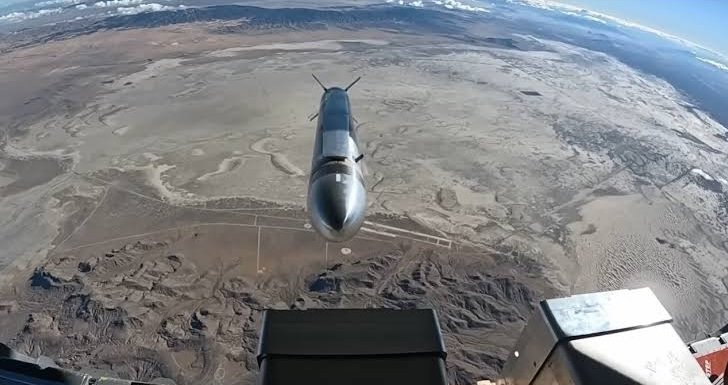
HUNTSVILLE, Alabama — Leidos’ AGM-190A “Havoc Spear” small cruise missile has entered operational use, with the weapon undergoing flight testing and having already been deployed in military exercises and combat, Leidos CEO Tom Bell said during the company’s second-quarter 2026 earnings call.
Bell did not disclose the locations or dates of the combat deployments, current production volumes, contract values or a specific expansion timeline.
The U.S. Air Force designated the Leidos Small Cruise Missile as the AGM-190A in February 2026, while Air Force Special Operations Command (AFSOC) announced the Havoc Spear name in May 2026. AFSOC said Secretary of the Air Force Troy Meink selected the name during a November 2025 visit to AFSOC headquarters at Hurlburt Field.
Leidos is now discussing a larger procurement and expansion of the missile with the U.S. Air Force and U.S. Special Operations Command (SOCOM). Bell said the discussions also include developing the AGM-190A into a broader “family of systems.”
The roughly 200-pound-class missile was developed by Leidos Dynetics, with development beginning around 2021 and drawing on experience from the GBU-69/B Small Glide Munition. In 2022, Leidos signed a Cooperative Research and Development Agreement with SOCOM to develop the weapon as a low-cost, adaptable delivery platform.
Testing included AC-130J launch development, with successful store-separation testing in December 2023 and the first guided flight test in late 2024. By May 2025, testing had demonstrated a standoff range of more than 400 nautical miles (about 740 km) from a C-130 aircraft.
The AGM-190A uses a Pratt & Whitney TJ150-7 turbojet, reaches high-subsonic speeds of around Mach 0.8, and has a service ceiling of about 9,000 meters. Its modular hardware and open-system software are designed to support mission adaptability, including operation in GPS-denied environments and terminal guidance options. A warhead in the 23 kg (50 lb) class has also been reported.
The missile can be launched from several platforms and systems, including AC-130J Ghostrider gunships, MC-130J aircraft, MQ-9 Reapers, OA-1K Skyraider II aircraft, conventional wing pylons, palletized drop systems and ramp-mounted launch tubes.
In July 2026, SOCOM awarded Leidos a $27.2 million contract modification for AGM-190A All Up Rounds. Work in Huntsville, Alabama, is scheduled to continue through February 2029.
LCCM Expansion
The AGM-190A also forms the basis for Leidos’ Low-Cost Containerized Munitions (LCCM) framework announced earlier this year. Bell said the small cruise missile program helped position Leidos for the broader family-of-systems approach.
Under May 2026 Department of War framework agreements involving Leidos, Anduril, CoAspire and Zone 5, Leidos is to deliver an initial 3,000 LCCM units. The LCCM is approximately twice the size of the AGM-190A and has greater fuel capacity, while using a modular airframe and common Weapon Open Systems Architecture.
Production is planned to begin in 2027, with Leidos targeting 3,000 units before the end of the decade. The broader LCCM effort aims for more than 10,000 missiles over three years beginning in 2027. The system is initially planned for ground launch from containers, with maritime and air-launched variants also possible.
Leidos has estimated the addressable market for low-cost and containerized munitions at more than $44 billion over the next 10 years. The company is positioning Havoc Spear, LCCM and the Indirect Fire Protection Capability (IFPC) as key parts of its defense-technology expansion.
For LCCM, a production-readiness and scaling review is scheduled for later in August 2026, followed by full flight testing next summer and then full-rate production.
Leidos reported about $4.6 billion in second-quarter 2026 revenue, up 7% year over year, and raised its full-year guidance. The company said its defense business also recorded accelerating revenue and a high book-to-bill ratio.
——— End of Article ———