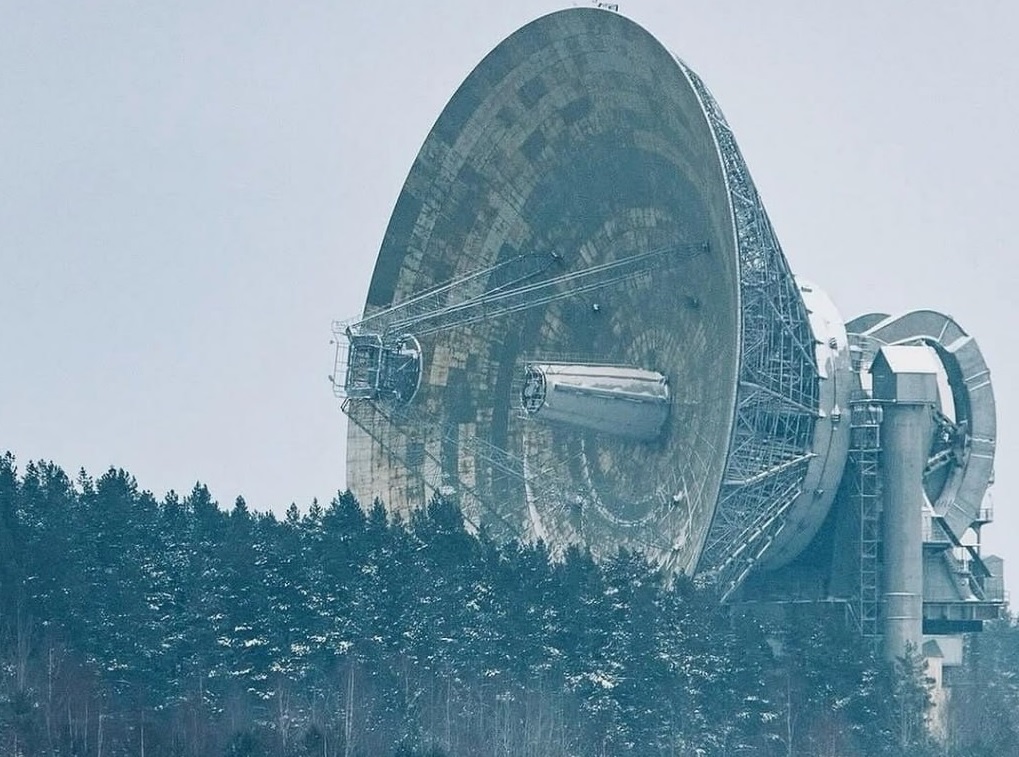
The Kalyazin RT-64 radio telescope stands as a monument to Soviet-era ambition and modern scientific exploration. Located near the town of Kalyazin in Russia’s Tver Oblast, this colossal structure is a symbol of technological prowess, initially conceived to play a pivotal role in humanity’s journey to the stars.
Origins: A Vision for Mars and Beyond
The Kalyazin RT-64 was constructed in the late 1980s during the twilight of the Soviet Union. Designed as part of the nation’s ambitious space exploration program, its primary mission was to support interplanetary communication, including potential manned missions to Mars. The telescope was also envisioned to explore the "Silver Galaxy," a term symbolizing humanity's dream of venturing beyond our solar system into the vast reaches of the Milky Way.
With a dish diameter of 64 meters, the RT-64 was one of the largest radio telescopes of its time. Its high sensitivity and ability to detect faint radio signals made it indispensable for deep-space communication and scientific observation.
Technical Specifications
The RT-64 boasts impressive capabilities that ensure its continued relevance in modern astrophysics and space exploration:
- Antenna Size: 64 meters in diameter, providing a large surface area for capturing weak signals from deep space.
- Frequency Range: Operates across multiple frequency bands, enabling diverse research applications, from pulsar studies to planetary radar.
- Precision Mechanisms: Equipped with advanced tracking systems to maintain accurate alignment with celestial objects.
- Powerful Receivers: Highly sensitive receivers capable of detecting signals from distant galaxies and space probes.
A Legacy of Adaptation
While the Kalyazin RT-64 was initially designed for interplanetary missions, the dissolution of the Soviet Union in 1991 led to a shift in its operational focus. Rather than facilitating manned Mars missions, the telescope found a renewed purpose in scientific research.
Today, it is integrated into the Russian VLBI (Very Long Baseline Interferometry) network, contributing to high-precision astronomical observations. The RT-64 plays a key role in studying quasars, pulsars, and the structure of distant galaxies. It is also used for geodetic measurements, helping scientists monitor Earth's tectonic movements and rotation.
Contemporary Relevance
Despite its origins in the Cold War era, the RT-64 remains an active and vital tool in modern astronomy. Its collaboration with international research efforts underscores its significance in global scientific endeavors.
- Space Exploration: Supports communication with Russian spacecraft and contributes to the study of the solar system.
- Radio Astronomy: Observes cosmic phenomena, such as black holes, neutron stars, and interstellar gas clouds.
- Earth Monitoring: Aids in tracking satellites and studying Earth's dynamics through geodetic VLBI techniques.
Challenges and Preservation
Maintaining a structure of this scale and complexity is no small feat. Over the years, the RT-64 has faced funding challenges and the natural wear and tear of aging equipment. However, efforts to modernize and preserve the facility continue, ensuring its operational longevity.
Looking to the Future
The Kalyazin RT-64 radio telescope is a testament to human ingenuity and perseverance. From its origins as a communication hub for Mars-bound missions to its modern role in unraveling the mysteries of the universe, it serves as a bridge between the dreams of the past and the discoveries of the future.
As space exploration gains renewed momentum worldwide, the RT-64 stands ready to contribute its capabilities to new missions, perhaps even rekindling its original purpose of facilitating humanity’s journey to other planets and beyond.
——— End of Article ———