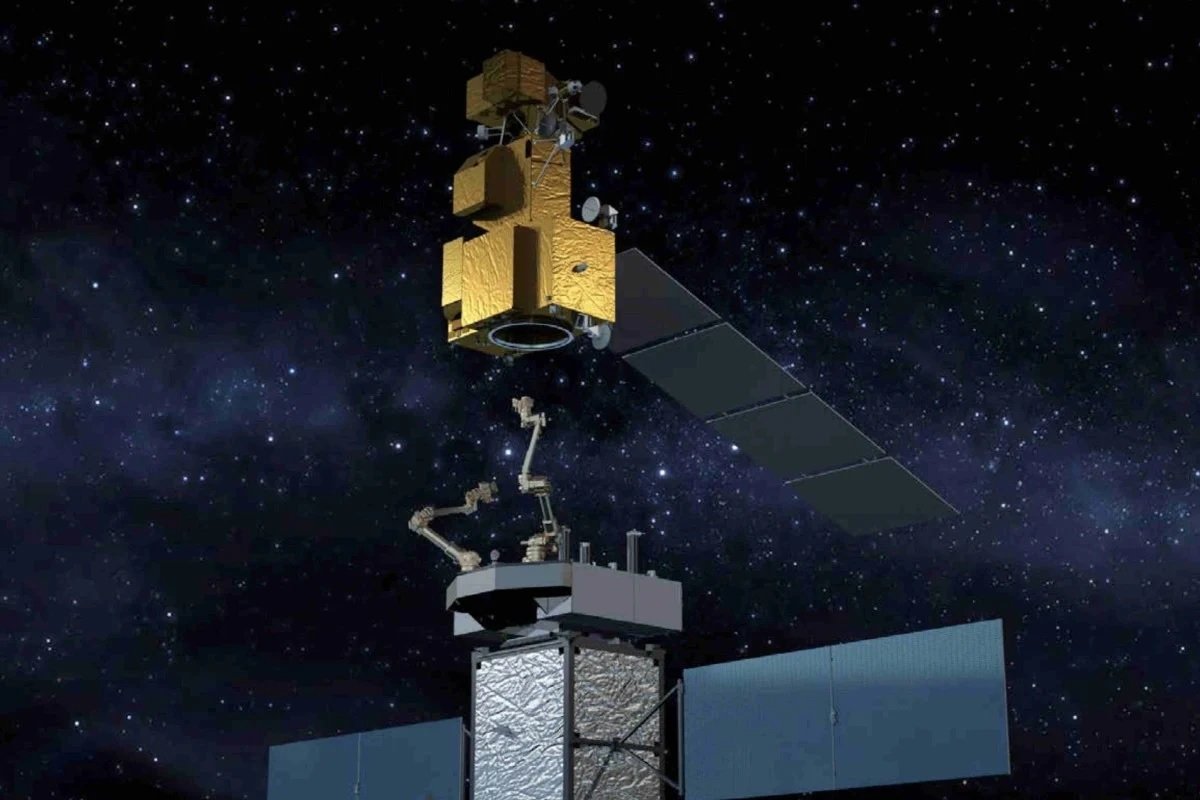
BEIJING, — Chinese researchers have reported what they describe as China’s first successful in-orbit refueling of a high-orbit BeiDou navigation satellite. The operation reportedly involved transferring room-temperature propellant to extend the satellite’s service life.
The claim was disclosed in a paper by researchers from China’s state-funded Deep Space Exploration Laboratory, which is currently under peer review for the Journal of Deep Space Exploration. The paper did not provide the date, satellites involved, amount of propellant transferred or the resulting increase in service life.
A separate study published in April 2025 by Chinese Academy of Sciences researchers in the International Journal of Aerospace Engineering provided more details. It identified the servicing spacecraft as Shijian-25 and the target as BeiDou-2 G7, stating that Shijian-25 transferred 142 kilograms of propellant to BeiDou-2 G7 in February 2025. The study said the transfer was expected to extend the satellite’s service life by eight years. Neither paper cited an independent source confirming the transfer.
Shijian-25's servicing mission
Shijian-25 was launched on January 7, 2025, from the Xichang Satellite Launch Center aboard a Long March-3B rocket. Its developer, the Shanghai Academy of Spaceflight Technology, described its mission as testing technologies for satellite refueling and life-extension services, along with repair and space-debris removal capabilities.
The reported refueling used room-temperature storable chemical propellant, avoiding the need for complex cryogenic cooling systems. Chinese researchers said the mission provided practical experience but also stressed the need to develop technology for transferring ultra-low-temperature propellants, which offer better performance for larger spacecraft and deep-space missions.
Tracking data conflict with the reported timeline
Independent orbital-tracking data have raised questions about the reported February 2025 rendezvous.
U.S. Space Force tracking records indicate that Shijian-25 and BeiDou-2 G7 did not come close enough to dock during February or the first half of 2025. BeiDou-2 G7 remained near 110.5 degrees east longitude in geostationary orbit from January to July, while Shijian-25 was tracked near 120 degrees east longitude after launch, remaining there until June before later moving to about 127 degrees east.
Satellite-tracking expert Jonathan McDowell, a former Harvard astrophysicist, said the observed orbital paths were not consistent with a rendezvous and refueling in early 2025.
Separately, tracking firms observed close approaches and apparent docking between Shijian-25 and Shijian-21 in mid-2025. The activity was monitored by U.S. surveillance satellites. Shijian-21 had previously docked with a retired BeiDou satellite in 2022 and moved it to a higher disposal orbit.
Significance for BeiDou
China’s BeiDou system provides global positioning, navigation and timing services for civilian applications, including mapping and financial systems, as well as military uses. Its constellation includes satellites in high Earth orbit, including geostationary orbit roughly 36,000 kilometers above Earth.
In-orbit refueling could allow satellites to remain operational after their onboard propellant is depleted, reducing the need to replace otherwise functional spacecraft. The rendezvous and docking technologies involved can also support spacecraft repair, inspection, repositioning and debris-removal missions.
The South China Morning Post, which first reported the peer-review paper, contacted the Chinese research teams for comment. As of late September 2026, no official confirmation beyond the scientific papers has been issued, and the peer-review process remains ongoing. Publicly available tracking data have not independently confirmed the reported February 2025 refueling.
——— End of Article ———