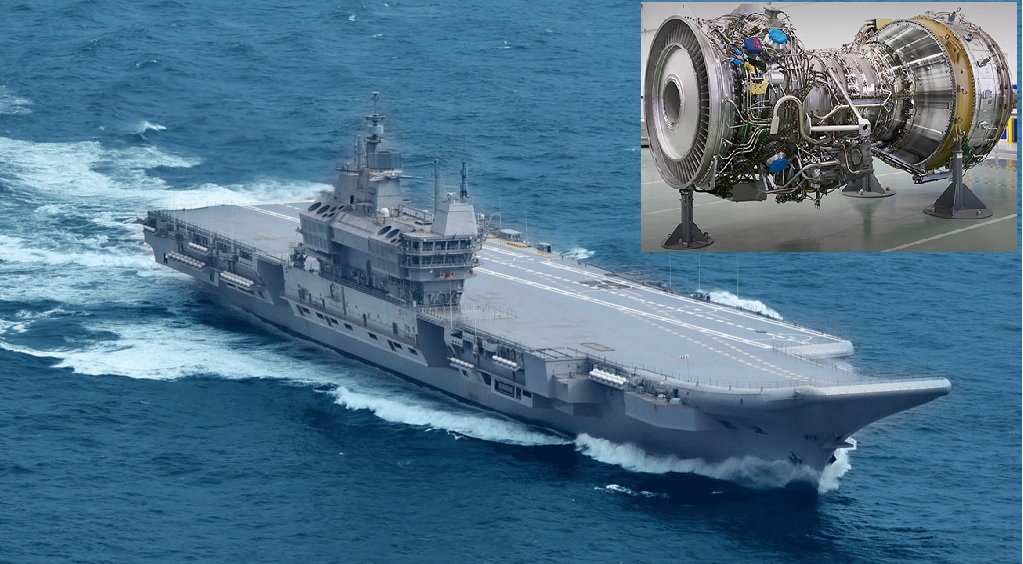
India's ambitious naval expansion plans are poised for a technological leap, as its second Indigenous Aircraft Carrier (IAC-2) considers adopting the Rolls-Royce MT-30 gas turbine engine paired with an Integrated Electric Propulsion System (IEPS). This potential transition signifies a departure from the U.S.-sourced LM2500 engines, aligning India's maritime capabilities with cutting-edge global standards.
The Rolls-Royce MT-30: A Powerhouse in Naval Propulsion
The Rolls-Royce MT-30 has gained acclaim as one of the most power-dense marine gas turbines available, delivering up to 36 MW of power per unit. This capability has been proven aboard elite vessels like the Royal Navy's HMS Queen Elizabeth and HMS Prince of Wales. These ships utilize the MT-30 within an electric propulsion framework, achieving enhanced efficiency, operational versatility, and reduced acoustic signatures—an invaluable feature for naval stealth and survivability.
Why MT-30 for IAC-2?
India's first Indigenous Aircraft Carrier, INS Vikrant, operates with four LM2500 gas turbines. However, the IAC-2 could leverage the MT-30's compact and lightweight design to optimize space for advanced weapon systems, aviation facilities, and crew accommodations. Furthermore, the IEPS integration would allow the ship to utilize electric power for various systems, enabling quieter operations and reducing fuel consumption during lower-speed missions.
The MT-30's origins as a derivative of Rolls-Royce’s Trent aero engines ensure reliability and long-term performance. Its ability to propel vessels at speeds exceeding 40 knots, when paired with diesel engines, reflects its unmatched power density—a crucial advantage for modern aircraft carriers operating in contested environments.
Strengthening UK-India Defense Ties
The decision to consider Rolls-Royce propulsion systems is bolstered by the Joint Working Group on Electric Propulsion Capability Partnership, a bilateral initiative between India and the UK. This collaboration aims to foster technological exchange and enhance industrial partnerships, paving the way for the MT-30 and IEPS to become mainstays in future Indian naval projects.
Besides IAC-2, the Indian Navy’s destroyers, frigates, corvettes, and landing platform docks (LPDs) are likely candidates for this propulsion upgrade, underscoring a broader trend toward modernizing fleet-wide capabilities.
Beyond Power: Strategic Implications
The adoption of Rolls-Royce marine turbines would mark a significant shift in India's defense sourcing strategy. For decades, India has relied on propulsion systems from the U.S., Russia, and Ukraine. Diversifying with UK-origin technology not only reduces dependency but also strengthens interoperability with allied navies.
For the Indian Navy, the benefits are multifold:
- Enhanced Ship Performance: The MT-30 enables higher speeds and extended operational ranges, critical for aircraft carrier missions.
- Reduced Maintenance Costs: The turbine's modern design minimizes upkeep, ensuring cost efficiency over the vessel's lifecycle.
- Global Compatibility: Leveraging the MT-30 aligns India’s naval fleet with contemporary propulsion standards, enhancing operational cohesion in joint exercises with partner nations.
IAC-2: A Future-Ready Carrier
Although the propulsion system for IAC-2 is yet to be finalized, the MT-30’s proven track record makes it a compelling choice. If selected, this propulsion overhaul will position the IAC-2 as a technologically advanced platform capable of supporting India’s growing maritime ambitions. Furthermore, the integration of IEPS could set a precedent for future Indian warships, advancing the Navy’s capability to project power across the Indo-Pacific.
As India continues to assert its role as a maritime powerhouse, the IAC-2, with Rolls-Royce MT-30 engines at its heart, could symbolize a new era of naval innovation—an era that embraces technological independence, strategic partnerships, and operational excellence.
——— End of Article ———