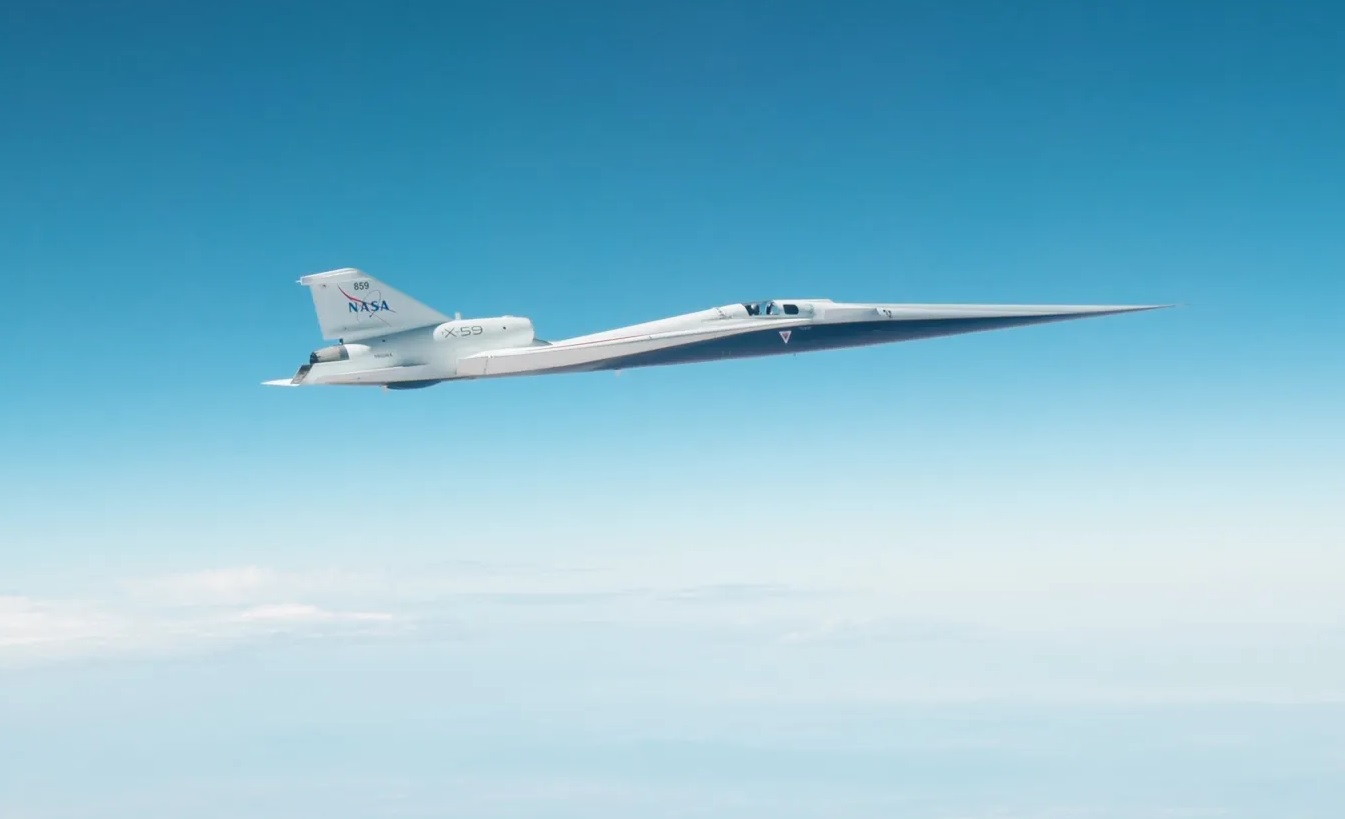
EDWARDS, California, — June 13, 2026 : NASA’s X-59 quiet supersonic research aircraft has successfully completed its first flight under planned mission conditions, reaching a speed of Mach 1.4 and an altitude of 55,000 feet on June 12, 2026. The achievement marks the fastest and highest flight conducted by the aircraft to date and represents a significant milestone in NASA’s Quesst (Quiet SuperSonic Technology) mission.
The flight took place exactly one week after the X-59 completed its first supersonic flight. On June 5, NASA test pilot Jim “Clue” Less flew the aircraft to approximately Mach 1.1 at an altitude of 43,400 feet during an 81-minute sortie from Edwards Air Force Base in California.
Envelope Expansion Testing Continues
The recent flights are part of NASA’s ongoing envelope expansion program, a testing process in which engineers gradually increase an aircraft’s speed and altitude to assess performance, verify system reliability, and calibrate onboard instruments under increasingly demanding conditions.
During the initial supersonic test flights, a NASA F-15 chase aircraft accompanied the X-59. The sonic booms generated by the F-15 masked any sound produced by the X-59, as the current phase of testing is focused on evaluating structural integrity, aerodynamic performance, and flight systems rather than measuring acoustic signatures.
NASA officials stated that the June 12 flight successfully demonstrated the aircraft’s ability to operate at its intended mission conditions, providing valuable data for future testing phases.
Designed to Reduce Sonic Booms
The X-59, developed by NASA in partnership with Lockheed Martin’s Skunk Works, is specifically designed to address one of the primary challenges associated with supersonic flight: the loud sonic boom.
When conventional aircraft travel faster than the speed of sound, they generate pressure waves that combine into a powerful shockwave. As this shockwave reaches the ground, it is heard as a loud sonic boom that can exceed 100 perceived noise decibels. Concerns about noise pollution led regulators to prohibit commercial supersonic flights over land in the United States in 1973.
The X-59 incorporates several design features intended to reduce this effect.
The aircraft measures approximately 99.7 feet in length with a 29.5-foot wingspan. Its distinctive needle-like nose accounts for nearly one-third of the aircraft’s overall length. The elongated structure and carefully shaped airframe are designed to separate the pressure waves generated by different parts of the aircraft, including the nose, wings, cockpit, and engine.
Instead of merging into a single shockwave, these separated waves travel through the atmosphere independently and reach the ground as a series of smaller pressure changes. NASA expects this configuration to produce a quieter sonic “thump” of approximately 75 perceived noise decibels, a sound level comparable to a car door closing.
Advanced Systems and Modified Airframe
The X-59 is based on a modified Gulfstream aircraft design and incorporates several advanced technologies. One of its most notable features is the eXternal Vision System (XVS), which replaces a traditional forward-facing cockpit windshield with a combination of high-resolution cameras and display systems. This arrangement provides pilots with forward visibility while allowing the aircraft to maintain its extended nose design.
The aircraft serves as the centerpiece of NASA’s Quesst mission, which aims to collect scientific data on public reactions to quieter supersonic flight and support the development of future commercial supersonic aircraft.
Community Overflights Planned
Following the completion of performance testing, NASA plans to transition the program into its acoustic validation phase. The X-59 will conduct a series of flights over selected communities across the United States while operating at its established mission conditions of Mach 1.4 and 55,000 feet.
During these overflights, NASA will deploy ground-based microphone arrays to record the aircraft’s acoustic signature. Residents in the test areas will also be surveyed to gather information on how they perceive the sound generated by the aircraft.
The collected data will be shared with aviation regulatory bodies, including the Federal Aviation Administration (FAA) and the International Civil Aviation Organization (ICAO).
Path Toward Future Supersonic Travel
NASA plans to continue flight testing over the coming months, with additional envelope expansion flights expected to reach speeds of up to Mach 1.6 and altitudes approaching 60,000 feet.
The agency hopes that data gathered through the Quesst mission will help establish new science-based noise standards for supersonic aircraft. If regulators determine that quieter supersonic flight can be conducted without significant disturbance to communities, the findings could support future changes to existing regulations governing commercial supersonic operations over land.
NASA officials believe the research could contribute to the development of next-generation commercial aircraft capable of significantly reducing travel times while meeting modern environmental and noise requirements.
——— End of Article ———