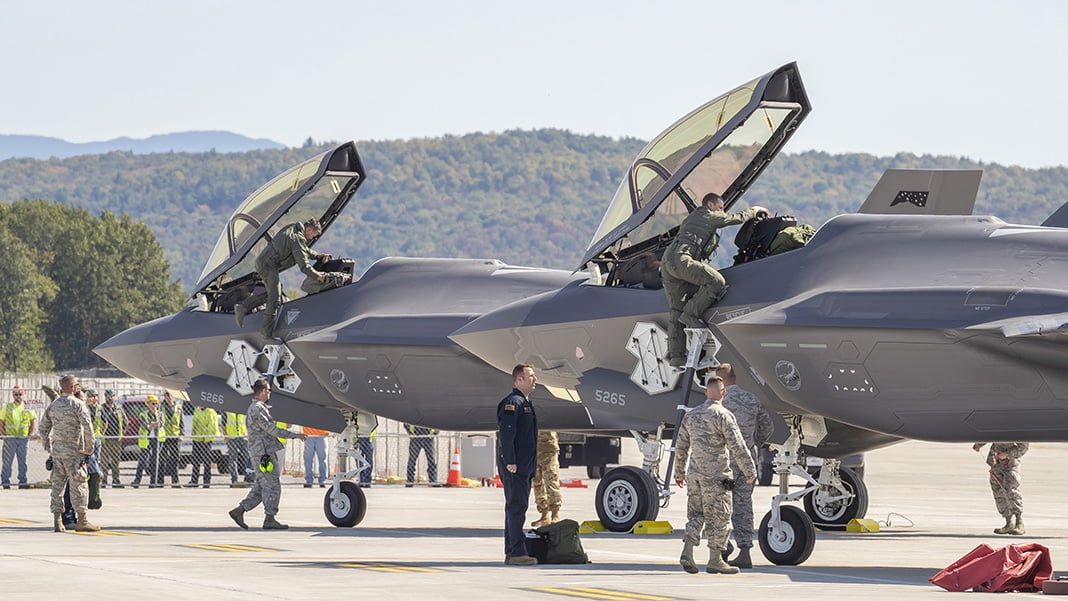
WASHINGTON, — June 13, 2026 : The readiness of the U.S. military's F-35 Lightning II fleet continued to decline during fiscal year 2025, with only one-quarter of the global fleet capable of performing all assigned missions, according to a new report released by the U.S. Government Accountability Office (GAO).
The report, published on June 11, highlights ongoing challenges affecting the world's largest fifth-generation fighter program, including software delays, spare parts shortages, corrosion issues, rising sustainment costs, and shortcomings in contractor incentive structures.
Readiness Metrics Continue Downward Trend
According to the GAO, key readiness indicators have deteriorated significantly since fiscal year 2021.
The fleet's mission capable rate, which measures the percentage of time an aircraft can perform at least one assigned mission, declined from 67 percent in fiscal 2021 to 44 percent in fiscal 2025.
Meanwhile, the full mission capable rate, representing the percentage of time aircraft can perform all assigned missions, dropped from 38 percent to 25 percent during the same period.
The report noted that readiness levels varied among the three F-35 variants. The Air Force's F-35A recorded a mission capable rate of 38.6 percent in fiscal 2025, lower than the Marine Corps' F-35B and the Navy's F-35C, which achieved rates ranging between 54 percent and 64 percent.
However, the F-35A posted the highest full mission capable rate among the variants at 28.5 percent, nearly double that of the F-35B and F-35C.
Software Delays Affect New Aircraft
Air Force officials attributed part of the readiness decline to the introduction of aircraft equipped with the Technology Refresh 3 (TR-3) hardware and software package.
Due to ongoing software development delays, TR-3-configured aircraft remain restricted primarily to basic flight training missions and are currently unable to conduct combat operations. The delays have slowed the delivery of the aircraft's expanded combat capabilities and contributed to reduced fleet availability.
The report also identified corrosion problems and persistent spare parts shortages as major factors limiting readiness.
A 2025 study conducted by Lockheed Martin found that suppliers were unable to meet demand for 48 critical components, including canopies and other high-priority parts required to keep aircraft operational.
Joint Program Office Launches Readiness Recovery Plan
In response to declining readiness levels, the F-35 Joint Program Office (JPO) launched the Global Support Solution (GSS) Reset initiative in June 2025.
The program seeks to improve fleet performance and achieve an 80 percent mission capable rate and a 65 percent full mission capable rate by 2030.
To meet those objectives, the JPO estimates that an additional $13.7 billion will be required through fiscal year 2031 beyond previously planned funding levels.
The projected funding includes:
- $7.3 billion for depot-level spare parts and materials.
- $3.1 billion to expand military depot repair capacity.
- $3.3 billion for maintenance and fuel requirements.
According to the GAO, only $2.2 billion of the total funding requirement is directly associated with the GSS Reset initiative. The remaining $11.5 billion is intended to address historical budget shortfalls and reflects the difference between previous sustainment estimates and actual program requirements.
Program officials have indicated that readiness rates could decline further before improvements become visible, with significant gains potentially not emerging until late 2026 or beyond.
Supply Chain Constraints Remain a Major Risk
The GAO warned that the success of the GSS Reset strategy depends heavily on the defense industrial base's ability to increase production.
The Joint Program Office is relying on industry partners to deliver more than $7 billion worth of additional parts and materials, but existing supplier capacity constraints continue to present risks.
The report noted that shortages of critical components have repeatedly delayed repairs and contributed to aircraft remaining grounded while awaiting replacement parts.
Rising Sustainment Costs Create Long-Term Affordability Concerns
The F-35 remains the Department of Defense's most expensive weapon system.
As of 2024, estimated lifetime U.S. sustainment costs for the program stood at approximately $1.6 trillion, with costs continuing to increase as the fleet expands.
The GAO projects that by the mid-2030s, the military services could face an annual affordability gap of approximately $1.2 billion between projected sustainment requirements and available funding.
Auditors cautioned that the projected gap may be even larger because cost estimates were developed before Operation Epic Fury and may not fully account for additional flight hours generated by increased operational demands.
GAO Questions Effectiveness of Contractor Incentives
The report also examined the effectiveness of contractor incentive programs intended to improve readiness.
Between 2020 and 2023, the Joint Program Office paid more than $114 million to Lockheed Martin from approximately $269 million in available incentive fees tied to parts availability and readiness goals.
Despite those payments, readiness metrics either stagnated or continued to decline.
The GAO found that in 19 of 39 performance periods, adjustments were made to recorded full mission capable rates to account for factors deemed outside Lockheed Martin's control, such as delays attributed to military services. These adjustments increased the contractor's eligibility for incentive payments.
According to GAO estimates, Lockheed Martin would have earned roughly half the incentive fees if calculations had been based solely on unadjusted readiness figures.
The watchdog also reported inconsistencies in documentation related to incentive payments. During the review, the Joint Program Office provided multiple versions of fee calculation spreadsheets and used formulas that differed from those outlined in original contract agreements.
The current sustainment contract covering 2025 through 2028 no longer includes incentives tied directly to full mission capable rates. Instead, incentive payments are linked primarily to parts supply metrics, with performance targets that GAO said remain below broader program goals.
In contrast, engine manufacturer Pratt & Whitney has consistently met its sustainment targets since 2022 after implementing corrective actions recommended in previous GAO reviews.
Pentagon, JPO and Lockheed Martin Respond
The Joint Program Office agreed with the GAO's findings and recommendations.
A JPO spokesperson said the office remains focused on meeting its 2030 readiness goals through the Global Support Solution Reset initiative while ensuring fiscal accountability across the sustainment enterprise.
Lockheed Martin stated that it has invested more than $2 billion in advanced funding to accelerate spare parts production and improve fleet readiness.
The company said it continues to work closely with the Joint Program Office and industry partners to strengthen sustainment performance and support operational requirements.
GAO Calls for Additional Reforms
The GAO recommended that the Department of Defense develop comprehensive risk mitigation plans addressing industrial capacity, technical data management, affordability concerns, and service alignment.
The watchdog also urged the Pentagon to redesign contractor incentive structures, including consideration of performance penalties when readiness objectives are not achieved, and establish a more reliable system for tracking incentive fee payments.
Since 2014, the GAO has issued 46 recommendations related to F-35 sustainment. As of March 2026, the Department of Defense had implemented 14 of those recommendations.
The Pentagon has agreed with the latest recommendations contained in the report.
Despite the continuing readiness and affordability challenges, the F-35 remains the cornerstone of U.S. and allied air power. The Pentagon currently operates more than 800 F-35 aircraft and plans to acquire approximately 1,700 additional fighters through the mid-2040s, making the program a central component of future military aviation strategy.
——— End of Article ———