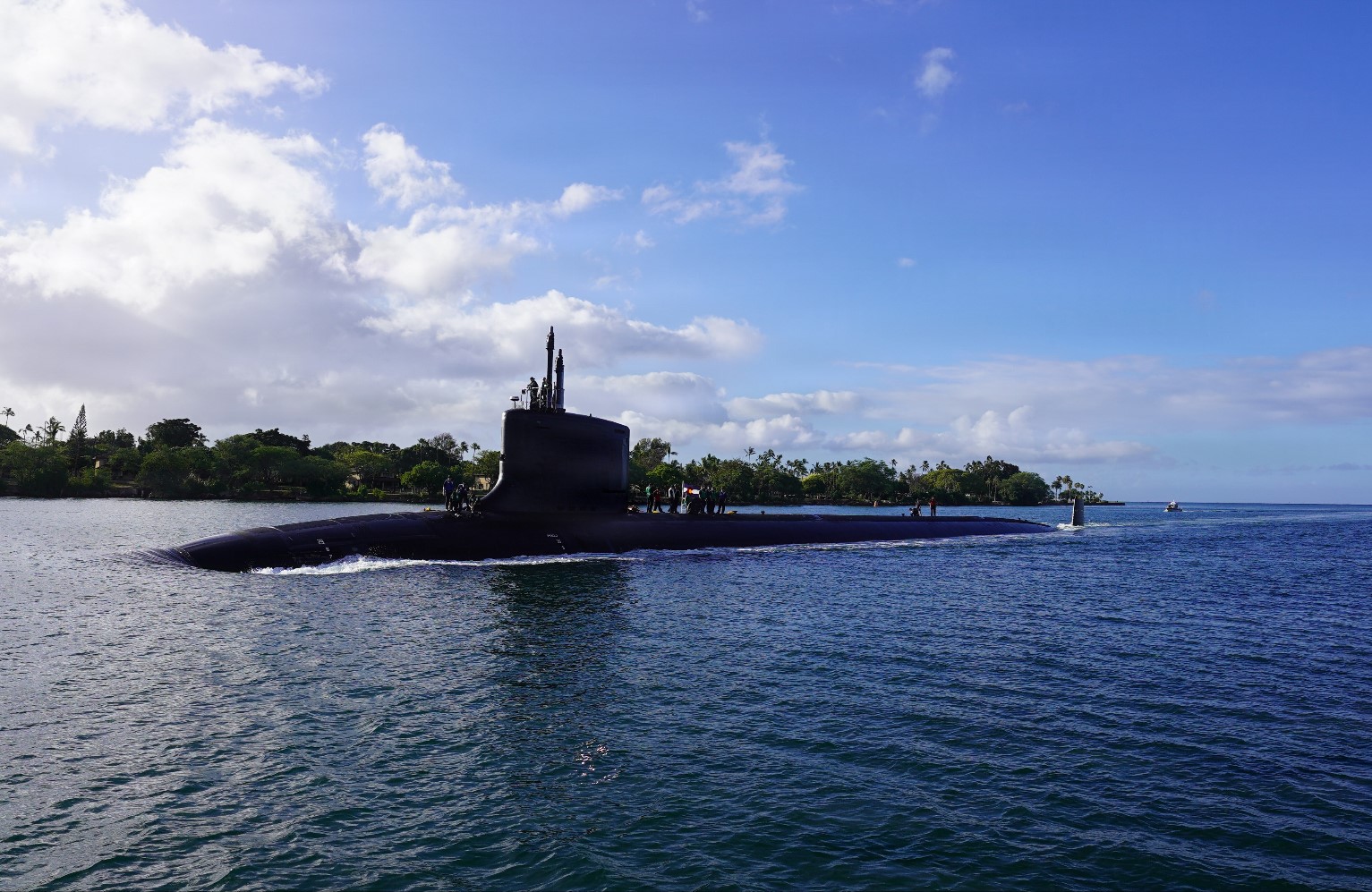
PEARL HARBOR, Hawaii, — June 14, 2026 : The U.S. Navy's Virginia-class fast-attack submarine USS Colorado (SSN 788) has returned to operational service after completing a major maintenance period at Pearl Harbor Naval Shipyard and Intermediate Maintenance Facility (PHNSY & IMF) 29 days ahead of schedule, providing an additional combat-ready submarine to the U.S. Pacific Fleet.
The submarine officially rejoined the fleet on June 10 following the successful completion of an Extended Dry-Docking Selected Restricted Availability (EDSRA) maintenance period that began in June 2024. USS Colorado completed post-maintenance sea trials on June 6, confirming the vessel's readiness for future operations.
The early completion represents a significant achievement for the shipyard and submarine crew, particularly as the U.S. Navy continues to emphasize undersea warfare readiness across the Indo-Pacific region. Returning a nuclear-powered attack submarine to service nearly a month earlier than planned increases operational flexibility for the Pacific Fleet and supports ongoing regional commitments.
Maintenance Completed Ahead of Schedule
The maintenance package involved extensive repairs, inspections, modernization work, and system upgrades required to maintain the submarine's operational effectiveness. Work on nuclear-powered submarines is particularly demanding due to strict safety requirements, radiation controls, confined workspaces, and the need to meet rigorous quality standards.
Unlike conventional warships, submarine maintenance requires specialized procedures and precision because errors can lead to costly delays and additional repairs. Shipyard personnel therefore focus heavily on achieving first-time quality during every phase of the project.
Capt. Ryan McCrillis, commander of PHNSY & IMF, credited the achievement to teamwork and a commitment to quality.
“Finishing ahead of schedule is not about rushing, it’s about hard work and persistence,” McCrillis said. “It’s producing first-time, high-quality work and attacking every roadblock with urgency. It’s a team effort, from the newest apprentice to senior shipyard leaders, the ship’s force, the project team, and support from the fleet and headquarters.”
According to shipyard officials, maintaining strong communication among maintenance teams, fleet representatives, and the submarine's crew helped prevent delays and allowed challenges to be addressed quickly as they emerged.
Close Cooperation Between Shipyard and Crew
A key factor in the project's success was the close integration between USS Colorado’s sailors and the shipyard workforce throughout the availability period.
Rather than relying solely on technical manuals and engineering documentation, maintenance teams worked directly with the crew, whose detailed knowledge of onboard systems helped accelerate troubleshooting and repairs.
Chad Renti Cruz, PHNSY & IMF project superintendent for USS Colorado, said the collaborative approach enabled rapid problem-solving.
“From the get-go, the team gelled as one,” Cruz said. “Whenever challenges or problems came up, we swarmed the issue, got all the right people in the room to lay out a solid plan, and executed it to a T.”
Cmdr. Justin Reeves, commanding officer of USS Colorado, emphasized the importance of cooperation between sailors and shipyard personnel throughout the maintenance period.
“Colorado’s success was largely due to the continual hard work, communication, and coordination between our Sailors and the shipyard team,” Reeves said. “Ending the availability early allows us to get back out to sea and prepare the crew for operations.”
The successful completion of sea trials demonstrated that all major systems were functioning properly before the submarine returned to fleet service.
USS Colorado and the Virginia-Class Fleet
Commissioned on March 17, 2018, at Naval Submarine Base New London in Groton, Connecticut, USS Colorado is the 15th Virginia-class submarine and the fifth Block III variant built for the U.S. Navy. The submarine is homeported at Joint Base Pearl Harbor-Hickam, Hawaii, and assigned to Submarine Squadron 7.
Virginia-class submarines form the core of the Navy's fast-attack submarine force. Since the lead boat entered service in 2004, more than two dozen vessels of the class have been commissioned.
Construction of the class is shared between Huntington Ingalls Industries in Newport News, Virginia, and General Dynamics Electric Boat in Groton, Connecticut.
The Block III variant introduced several significant improvements, including a redesigned bow equipped with the Large Aperture Bow sonar array and the replacement of traditional vertical launch tubes with two large-diameter Virginia Payload Tubes, increasing missile-carrying flexibility.
As a nuclear-powered, conventionally armed attack submarine, USS Colorado is equipped with Tomahawk cruise missiles for long-range land attack missions, heavyweight torpedoes for anti-submarine and anti-surface warfare, and advanced sensors for intelligence, surveillance, and reconnaissance (ISR) missions. The submarine is also capable of supporting special operations forces and conducting a wide range of undersea operations.
Strategic Importance for the Indo-Pacific
The submarine's early return to service highlights the growing importance of Pearl Harbor Naval Shipyard as a strategic maintenance hub for U.S. naval forces operating across the Pacific and Indian Oceans.
Located between the U.S. West Coast and the Western Pacific, Pearl Harbor allows submarines to undergo major maintenance without requiring lengthy transits back to mainland shipyards. This helps reduce downtime and enables vessels to return to operational duties more quickly.
The shipyard's role has become increasingly important as it supports the broader objectives of the AUKUS partnership. PHNSY & IMF is currently helping train more than 230 Australian civilian maintainers and personnel from the Royal Australian Navy as Australia prepares to expand its submarine capabilities under the trilateral agreement.
By completing USS Colorado's maintenance nearly a month ahead of schedule, the shipyard can redirect skilled workers and resources to other submarine projects sooner than expected, helping reduce maintenance backlogs and improve overall fleet readiness.
Navy officials noted that efficient maintenance scheduling remains a critical component of sustaining submarine operations in the Indo-Pacific, where attack submarines continue to play an important role in deterrence, intelligence collection, anti-submarine warfare, strike missions, and support for joint military operations.
The return of USS Colorado strengthens the Pacific Fleet's available undersea force and demonstrates ongoing efforts by the U.S. Navy and Pearl Harbor Naval Shipyard to improve maintenance performance while maintaining high safety and quality standards.
——— End of Article ———