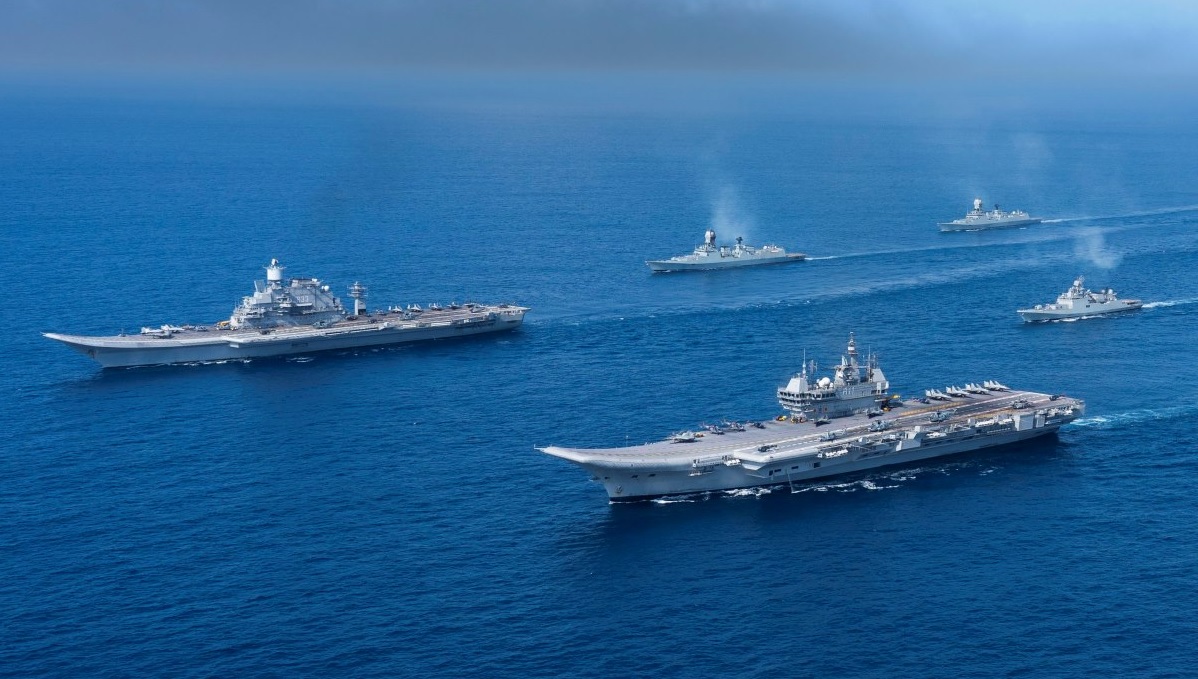
The Indian Navy is preparing for a groundbreaking naval exercise in the Arabian Sea, marking a significant leap in its maritime strength. For the first time, India will conduct dual-carrier operations involving the newly inducted INS Vikrant and the formidable INS Vikramaditya. This exercise not only demonstrates India's growing naval capabilities but also underscores its strategic positioning in the Indo-Pacific, a region that is becoming increasingly contested due to rising geopolitical tensions, particularly with China's expanding naval footprint.
The INS Vikrant: A Milestone in Indian Naval Engineering
The INS Vikrant, India's first indigenously designed and built aircraft carrier, represents a monumental achievement in the nation's defense sector. Weighing 44,000 tonnes and equipped to carry 28-30 aircraft, it marks India's entry into an elite group of nations capable of dual-carrier operations. The induction of INS Vikrant into the Western Fleet, based out of Karwar, significantly enhances the navy's offensive and defensive power, boosting its “Sword Arm” capability, which refers to the fleet's strike and combat power.
INS Vikrant is equipped with a complex and versatile aviation capability, hosting a mix of fighter jets like the MiG-29K and helicopters for reconnaissance, anti-submarine warfare, and logistics. The carrier also boasts advanced air traffic control systems, radar, and sensor technologies that enable it to function as a floating airbase, projecting power far beyond Indian shores.
Dual-Carrier Drills: A Strategic Power Play
The upcoming exercise will focus on two major elements: INS Vikrant and INS Vikramaditya, the latter being a 45,000-tonne, Kiev-class carrier that has long been the flagship of the Indian Navy. Together, these two carriers will form the core of the Carrier Strike Groups (CSGs), each designed to operate autonomously with a wide array of support vessels. A typical CSG includes not just the carrier but also frigates, destroyers, submarines, and replenishment ships, all working in tandem to defend the carrier while enhancing its strike capability.
The exercise will simulate a highly complex and challenging tactical environment, pitting the two carriers against opposing forces. These drills are designed to test the capabilities of both carriers under real-world combat conditions, including live-fire exercises, air-to-air combat scenarios, and anti-submarine operations. This ensures that both the carriers and their accompanying strike groups are battle-ready, with full integration of their air wings, weapons systems, and support fleets.
Testing INS Vikrant's Operational Readiness
One of the primary goals of this exercise is to rigorously test all of INS Vikrant's operational systems. Everything from the aircraft lift systems, which move fighter jets from the hangar to the flight deck, to air traffic control operations will be scrutinized. The carrier’s ability to quickly launch its aircraft, measured by the "sortie generation rate," will also be a key performance indicator.
Moreover, these drills will test the aircrew’s ability to react to emergency situations. Whether it’s scrambling jets to respond to an aerial threat or conducting night-time operations in adverse weather, the aircrew's proficiency will be closely monitored. Such exercises are critical to ensuring that the carrier can function effectively even in the most demanding conditions, where the ability to launch and recover aircraft is akin to “threading a moving needle” due to the dynamic nature of the sea.
Geopolitical Implications: A Deterrent in the Indo-Pacific
The timing of these two-carrier drills is especially crucial, given the growing complexities in the Indo-Pacific region. China's expanding influence, particularly its naval presence in the Indian Ocean, has raised concerns among regional players. India’s ability to deploy two fully operational carrier strike groups is a clear message of deterrence, underscoring its role as a key player in maintaining stability in the region.
With this exercise, India joins an exclusive club of nations capable of executing dual-carrier operations, a feat achieved by only a handful of navies globally, including the U.S., the U.K., and China. This operational capability is vital in ensuring that India can project power across the vast waters of the Indian Ocean and protect its maritime interests, from securing sea lanes to deterring potential threats in its strategic backyard.
The Road Ahead
The successful completion of these drills will pave the way for INS Vikrant’s full integration into the Indian Navy’s operational fleet, further solidifying India's maritime prowess. The drills will be closely monitored by a team of inspectors from fleet headquarters, who will assess the carrier's readiness and ability to perform in real combat scenarios. Once fully inducted, INS Vikrant will significantly bolster India's naval power projection capabilities, not just in the Arabian Sea but across the wider Indo-Pacific region.
This two-carrier exercise is not just a display of military strength but also a statement of India's intent to secure its maritime interests in an increasingly volatile region. As the world watches, India’s naval modernization continues to gather momentum, positioning it as a dominant force in the maritime domain.
——— End of Article ———