New Delhi, — April 27, 2026 : An Indian hacktivist group operating under the name HackShyen has announced the deployment of a newly developed Critical National Infrastructure (CNI) exploitation framework, stating that the system is now fully operational and actively targeting infrastructure in Pakistan.
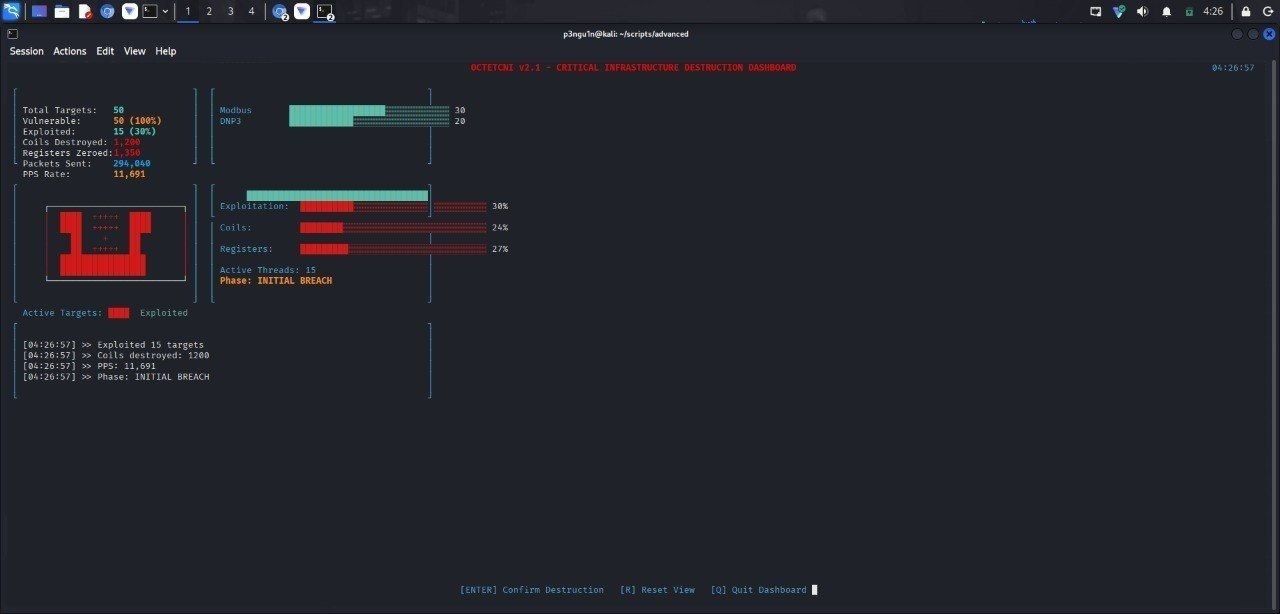
According to information released by the group, the framework is being used in an ongoing campaign identified as BlackOutOp2026 and Revolutionize Indian Hacktivism. HackShyen describes the initiative as the largest cyber operation conducted by the group to date, with more than 400 industrial control systems (ICS) reportedly targeted across multiple sectors.
Framework Deployment and Structure
HackShyen stated that the exploitation framework has been made freely available to the broader Indian hacktivist community to support coordinated cyber operations. The system is designed to function autonomously, combining reconnaissance, exploitation, and disruption capabilities into a single integrated platform.
The framework reportedly begins with an automated discovery phase that uses the Shodan Enterprise API to identify internet-exposed and potentially vulnerable ICS devices. These include systems operating on widely used industrial communication protocols such as Modbus and DNP3, as well as infrastructure associated with Siemens industrial technologies.
Once targets are identified, the framework transitions directly into exploitation without requiring manual intervention. It operates on pre-configured instructions that determine which modules to activate, enabling continuous execution across multiple targets simultaneously.
Exploitation Methods and Capabilities
A central component of the framework involves protocol-specific exploitation techniques. HackShyen has highlighted the use of Modbus coil rewrite methods, which allow unauthorized modification of discrete outputs within industrial systems. In operational terms, these outputs function as switches controlling physical equipment.
Through this approach, the framework enables remote manipulation of connected machinery by issuing direct ON/OFF commands. The system is designed to execute these actions without authentication where vulnerabilities exist, leveraging known weaknesses in legacy ICS protocols that lack built-in security controls.
The framework also includes destruction-oriented modules intended to disrupt system functionality. These modules are activated automatically once access is established, according to the group’s description of its operational workflow.
Reported Impact on Infrastructure
HackShyen claims that the framework has already achieved scanning and access across hundreds of ICS devices within Pakistan’s critical infrastructure environment. The group reports that exploitation modules have been deployed on multiple systems, resulting in operational disruptions.
The types of infrastructure identified as potential targets include electricity distribution systems, water supply networks, industrial manufacturing facilities, and other sectors dependent on automated control systems such as oil and gas and transportation.
According to the group, the ability to manipulate ICS components can lead to direct physical consequences. These include power outages, disruption of water distribution, and shutdown or damage to industrial machinery through abrupt command execution.
Previous Activity and Context
HackShyen has previously claimed involvement in cyber operations targeting Pakistani entities. In January 2026, the group reported a data breach affecting the Water and Power Department in Gilgit-Baltistan, which it said impacted hydel power stations. Additional activity was reported in April 2026 involving operations against commercial sector domains.
Pakistan has recorded 98 cyber incidents during the first quarter of 2026, affecting a range of sectors including federal and provincial institutions, businesses, and educational organizations. However, there has been no independent confirmation from Pakistani authorities directly linking these incidents to the current campaign.
Verification and Ongoing Developments
As of now, there is no independent verification of the scale of disruption claimed by HackShyen or official confirmation of widespread infrastructure impact. The group’s statements remain the primary source of information regarding the operation.
The release and active deployment of an automated ICS exploitation framework represent a notable development in hacktivist activity, particularly in its focus on critical infrastructure systems and its use of scalable, protocol-based attack methods.
Further details regarding the extent of the operation and its real-world impact are expected as additional information becomes available from official or independent sources.
——— End of Article ———