NEWPORT NEWS, Virginia — April 27, 2026 : Huntington Ingalls Industries (HII) has been awarded a contract by the Defense Innovation Unit (DIU) to develop a Torpedo Tube Launch and Recovery (TTLR) system designed to autonomously deploy and retrieve the company’s REMUS unmanned underwater vehicles (UUVs) from U.S. Navy submarines.
The award represents a procedural step in the U.S. Navy’s broader effort to integrate autonomous maritime systems into routine submarine operations, with the objective of extending operational reach and improving underwater surveillance capabilities.
Integration of Autonomous Systems into Submarine Operations
The TTLR system is engineered to function through standard submarine torpedo tubes, enabling submarines to deploy and recover UUVs without requiring diver intervention. The capability is intended to expand mission flexibility, enhance stealth characteristics, and reduce operational risk and crew workload.
HII’s selection reflects its dual role as one of two primary builders of U.S. nuclear-powered submarines and a major producer of unmanned underwater systems. The company stated that the system will support manned–unmanned teaming concepts, allowing submarines to conduct extended intelligence, surveillance, and reconnaissance (ISR) missions using autonomous platforms.
Duane Fotheringham, president of the Unmanned Systems group within HII’s Mission Technologies division, said the contract builds on the company’s 25-year experience in autonomous maritime platforms and their integration into submarine operations. He noted that HII continues to work with the U.S. Navy on deploying operational capabilities in the subsea domain.
REMUS UUV Operational Background
HII’s REMUS family of UUVs has been deployed globally for defense, scientific, and commercial applications. According to company data, more than 750 REMUS vehicles have been delivered to over 30 countries, including 14 members of NATO. Over 90% of these systems remain in active service after more than two decades, indicating long-term operational durability.
The REMUS platform originated from research sponsored by the Office of Naval Research and has since evolved into a widely used unmanned maritime system. The product line recently marked its 25th anniversary.
Recent Testing and Demonstrations
The DIU contract follows a series of tests conducted in 2025 involving the REMUS platform and submarine integration.
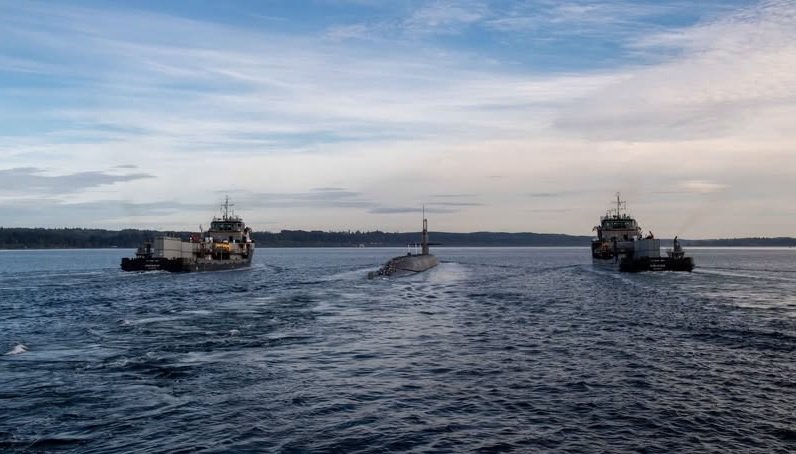
In June 2025, the United States Navy, in partnership with the Woods Hole Oceanographic Institution (WHOI), advanced the “Yellow Moray” UUV capability program. The effort included the first forward-deployed torpedo tube launch and recovery of a REMUS 600 vehicle from the USS Delaware (SSN-791), a Virginia-class fast attack submarine constructed by HII.
During the deployment, personnel from Unmanned Undersea Vehicle Squadron One (UUVRON-1), supported by WHOI, conducted three fully autonomous launch and recovery sorties through the submarine’s torpedo tubes without diver assistance. The operations demonstrated the feasibility of autonomous manned–unmanned teaming for ISR missions and other maritime tasks.
In July 2025, further testing was carried out by a joint team from HII, WHOI, and the Navy’s Naval Undersea Warfare Center Division Newport (NUWC). The trials took place at a torpedo tube and shutterway test facility located at Seneca Lake.
The test involved the latest generation REMUS 620 UUV. During in-water trials, the vehicle demonstrated advanced autonomous navigation and communication capabilities. It successfully docked with a shock and fire enclosure capsule (SAFECAP) inside a submerged test fixture and executed reverse swim-out launch and safe separation procedures. These tests validated key mechanical and software systems required for operational deployment.
Industrial and Strategic Context
HII, headquartered in Virginia, is the largest shipbuilder in the United States and employs approximately 44,000 personnel. The company has more than 140 years of experience supporting U.S. national security programs and delivers capabilities across shipbuilding, mission technologies, unmanned systems, C6ISR, artificial intelligence and machine learning, electronic warfare, and training systems.
The TTLR program aligns with HII’s broader strategy of combining nuclear-powered submarine design with autonomous systems development. The integration of UUVs into standard submarine interfaces is expected to expand mission endurance, improve stealth operations, and reduce demands on submarine crews.
The contract continues HII’s collaboration with the U.S. Navy, WHOI, and other partners to advance undersea autonomous capabilities. No contract value was disclosed in the announcement.
——— End of Article ———