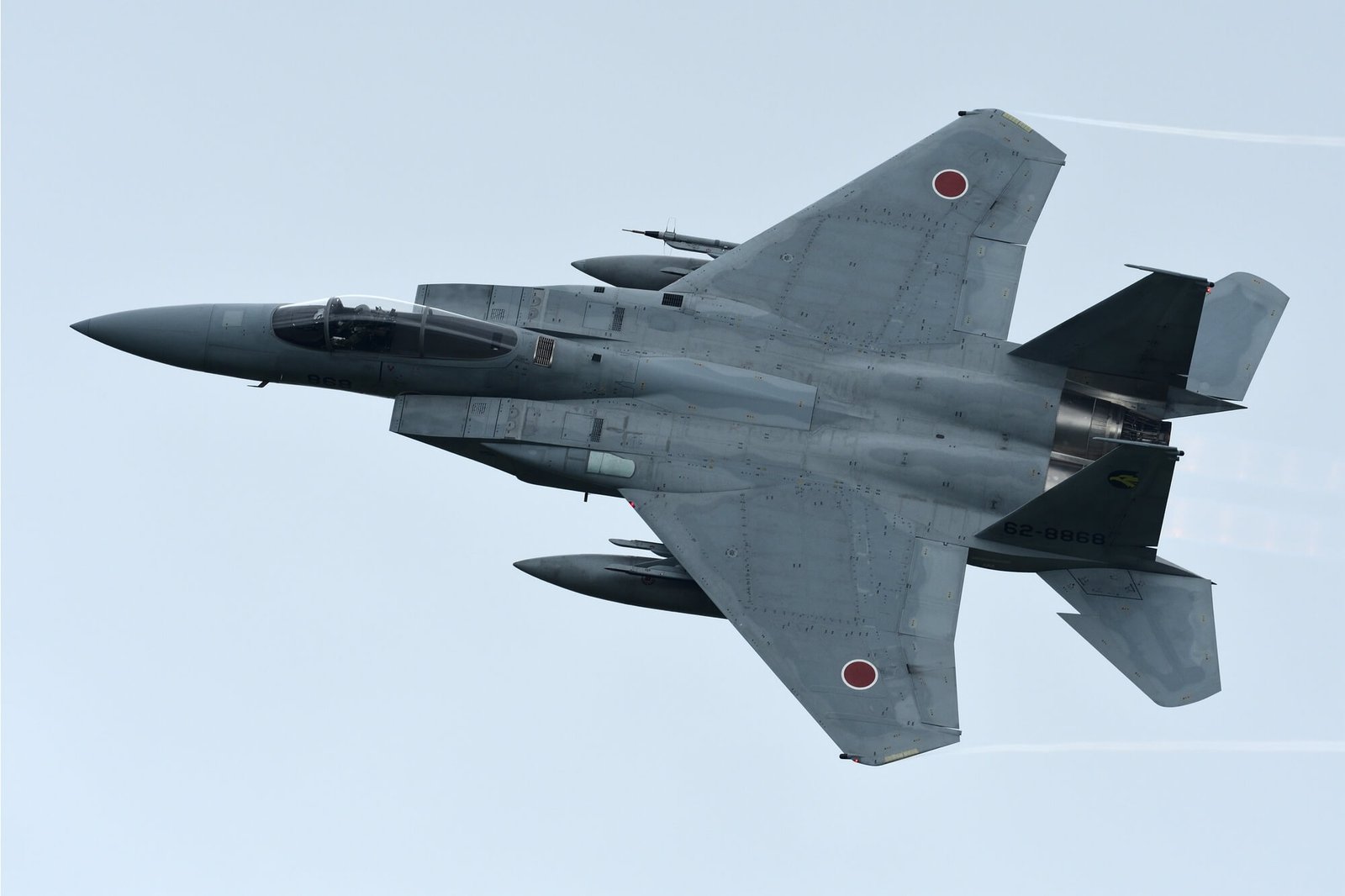
TOKYO — Japan’s Ministry of Defense signed four new contracts in May 2026 to support the ongoing modernization of Japan Air Self-Defense Force (JASDF) F-15J fighters to the F-15JSI, or Japan Super Interceptor, configuration.
The four agreements were concluded with the U.S. Air Force under the Foreign Military Sales (FMS) program. Their combined value is ¥42.65 billion (approximately $267.75 million). The contracts cover equipment for improving the fighters’ combat capabilities, communications systems maintenance equipment, flight operations support and logistics support for the serial modernization program.
Four Contracts Cover F-15J Modernization
According to Japan’s Ministry of Defense contract information, the largest agreement is valued at ¥34,598,728,358, or approximately $217.2 million. It covers equipment intended to enhance the combat capabilities of the F-15Js being modernized to the JSI configuration.
A second contract, worth ¥3,223,462,424 (about $20.2 million), covers communications systems maintenance equipment.
The third agreement provides equipment to support flight operations of the upgraded F-15Js, identified as MDS. It is valued at ¥36,742,200, or around $230,600.
The fourth contract covers logistics support for the serial modernization of the F-15J fleet. It is worth ¥4,794,000,798 (about $30.1 million).
Together, the four contracts total ¥42,652,933,780, equivalent to approximately $267.75 million.
F-15JSI Modernization Program
The F-15JSI program is a major modernization effort for selected JASDF F-15J fighters. The program is being carried out by Boeing and Mitsubishi Heavy Industries under the U.S. FMS framework, with the main contract framework finalized at the end of 2021.
The modernization is intended to bring selected F-15J aircraft to a capability level comparable to modern F-15 variants such as the F-15EX and F-15QA, while continuing to use the remaining service life of the existing airframes.
A major part of the upgrade is the replacement of the F-15J’s older AN/APG-63(V)1 mechanically scanned radar with the AN/APG-82(V)1 active electronically scanned array (AESA) radar.
The aircraft are also receiving upgraded electronic warfare, radar warning and communications equipment intended to bring their systems closer to the Advanced Eagle standard. The electronic warfare upgrade includes the Eagle Passive Active Warning Survivability System (EPAWSS).
Mitsubishi Heavy Industries is separately studying the possibility of integrating a Japanese-developed AESA radar into the modernized aircraft. Further details of that work have not been released.
Increased Weapon-Carrying Capability
The F-15JSI modernization will also increase the aircraft’s ability to carry air-to-air weapons.
An unmodernized F-15J can carry up to eight air-to-air missiles, while the JSI configuration is expected to carry more than twice that number. The final weapon configuration has not been fully detailed.
Mitsubishi is testing the AAM-4 (Type 99) missile for compatibility with the upgraded aircraft, while the modernization includes integration for the AAM-4B and AAM-5B.
Japan is also considering the integration of air-launched cruise missiles, including the AGM-158 JASSM.
Modernization Numbers Reduced
Japan initially planned to modernize approximately 98 F-15J aircraft to the F-15JSI standard. Funding was later secured for modernization of 68 aircraft.
The number has since been reduced. Japan’s defense planning documents identify 54 F-15 aircraft for the modernization program. Japan’s Ministry of Defense has also continued to plan the replacement of F-15 aircraft that are not suitable for modernization with F-35A and F-35B fighters.
The JASDF operates approximately 200 F-15J/DJ fighters in total.
The reduction in the number of aircraft selected for the JSI program means that the modernization effort will apply to only part of Japan’s F-15J/DJ fleet.
Surplus F-100 Engines
The modernization and wider changes to the F-15J fleet are also creating surplus equipment.
IHI Corporation has been examining options for disposing of approximately 200 Pratt & Whitney F100 engines removed from F-15J aircraft as older airframes leave service.
The F-15 modernization program itself has also received multiple modifications under the broader U.S. contract FA8634-22-C-2705, covering areas including radars, self-protection systems, mission computers and other equipment.
Japan’s wider fighter modernization effort is taking place alongside the introduction of the F-35 and development of the Global Combat Air Programme (GCAP) with the United Kingdom and Italy. Japan, the UK and Italy continue to advance GCAP through their joint government organization and industry partnership.
The four May 2026 FMS contracts therefore represent another stage in Japan’s ongoing effort to modernize the selected F-15J aircraft that will remain in JASDF service.
——— End of Article ———