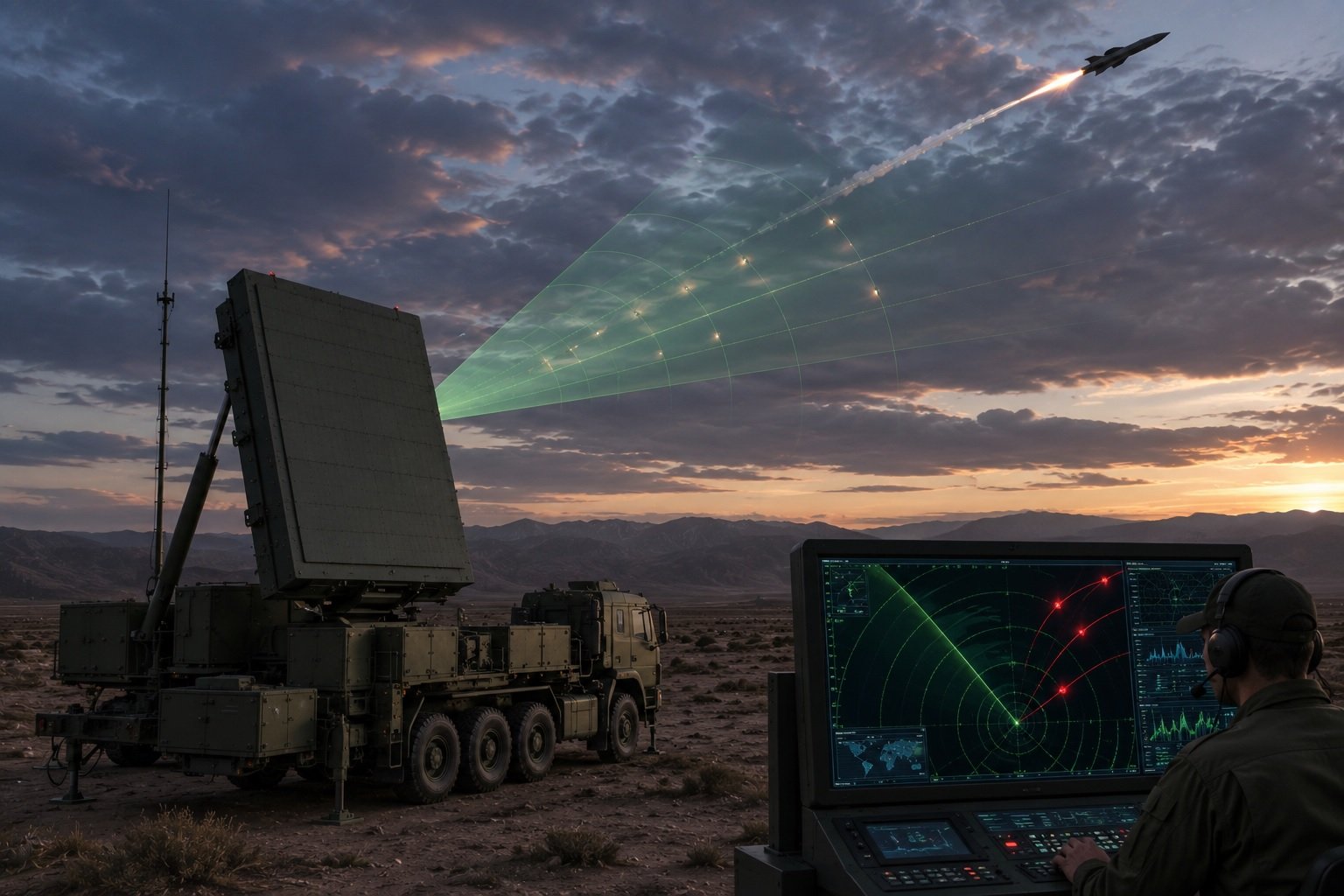
REDSTONE ARSENAL, Alabama — The U.S. Missile Defense Agency (MDA) is seeking industry prototypes for a new highly mobile radar system designed to detect, track and discriminate ballistic, cruise and hypersonic missiles and other advanced airborne threats.
The Forward-Based Mode (FBM) Radar Next program is being led by the MDA’s Mobile Land-Based Sensors Project Office. The agency issued a presolicitation notice on August 10, 2026, through SAM.gov under its Nimble Options for Buying Layered Effects (NOBLE) Multiple Authority Announcement.
Rapid Prototyping and Production
The MDA plans to use Other Transaction Authority (OTA) to speed up the prototyping process. The prototype must demonstrate a clear path to rapid, high-volume production at an affordable unit cost, allowing systems to be produced and replaced cost-effectively in forward locations.
Only companies that successfully complete the prototype project will be eligible for a potential sole-source follow-on production award.
The MDA will first screen out speculative or immature technologies. Vendors must demonstrate hardware maturity and provide empirical measurement data before entering the prototyping pipeline. The planned stages include concept development; technology and manufacturing readiness and extensibility; subscale prototyping with modeling and simulation; and full-scale prototype development and demonstration.
Proposals will be evaluated on technical merit, operational feasibility, schedule viability, producibility, affordability and cost realism.
Mobile and Survivable Design
The FBM Radar Next is intended to address limitations of current static or semi-mobile radars, which the MDA says can be vulnerable to counterattacks and lack the rapid relocation capability needed for distributed operations.
The system must be transportable by C-17 aircraft and tactical ground vehicles, while supporting rapid setup and teardown. It must provide high-sensitivity detection, persistent tracking and precise discrimination in high-clutter and contested electromagnetic environments.
The radar must also support remote operation and automated health monitoring, reducing the need for personnel at the radar site.
It must remain interoperable with existing Command and Control, Battle Management and Communications (C2BMC) networks and use a flexible aperture configuration and modular open-systems architecture. Its physical, thermal and electromagnetic signatures must also be designed to improve survivability.
Driven by Changing Missile Threats
The MDA said the requirement for agile and survivable forward-based sensors has increased as adversaries develop more sophisticated missile capabilities. The notice comes amid reports of Iranian targeting of U.S. air-and-missile defense radars in the Middle East, Russian use of hypersonic and ballistic missiles in Ukraine, and China's continued expansion of missile arsenals in the Pacific.
FBM Radar Next is positioned as a more mobile successor concept to systems such as the AN/TPY-2, which has been used in forward-based roles but is not optimized for rapid relocation.
The MDA’s Fiscal Year 2027 budget request includes funding for two next-generation radar prototypes to mature technologies for a future fleet.
The formal solicitation has not yet been released, and the government is not currently accepting inquiries or feedback on the presolicitation. The listed place of performance is Redstone Arsenal, Alabama. The notice carries public-release marking 26-MDA-12385, dated August 10, 2026.
Offerors must hold or obtain a facility security clearance through the Defense Counterintelligence and Security Agency (DCSA) before beginning the first cycle. The MDA also encourages teaming arrangements involving non-traditional defense contractors and small businesses, including shared resource alignment or co-investment.
——— End of Article ———