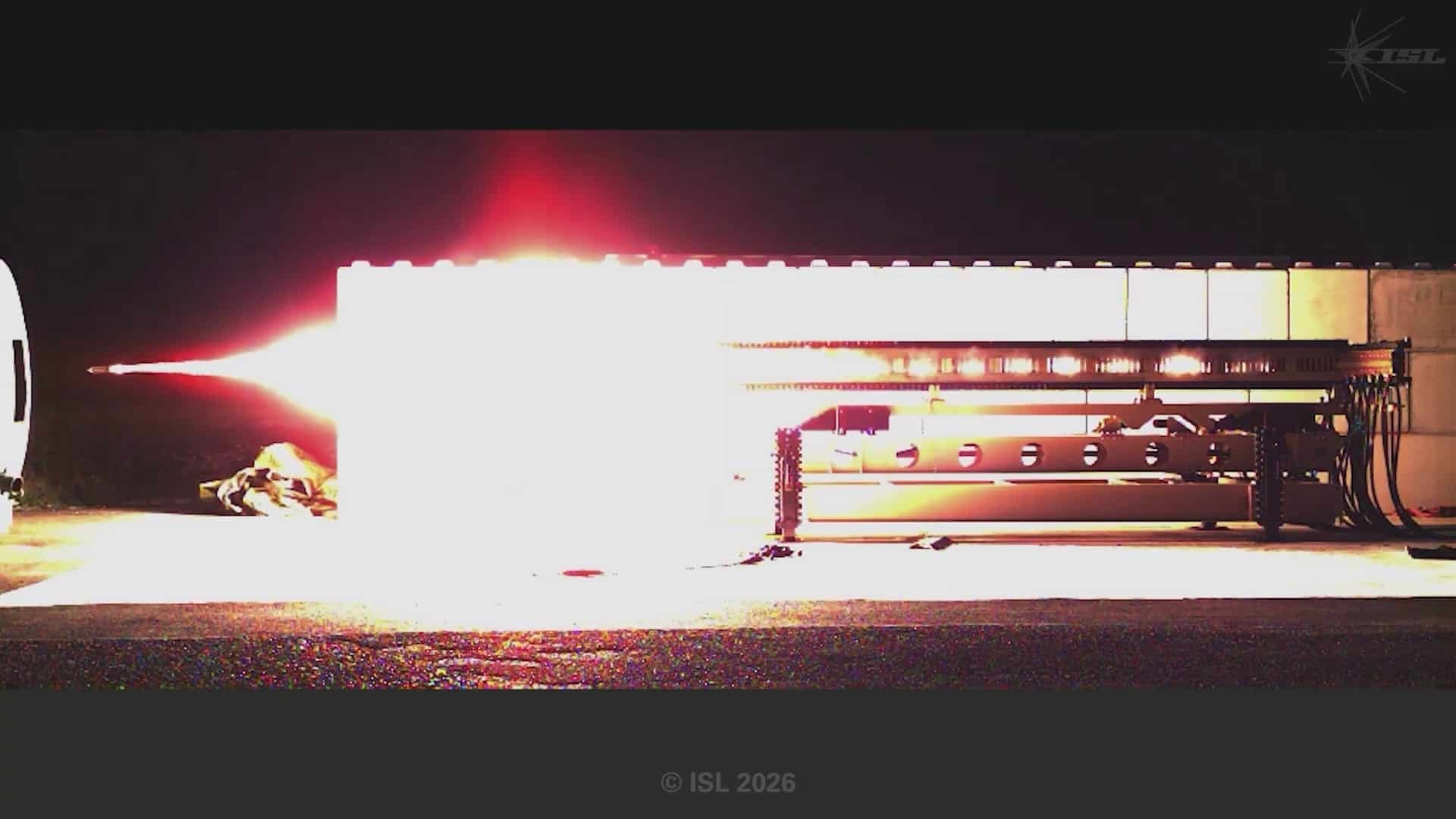
Saint-Louis, France — The French-German Research Institute of Saint-Louis (ISL) has successfully conducted the first outdoor firing test of its domestically developed electromagnetic railgun. The test took place on June 29, 2026, at the institute's proving ground in Baldersheim, France, marking an important step in moving the technology from laboratory research to open-range testing.
The firing was carried out under ISL's Railgun Free Flight Facility programme, which was launched two years ago to advance electromagnetic launcher research beyond controlled laboratory conditions. The programme brings together specialists from different scientific fields within the institute to support the development and testing of the technology.
A railgun uses electrical energy, rather than chemical propellants, to accelerate a projectile along two parallel rails. Conducting tests in an open-range environment allows researchers to study projectile performance and flight behaviour under conditions that are closer to real-world use than laboratory experiments.
According to ISL, the new facility enables gradual increases in launch energy across multiple firing tests, studies of projectile behaviour over longer distances, research on launcher integration, and the development of munitions specifically designed for electromagnetic launch. These capabilities represent the next stage in the institute's long-running electromagnetic acceleration research.
The railgun is designed to propel projectiles using electricity, eliminating the need for propellant powder. According to ISL, the system is designed to achieve a muzzle velocity of more than 2,000 metres per second (m/s) while offering the potential for lower mission costs compared with conventional gun systems.
ISL also highlighted several potential operational advantages of the technology, including an extended firing range of more than 200 kilometres, reduced flight time that could improve air defence response, enhanced lethality due to the projectile's high impact speed, and increased ammunition storage capacity because the system does not require propellant charges.
ISL has been conducting research on electromagnetic launchers for decades, with previous work focused on laboratory-scale testing. The new outdoor facility expands those capabilities and strengthens European research in advanced electromagnetic launcher technology.
The technology has attracted long-term interest for possible future defence applications, including countering hypersonic threats. However, ISL said significant additional research, higher-energy testing, system integration, and qualification will be required before the technology could be considered for operational use.
ISL is a joint French-German defence research institute funded by the French Agency for Defence Innovation (AID) and the German Ministry of Defence. The institute plans to continue testing by increasing energy levels, extending firing distances, and carrying out further integration studies as part of its long-term research programme.
Source: navalnews / defense.gouv.fr
——— End of Article ———