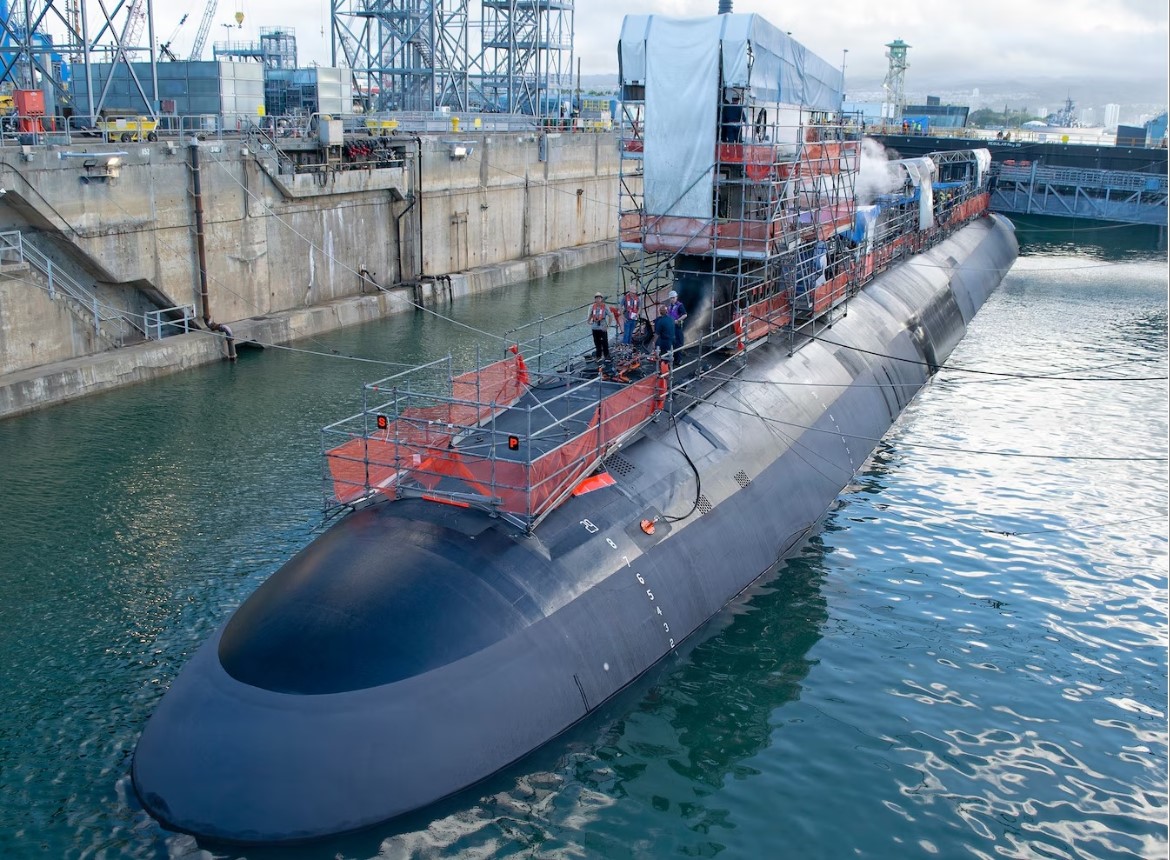
PEARL HARBOR, Hawaii — The U.S. Navy's Virginia-class fast-attack submarine USS Illinois (SSN-786) has completed an extended scheduled maintenance period at the Pearl Harbor Naval Shipyard and Intermediate Maintenance Facility, undocking from Dry Dock 2 on June 24, 2026, and moving into the next phase of testing before returning to operational service.
Photographs released by the U.S. Navy show the submarine leaving the dry dock after the overhaul. According to open-source analysis, USS Illinois has become the second confirmed Virginia-class submarine equipped with the Large Vertical Array (LVA), an advanced hull-mounted sonar system developed under the Navy's long-running Acoustic Superiority program.
Although the U.S. Navy has not officially confirmed the installation of the LVA on USS Illinois, open-source analysts have linked the submarine's maintenance timeline with the documented rollout of the sonar upgrade.
Large Vertical Array Improves Underwater Detection
The Large Vertical Array (LVA) is a hull-mounted acoustic sensor designed to improve a submarine's ability to detect and track other vessels at greater distances. It complements the six Lightweight Wide Aperture Arrays already installed along the sides of every Virginia-class submarine.
By combining data from multiple sonar arrays, the system helps the crew develop a clearer picture of surrounding underwater contacts. This improves situational awareness and supports operational decisions such as maneuvering, avoiding threats, or tracking other submarines and surface ships.
The LVA has been under development for nearly two decades as part of the U.S. Navy's effort to maintain an advantage in undersea warfare against increasingly quieter submarines operated by potential adversaries, including Russia and China.
Developed Through Navy and Industry Cooperation
The sonar system was developed through joint work between the U.S. Navy and General Dynamics Electric Boat, with production beginning in 2017 at RTX's Jacksonville, Florida, facility. RTX was previously known as United Technologies Aerospace Systems before becoming part of the company's current structure.
The LVA forms one element of the Navy's broader Acoustic Superiority program, which combines improved sonar technology with submarine quieting measures to enhance both detection capability and survivability.
First Demonstrated on USS South Dakota
The first submarine publicly associated with the LVA was USS South Dakota (SSN-790) under the Navy's South Dakota Insertion Program.
During its post-shakedown availability beginning in 2018, USS South Dakota received the new sonar array along with upgraded hull coatings and machinery quieting improvements. The submarine completed at-sea testing of these systems in 2019.
According to publicly available Navy briefing materials, the program represented the most significant upgrade to Virginia-class sonar arrays and hull treatments since the class entered service.
Expansion Across the Fleet
Open-source reporting indicates the U.S. Navy plans to install the Large Vertical Array (LVA) as standard equipment on Block V Virginia-class submarines currently under construction.
Earlier Block III and Block IV submarines, including USS Illinois, can receive the system during extended maintenance periods through retrofit programs.
Naval analyst H.I. Sutton has also reported that at least one Ohio-class ballistic missile submarine, USS Tennessee (SSBN-734), has received the LVA, suggesting the technology is gradually being introduced across different submarine classes. However, the U.S. Navy has not publicly confirmed the full scope of deployment.
About USS Illinois
USS Illinois was commissioned on October 29, 2016, becoming the 13th Virginia-class submarine and the third U.S. Navy vessel to bear the name of the state of Illinois.
As a Block III submarine, it features a redesigned bow equipped with two large-diameter Virginia Payload Tubes, replacing the earlier arrangement of individual vertical launch tubes. The design retained the submarine's Tomahawk land-attack missile capacity while reducing construction costs by an estimated $400 million per submarine.
USS Illinois is designed to perform a wide range of missions, including anti-submarine warfare, anti-surface warfare, land-attack strike operations, intelligence, surveillance and reconnaissance (ISR), and support for special operations forces. Improved sonar capability directly supports these missions by enhancing underwater detection and contact tracking.
Pearl Harbor's Strategic Role
The maintenance work was carried out at the Pearl Harbor Naval Shipyard and Intermediate Maintenance Facility, one of the U.S. Navy's primary repair centers in the Indo-Pacific region.
Located roughly midway between the U.S. West Coast and the Western Pacific, the shipyard enables forward-deployed submarines and surface ships to undergo major repairs and modernization without returning to the continental United States. This reduces transit time and helps maintain operational availability in the Pacific.
According to the U.S. Navy, the undocking operation required approximately 10 to 12 hours and involved coordinated efforts by shipyard personnel, engineers, tugboat crews, and the submarine's crew. Following the undocking, USS Illinois will complete final testing and certification before returning to the Pacific Fleet.
Capt. Ryan McCrillis, commander of the Pearl Harbor Naval Shipyard and Intermediate Maintenance Facility, described the completion of the maintenance period as an important step in supporting fleet readiness.
While the U.S. Navy continues to keep detailed information about submarine sensor systems classified, open-source analysis strongly indicates that USS Illinois has joined a small group of U.S. submarines equipped with the Large Vertical Array (LVA), further expanding the Navy's Acoustic Superiority modernization program.
Source: defence-blog / navsea.navy.mil / navalnews
——— End of Article ———