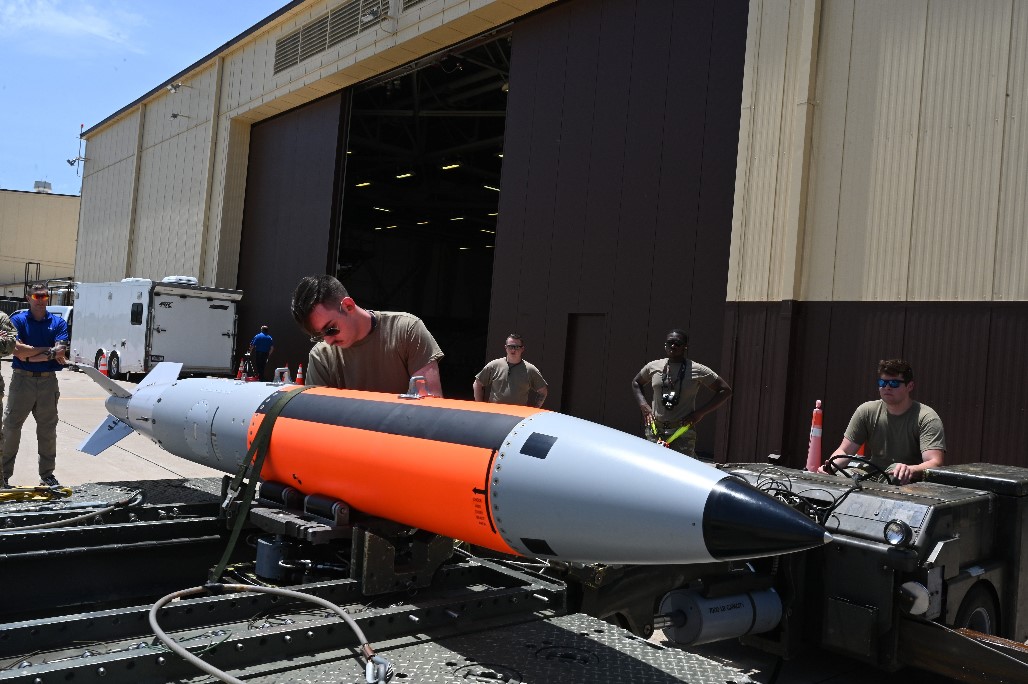
WASHINGTON — The U.S. Department of Energy's National Nuclear Security Administration (NNSA) has completed a key manufacturing milestone for the B61-13 nuclear gravity bomb, finishing production of all planned canned subassemblies (CSAs) for the current fiscal year three months ahead of schedule at the Y-12 National Security Complex in Oak Ridge, Tennessee.
The completed components have undergone the NNSA's "diamond stamping" certification process, which confirms they meet all technical, safety, and quality requirements for "war reserve" status. This certification allows the components to be integrated into the U.S. nuclear stockpile for operational use.
The B61-13 is the latest version of the B61 nuclear gravity bomb, the longest-serving and one of the most versatile nuclear weapons in the U.S. arsenal. It is being developed as part of a joint effort between the NNSA and the U.S. Department of Defense to provide an updated capability against hardened and deeply buried military targets.
The weapon is planned for delivery by U.S. strategic bomber aircraft, including the B-2 Spirit and the future B-21 Raider.
Early Production Milestone
The latest achievement follows another major milestone reached in May 2025, when the NNSA completed the first production unit of the B61-13 nearly a year earlier than originally planned. The program reached that point less than two years after it was publicly announced in late 2023, making it one of the fastest-developed U.S. nuclear weapon programs since the end of the Cold War.
NNSA Administrator Brandon Williams said the program reflects the agency's ability to deliver modernization efforts on an accelerated timeline.
"The progress on the B61-13 program demonstrates the Nuclear Security Enterprise's ability to respond to evolving geopolitical requirements with speed and precision," Williams said.
He added that completing the 2026 baseline deliverables ahead of schedule demonstrates operational discipline and supports the modernization of the United States' nuclear deterrent.
What Diamond Stamping Means
In a modern two-stage thermonuclear weapon, the nuclear explosive package consists of a primary stage and a secondary stage. The canned subassembly contains the secondary stage capsule and related components sealed inside a thin stainless steel or aluminum alloy container.
The "diamond stamping" process certifies that each component has successfully passed the NNSA's inspection and certification standards. Components receiving this designation are approved as "war reserve" quality and are authorized for deployment within the U.S. nuclear stockpile.
B61-13 Builds on the B61-12
The B61-13 incorporates the same modern safety, security, and precision guidance features introduced under the B61-12 Life Extension Program, which the NNSA completed in January 2025.
Unlike the B61-12, however, the B61-13 has a higher nuclear yield designed for use against certain hardened, deeply buried, and larger-area military targets. According to the NNSA, the weapon is intended to provide the U.S. President with additional nuclear response options while using existing production capabilities developed for the B61-12 program.
Officials have also stated that production of the B61-13 will involve a limited number of weapons, with adjustments to B61-12 production to maintain the overall size of the U.S. nuclear stockpile rather than increase it.
Part of Broader Nuclear Modernization
The B61-13 is one of six active warhead modernization programs currently managed by the NNSA to maintain the long-term safety, security, reliability, and effectiveness of the U.S. nuclear deterrent.
According to the agency, all six modernization programs are currently meeting or exceeding their planned schedules, continuing the NNSA's record of delivering warhead modernization projects on time or ahead of schedule throughout this decade.
The latest milestone at the Y-12 National Security Complex represents another step in the ongoing modernization of the U.S. nuclear stockpile through coordinated work across the Nuclear Security Enterprise, including facilities such as Y-12, Pantex Plant, Los Alamos National Laboratory, Sandia National Laboratories, and the Kansas City National Security Campus.
Source: energy.gov
——— End of Article ———