Paris, — June 21, 2026 : France’s Directorate-General for Armaments (DGA) has signed a contract with Swedish defense company Saab for the procurement of Next Generation Light Anti-tank Weapon (NLAW) systems for the French Armed Forces. The agreement includes the supply of NLAW launchers as well as indoor and outdoor training simulators, with deliveries scheduled between 2026 and 2030.
The acquisition is intended to strengthen the French Army’s infantry anti-armor capabilities by introducing an intermediate-class mobile weapon system. The NLAW will fill the capability gap between the Army’s existing AT4 disposable grenade launchers and the longer-range Akeron MP anti-tank missile systems.
While Saab retains intellectual property rights and overall design authority for the NLAW, production for the French contract will be carried out by Thales UK, which currently serves as the sole manufacturer of the system. Approximately 60 percent of NLAW production is localized within the United Kingdom.
The financial value of the contract and the number of systems ordered have not been publicly disclosed. However, defense industry analysts estimate that the initial procurement could exceed 2,000 units based on France’s historical anti-tank weapon inventory requirements. The agreement also includes provisions for potential follow-on orders.
NLAW Operational Capabilities
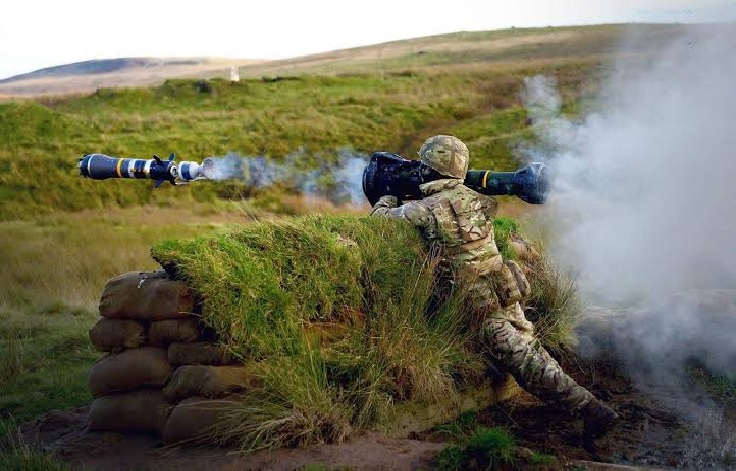
The Next Generation Light Anti-tank Weapon (NLAW) is a lightweight, disposable anti-tank missile system designed to provide infantry units with a guided solution against armored vehicles at short ranges. The weapon operates on a “shoot-and-forget” principle, allowing operators to relocate immediately after launch without maintaining guidance on the target.
Before firing, the operator tracks a target for approximately three seconds. During this period, the missile’s onboard computer calculates the target’s movement and predicts its future position using the Predicted Line of Sight (PLOS) guidance method. Once launched, the missile follows its calculated flight path autonomously through inertial navigation.
The system offers two engagement modes:
Overfly Top Attack (OTA): In this mode, the missile flies approximately one meter above the target. Magnetic and optical sensors detect the armored vehicle and trigger the warhead, directing a shaped-charge jet downward into the vehicle’s more vulnerable top armor.
Direct Attack (DA): This mode is intended for engaging lightly armored vehicles, defensive positions, field fortifications, and personnel by striking the target directly.
NLAW has demonstrated effectiveness in urban warfare and ambush operations, where armored vehicle maneuverability is often limited and infantry units require rapid-response anti-armor capabilities.
NLAW Specifications
| Feature | Specification |
|---|---|
| System Weight | 12.5 kg |
| System Length | 1.02 meters |
| Engagement Range | 20–1,000 meters |
| Effective Range Against Moving Targets | Up to 600 meters |
| Warhead | 102 mm cumulative warhead |
| Guidance | Predicted Line of Sight (PLOS) with inertial navigation |
| Flight Speed | Approximately 200 m/s |
| Launch Preparation Time | Less than 5 seconds |
The weapon is designed for single-soldier operation, enabling infantry units to deploy anti-tank firepower without requiring dedicated missile teams or vehicle-based launch platforms.
Expanding France-Sweden Defense Cooperation
The NLAW acquisition forms part of a broader defense relationship between France and Sweden. Both countries have recently expanded military cooperation through a series of reciprocal procurement agreements aimed at strengthening European defense industrial collaboration.
France has placed orders for Saab-produced airborne early warning aircraft, while Sweden has acquired France’s Akeron MP anti-tank missile system. Sweden has also selected Naval Group’s FDI-class frigate design for its future fleet of four Luleå-class warships under a separate program estimated at approximately €4.25 billion.
Defense analysts note that these reciprocal acquisitions reflect growing efforts among European nations to increase defense cooperation, improve industrial interoperability, and strengthen regional security capabilities.
International Interest in NLAW
Global interest in the NLAW system has increased significantly in recent years. The weapon gained international attention following its extensive operational use by Ukrainian forces since 2022, where it demonstrated effectiveness against armored vehicles in both urban and conventional combat environments.
Several countries have since evaluated the system for potential procurement. The Japan Self-Defense Forces are currently assessing NLAW as part of a broader study examining anti-tank weapons that have demonstrated effectiveness in modern combat operations. The evaluation could lead to future procurement decisions as Japan continues to modernize its ground force capabilities.
For France, the NLAW procurement provides an additional layer of anti-armor capability at the squad level, enhancing the Army’s ability to counter armored threats while complementing existing AT4 and Akeron MP systems. Deliveries are expected to begin in 2026, with training programs supported by the simulator package included in the contract.
——— End of Article ———