NEW DELHI — May 29, 2026 : The Union Finance Ministry has approved the ₹70,000-crore Project-75I (P-75I) submarine programme, moving one of India’s largest naval acquisition efforts to its final stage before contract signing. The proposal now awaits approval from the Cabinet Committee on Security (CCS), chaired by the Prime Minister, which will provide the final clearance required for implementation.
Project-75I involves the construction of six advanced conventional diesel-electric submarines for the Indian Navy under the Strategic Partnership Model. State-owned Mazagon Dock Shipbuilders Limited (MDL) will manufacture the submarines at its Mumbai facility in partnership with Germany’s thyssenkrupp Marine Systems (tkMS). The MDL-tkMS consortium was selected after successfully meeting technical requirements and prevailing over the competing bid submitted by Larsen & Toubro (L&T) and Spain’s Navantia.
Design, Technology Transfer and Capabilities
The six submarines will be based on a variant of Germany’s HDW Class 214 design, also referred to as the Type 214 Next Generation platform. As part of the agreement, tkMS will undertake a comprehensive transfer of submarine design and manufacturing technology to India, strengthening domestic industrial expertise and long-term maintenance capabilities.
A key operational requirement of Project-75I is the integration of a sea-proven Air-Independent Propulsion (AIP) system. The technology uses polymer electrolyte membrane hydrogen fuel cells to generate electricity, enabling submarines to remain submerged for extended periods—often up to two weeks—without surfacing or snorkeling for oxygen. This capability significantly lowers acoustic and thermal signatures, reducing the likelihood of detection by hostile sensors during underwater operations.
In addition to AIP capability, the submarines are expected to incorporate advanced underwater warfare systems, including modern sensors, heavyweight torpedoes, missile-launch capability, enhanced stealth features, and improved survivability. The vessels are projected to have a submerged displacement of approximately 3,400 to 3,500 tonnes, making them among the largest conventional submarines planned for service with the Indian Navy.
Delivery Timeline and Indigenisation
According to the planned delivery schedule, the first submarine will be delivered to the Indian Navy seven years after contract finalization. The remaining five vessels are scheduled to be delivered at a rate of one submarine per year. Production activities are expected to begin in the third year after the contract is signed, following detailed design work and infrastructure preparations.
The programme also includes phased indigenous manufacturing requirements aimed at supporting India’s long-term defence self-reliance goals. Under contractual provisions, the first submarine must incorporate at least 45 percent indigenous content. This figure will progressively rise across the programme, reaching 60 percent by the sixth and final submarine through greater domestic manufacturing and supply-chain participation.
Programme Background and Strategic Context
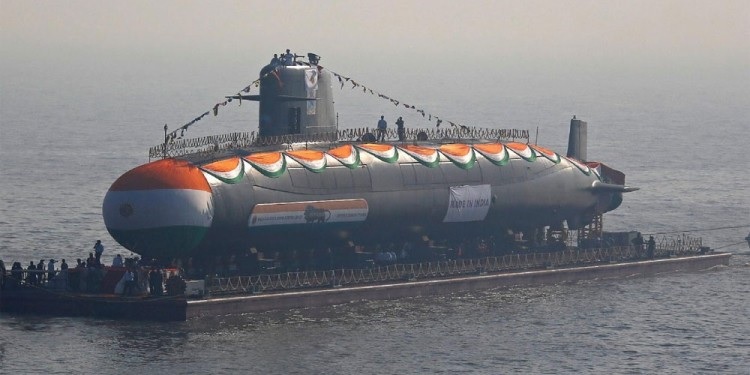
Project-75I succeeds the earlier Project-75 programme, under which MDL constructed six Kalvari-class (Scorpene) diesel-electric submarines with technology transfer from France’s Naval Group. The final vessel of the class, INS Vaghsheer, entered service in January 2025, marking the completion of the first phase of India’s modern conventional submarine-building effort.
The programme forms part of India’s 30-year submarine-building plan approved in 1999 to modernize the Navy’s underwater fleet and replace aging submarines amid expanding maritime security requirements in the Indian Ocean Region. Project-75I also aligns with broader India-Germany defence industrial cooperation, following the signing of a defence industrial roadmap in Berlin to support joint development, co-production, and technology partnerships in military systems.
Project-75I received approval from the Defence Acquisition Council in 2014, while a Request for Proposal (RFP) was issued in July 2021. Negotiations involving the Ministry of Defence, MDL, and tkMS—including cost discussions and programme structuring—have since been completed. With Finance Ministry approval now secured, CCS clearance remains the final administrative step before formal contract signing, release of initial funding, and commencement of detailed design and construction activities.
——— End of Article ———