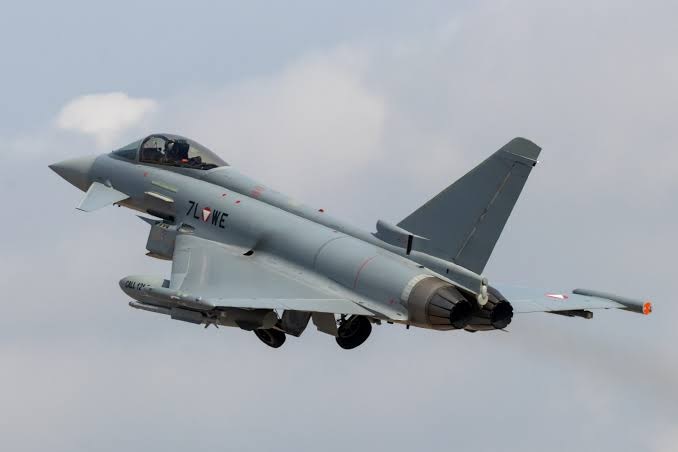
LONDON — The Eurofighter Typhoon program is facing a range of production, logistics and competitive challenges as partner nations work to sustain the aircraft while also investing in next-generation fighter programs.
Developed through a partnership between the United Kingdom, Germany, Italy and Spain, the Eurofighter was designed to share development costs, manufacturing work and industrial benefits among the four countries. While that approach helped secure long-term political and industrial support, it has also created a complex production and maintenance structure that is becoming more difficult to manage as demand increases.
The aircraft's manufacturing and supply chain are spread across the four partner nations. As a result, disruptions such as budget delays, export restrictions or industrial issues in one country can affect production and maintenance across the entire program. Industry observers note that these supply chain constraints have contributed to delays in spare parts availability, affecting fleet readiness for several operators.
The program also faces challenges because the Eurofighter fleet consists of multiple production standards. Tranche 1, Tranche 2 and Tranche 3 aircraft differ in avionics, sensor integration and weapons compatibility, creating a mixed fleet that requires different maintenance, software support and upgrade paths. This has increased sustainment costs and made long-term fleet management more complex.
Modernization efforts have also progressed at different speeds among partner nations. The United Kingdom's integration of the ECRS Mk2 radar and Germany's specialized Eurofighters equipped with the Saab Arexis electronic warfare system have experienced delays. Analysts attribute these delays primarily to differences in national funding decisions, procurement schedules and changing defense priorities rather than technical limitations.
Unlike some newer fighter programs that operate through a unified digital logistics network, Eurofighter support is managed through separate national systems. Defense analysts say this approach increases lifecycle costs and reduces efficiency because maintenance, software management and logistics are coordinated through multiple national frameworks instead of a single integrated system.
Despite these challenges, production is expanding to meet new requirements. Germany recently ordered 20 Tranche 5 Eurofighters to strengthen its combat fleet while maintaining domestic production lines. The program has also secured new export business after Türkiye signed an agreement in late 2025 to acquire 20 newly built Eurofighters along with second-hand aircraft.
However, experts note that each new operator introduces additional maintenance requirements, software configurations and logistics demands, placing further pressure on an already complex support network.
The Eurofighter has also faced increasing competition in the international fighter market from the U.S. F-35. In several recent procurement competitions, countries selected the fifth-generation aircraft over the Typhoon, citing its stealth capabilities and broader future growth potential despite comparable acquisition costs.
The shift in procurement priorities is also visible among Eurofighter partner nations. The United Kingdom has decided not to purchase additional Eurofighters and plans to retire older Typhoon aircraft earlier than originally scheduled while expanding its F-35A fleet.
Germany has also adjusted its acquisition strategy. Alongside new Eurofighter orders, Berlin has committed to purchasing 35 F-35 aircraft to support its NATO nuclear-sharing mission. Following the end of the Franco-German Future Combat Air System (FCAS) project in June 2026, reports indicate Germany is evaluating the possibility of expanding its F-35 fleet further while continuing to operate upgraded Eurofighters.
The aircraft's international profile was also affected by developments in the Middle East. In 2025, the Qatar Emiri Air Force confirmed plans to phase out its fleet of 24 Eurofighters, which had entered service beginning in 2022. Several of those aircraft are expected to be transferred to Türkiye.
Attention also focused on the 2024 "Zilzal-II" multinational air exercise held in Qatar, where reports indicated Eurofighters performed below expectations during simulated engagements against Pakistan Air Force-operated Chinese-built J-10CE fighters. Defense analysts note that military exercises are conducted under specific rules of engagement and do not necessarily represent actual combat performance, but the reported results prompted discussion about the Typhoon's competitiveness against modern fighter platforms.
Looking ahead, Eurofighter partner nations are increasingly focusing on sixth-generation aircraft development. The United Kingdom, Italy and Japan are jointly developing the Global Combat Air Programme (GCAP), while Germany is exploring the possibility of joining the initiative following the termination of the FCAS project.
Analysts say future multinational defense programs could benefit from lessons learned during the Eurofighter program, particularly in areas such as supply chain integration, common logistics systems, upgrade coordination and long-term sustainment planning.
The Eurofighter Typhoon remains a key combat aircraft for several European air forces, but the program's experience illustrates the operational and industrial challenges involved in managing a large multinational defense project while adapting to changing military requirements and growing competition from newer fighter platforms.
Source: militarywatchmagazine
——— End of Article ———