WASHINGTON — New satellite imagery indicates that construction activity has resumed at Iran's underground Pickaxe Mountain tunnel complex near the Natanz nuclear facility, while no major repair work has been observed at the country's main nuclear sites damaged during U.S. and Israeli strikes last year, according to a report by the Washington-based Institute for Science and International Security (ISIS).
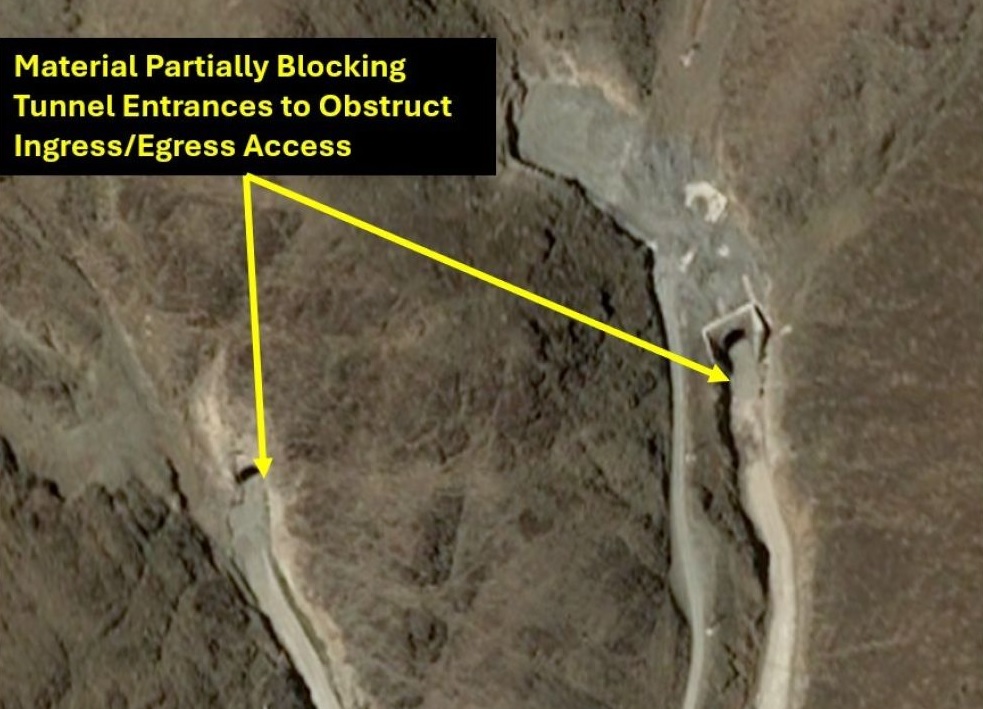
The latest imagery, provided by Vantor Tech in late June and analyzed by the institute, shows vehicles and construction crews working to reinforce tunnel entrances at the site, also known as Kuh-e Kolang Gaz La, located about one mile south of the main Natanz nuclear facility.
According to the institute, the ongoing work appears inconsistent with the terms of the June 17 U.S.-Iran memorandum of understanding (MOU), which requires Iran to maintain the status quo of its nuclear program and refrain from construction at nuclear-related sites while negotiations continue.
Recent satellite imagery from late June 2026, of the Natanz Nuclear Complex and the nearby Pickaxe Mountain facility, Fordow, and Esfahan, were provided to the Institute by @vantortech.
— Inst for Science (@TheGoodISIS) July 2, 2026
At Natanz, little activity can be seen. The access points to the below ground enrichment… pic.twitter.com/on6isIGhNA
No Major Repairs at Natanz, Fordo or Isfahan
Despite the renewed activity at Pickaxe Mountain, the report found no evidence that Iran has started major repairs at the country's three principal nuclear facilities—Natanz, Fordo and Isfahan—which sustained heavy damage during the June 2025 conflict involving the United States and Israel.
At Natanz, underground uranium enrichment halls remain inaccessible. Satellite images show damaged tunnel entrances, destroyed electrical infrastructure and cooling systems that have not yet been repaired.
The report also found no significant reconstruction work at the Fordo uranium enrichment plant or the Isfahan Nuclear Technology Center. Tunnel entrances at both sites remain sealed with earth, indicating that large-scale restoration has not yet begun.
Activity Continues at Pickaxe Mountain
The Pickaxe Mountain complex has been under construction since at least 2020 and is built deep inside a granite mountain near Natanz. The International Atomic Energy Agency (IAEA) has never been granted access to the site, and its exact purpose has not been officially confirmed.
ISIS analysts, including senior fellow Spencer Faragasso, assess that the underground complex is large enough to potentially house a new uranium enrichment facility, although no independent verification has confirmed that assessment.
Satellite imagery indicates that construction activity has continued since the April ceasefire that halted the U.S.-Israeli conflict with Iran. Recent images show workers reinforcing tunnel entrances, while some portals have been partially filled with dirt to restrict vehicle access. A smaller internal tunnel complex has also been completely sealed.
The institute said the contents of the sealed tunnels remain unknown, noting they could potentially contain equipment or material relocated from other nuclear facilities, although there is no public confirmation of what is stored inside.
Most of the Pickaxe Mountain complex does not appear to be operational, according to the analysis.
Defensive Measures at Fordo
The report also noted that Iran has introduced additional defensive measures at the Fordo facility.
Satellite images taken in May show earthen and rocky barriers constructed near blocked tunnel entrances. Defense analysts believe these obstacles are intended to make potential ground operations against the site more difficult.
According to the IAEA's previous assessments, most of Iran's approximately 440-kilogram stockpile of uranium enriched to 60% is believed to be stored at the Isfahan facility, with smaller quantities located at Natanz and Fordo.
Missile Infrastructure Also Being Restored
Alongside activity at nuclear-related sites, Iran has continued rebuilding parts of its underground missile infrastructure damaged during the 2025 conflict.
According to previous defense assessments cited in the report, Iran has restored access to 50 of 69 tunnel entrances across 18 underground missile facilities since the April ceasefire. Damaged access roads have also been repaired to restore logistical movement.
Peace Talks Continue
The latest satellite findings come as the United States and Iran continue negotiations under the June 2026 memorandum of understanding aimed at reducing regional tensions and maintaining the current status of Iran's nuclear program.
Israel is not a party to the agreement and has publicly criticized the diplomatic framework, arguing that it does not provide sufficient guarantees regarding the permanent dismantling of Iran's nuclear program.
The Institute for Science and International Security said continued satellite monitoring remains an important tool for assessing developments at Iran's nuclear facilities, particularly at locations where international inspectors have not been granted access.
Source: timesofisrael / isis
——— End of Article ———