Chongqing, China — Chongqing Jianshe Industry (Group) Co., Ltd., a state-owned Chinese defense company under China South Industries Group Corporation, has filed a patent for a multi-azimuth steel-ball launching structure designed to counter unmanned aerial vehicles (UAVs).
The patent, CN121977393A, titled “Structure for multi-azimuth launching steel balls,” was filed on March 30, 2026, and published on May 5, 2026. The company is based in Chongqing’s Banan District.
Chongqing Jianshe Industry traces its history to the Hubei Arsenal established in 1889, later known as the Hanyang Arsenal. The company specializes in light weapons and related equipment and manufactures full-caliber firearms, including the QBZ-191 assault rifle family, as well as automotive parts and other products. It holds hundreds of patents and operates multiple production bases.
Multi-barrel design
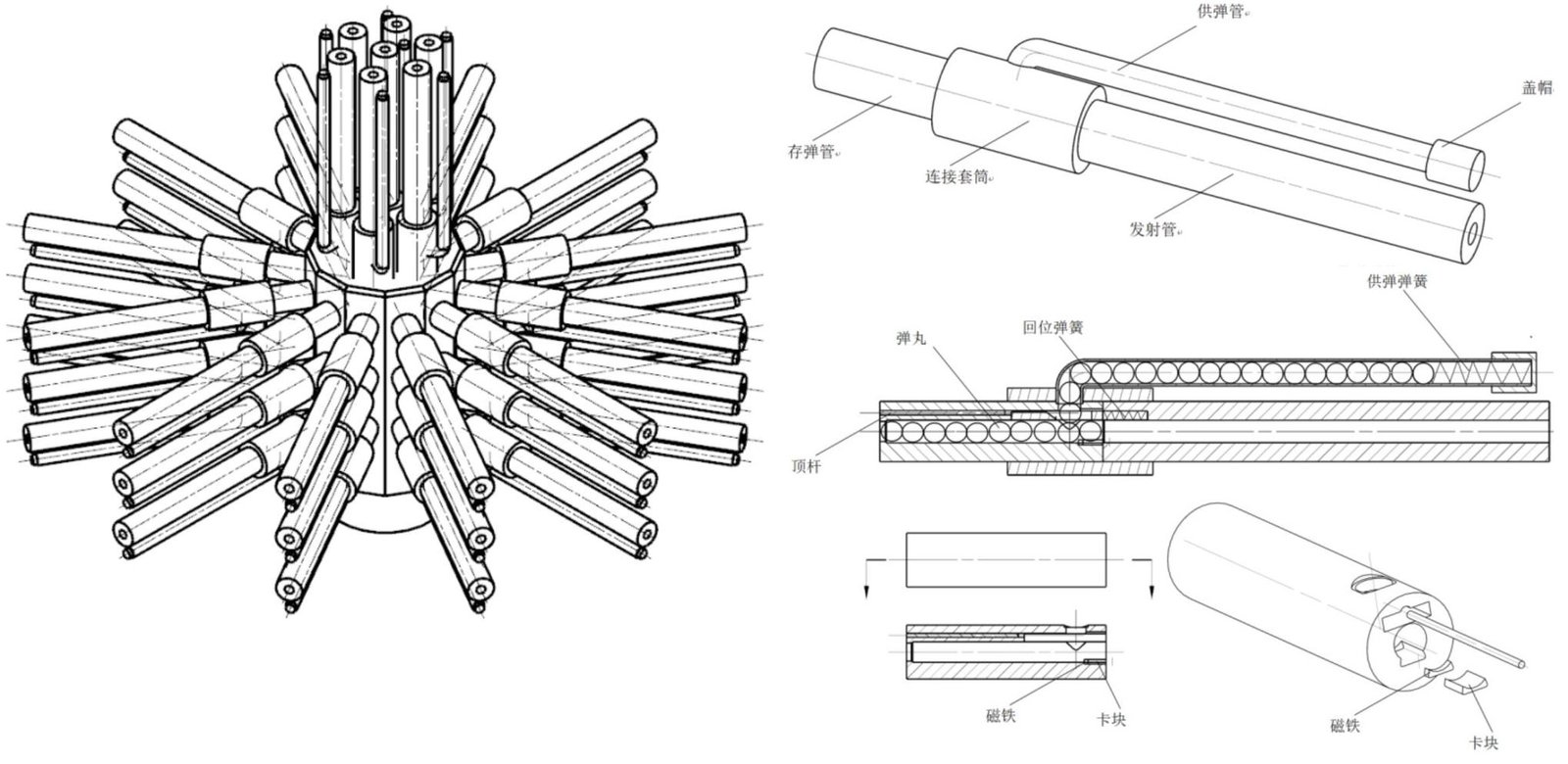
The patented system uses several barrel assemblies connected to a common front combustion chamber. Each assembly has a feed tube containing spherical steel projectiles, a storage tube and a launch tube.
A spring in the feed tube automatically moves the next steel ball into the storage tube after firing. The combustion chamber has multiple connection points on its front and circumference, allowing several barrels to be installed at different angles for multi-directional firing from a common propellant source.
The launch tube has an internal diameter slightly smaller than the steel projectile, allowing gas pressure to force the ball through the barrel. The steel balls and propellant are loaded separately.
Firing and loading mechanism
When the system fires, propellant gas from the combustion chamber pushes a pusher rod. This moves a locking and gas-blocking component so that its projectile-passing hole becomes misaligned with the storage-tube feed opening, sealing the opening and preventing gas leakage.
After chamber pressure falls, a return spring resets the blocking component and realigns the openings. The feed-tube spring then pushes the next steel ball into the storage tube.
The blocking component also has a slope that helps move a partially advanced projectile back into the feed tube during the sealing process. A magnet inside the storage tube holds the forwardmost steel ball slightly off-centre to help prevent jamming.
Anti-drone purpose
The patent states that the design addresses limitations of conventional single-projectile firearms and existing shotguns against small, fast-moving drones. Conventional shotguns can experience projectile collisions inside the barrel, which can increase dispersion at longer distances.
By placing steel balls in separate tubes and mounting multiple barrel assemblies at different angles, the patented design aims to create a wider spatial coverage pattern against approaching UAVs.
The structure is intended primarily for individual or light anti-drone use. However, the patent remains pending and does not confirm that a completed production weapon has entered service or that the system has been operationally deployed.
Images associated with the patent show technical drawings of the multi-barrel arrangement and its internal components.
——— End of Article ———