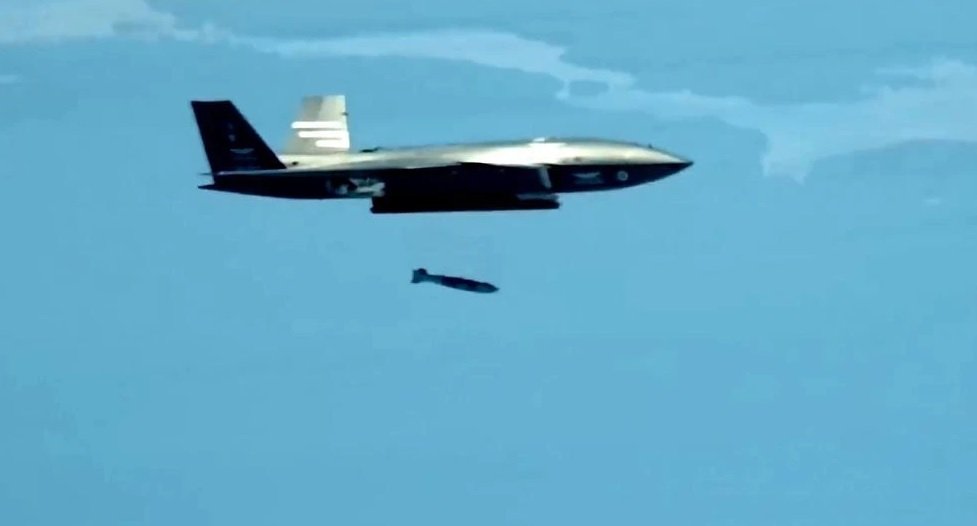
ÇORLU, Türkiye — Türkiye's Bayraktar KIZILELMA unmanned combat aircraft has successfully completed its first live-fire tests using its internal weapons bay, marking an important step in the platform's low-observable strike capability. During the tests, the aircraft accurately released two domestically developed smart munitions—ROKETSAN's TEBER-82 and ASELSAN's TOLUN-P—from its internal weapons compartment and achieved direct hits on their designated targets.
Baykar, the developer of KIZILELMA, announced the results on July 30, 2026. The tests were conducted at the Çorlu Flight Training and Test Center in Tekirdağ using the serial production aircraft with tail number S2.
According to the company, KIZILELMA first conducted a successful internal-bay firing of the ROKETSAN-produced TEBER-82 on July 25. A second test followed on July 28, when the aircraft successfully released ASELSAN's TOLUN-P munition from its internal weapons bay. In both flights, the aircraft took off from Çorlu, flew to the target area, released the weapons from the internal compartment, and accurately struck the designated targets.
The successful releases represent the first time both munitions have been fired from KIZILELMA's internal weapons bay. They had previously been tested from the aircraft's external under-wing hardpoints.
🇹🇷 Türkiye's Bayraktar KIZILELMA successfully completed its first live-fire tests from its internal weapons bay, releasing the TEBER-82 and TOLUN-P smart munitions and hitting designated targets. The milestone strengthens the UCAV's low-observable precision strike capability. pic.twitter.com/VDvmkPfjL7
— The Defense News (@TheDefenseNews) July 30, 2026
Internal Weapons Bay Supports Low-Observable Operations
The successful use of the internal weapons bay is an important capability for low-observable combat aircraft. Carrying weapons inside the fuselage helps reduce the aircraft's radar cross-section compared with external stores, while also preserving aerodynamic performance by minimizing drag.
Baykar said the successful tests confirm KIZILELMA's ability to conduct precision strikes while maintaining a lower radar signature. Internal carriage is intended to improve the aircraft's effectiveness during operations in heavily defended environments and support deeper penetration missions using domestically developed weapons.
Munitions Used During the Tests
The two precision-guided munitions used during the trials were developed by Turkish defense companies.
The TEBER-82, developed by ROKETSAN, is a guidance kit that converts standard MK-82 general-purpose bombs into precision-guided weapons. It uses inertial navigation, GPS, and a semi-active laser seeker for guidance. According to the available specifications, it has a range of 2 to 28 kilometers, weighs approximately 270 kilograms, offers a circular error probable of less than three meters, and can engage both fixed and moving targets. It also includes an optional proximity sensor.
Following the successful firing, ROKETSAN CEO Murat İkinci said the internal weapons station test had been completed successfully and highlighted the continued cooperation between the companies.
The TOLUN-P, developed by ASELSAN, is an INS/GNSS-guided gliding munition in the 250-pound class designed for precision strikes. According to ASELSAN CEO Ahmet Akyol, its integration involved the SADAK-4T smart pneumatic rack, enabling the weapon to be carried inside KIZILELMA's internal weapons bay.
Builds on Previous Weapons Integration
The internal weapons bay tests expand KIZILELMA's ongoing weapons integration program.
The aircraft has previously completed firing tests with the Gökdoğan air-to-air missile, the JET-230 air-to-surface supersonic missile, LGK-82 guidance kits, and external carriage and release of both TOLUN and TEBER-82 munitions.
In mid-July 2026, KIZILELMA successfully test-fired the JET-230 missile at a range exceeding 120 kilometers.
According to previous program milestones, the aircraft also became the first unmanned fighter to destroy a jet-powered aerial target using a beyond-visual-range air-to-air missile in November 2025. In December 2025, two KIZILELMA prototypes completed an autonomous close-formation flight.
Platform Overview
Bayraktar KIZILELMA is Türkiye's first jet-powered unmanned combat aircraft and is designed as a low-observable, single-engine multirole platform.
The aircraft has an overall payload capacity of approximately 1.5 tons distributed between its internal weapons bays and external under-wing stations. Depending on configuration, its maximum takeoff weight ranges from approximately 6 to 8.5 tons.
Broader Significance
Defense analysts note that data collected during KIZILELMA's internal weapons bay testing could support the development of other Turkish low-observable aircraft programs that also use internal weapon bays, including TUSAŞ's ANKA-III unmanned combat aircraft and the KAAN fifth-generation fighter.
The successful completion of the internal-bay live-fire tests marks another step in validating KIZILELMA's ability to integrate domestically produced precision-guided weapons while supporting low-observable strike operations.
——— End of Article ———