WASHINGTON, D.C., — BAE Systems has unveiled a truck-mounted prototype of its Multi-Domain Artillery Cannon System (MDACS) at the Association of the United States Army (AUSA) 2026 exhibition, held from October 12 to 14 at the Walter E. Washington Convention Center. The 155mm system is designed to intercept drones and missiles while retaining the ability to conduct precision strikes against ground targets.
BAE Systems presented MDACS alongside a High Power Microwave (HPM) system, combining conventional artillery and directed energy for layered defense against drone swarms and other aerial threats. The systems are intended to protect fixed and semi-fixed military installations at a moderate cost.
Truck-Mounted Design
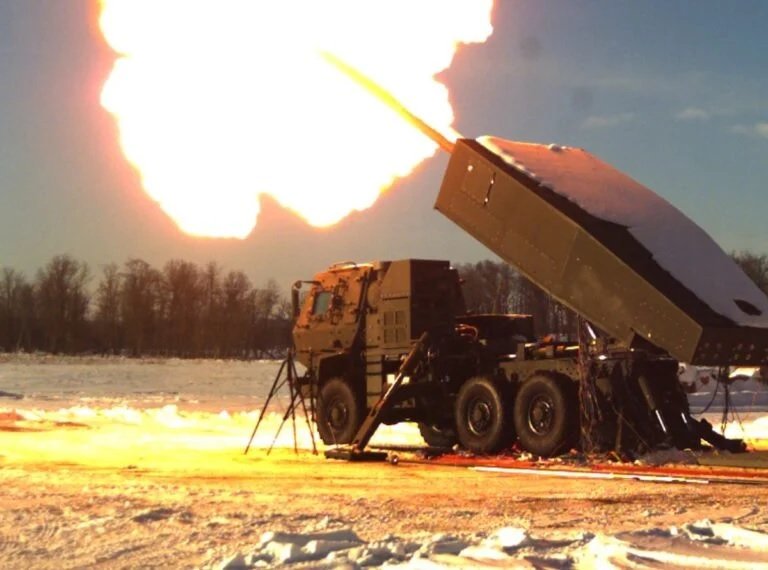
The MDACS prototype differs from earlier technology demonstrators and is mounted on a three-axle Oshkosh Family of Medium Tactical Vehicles (FMTV) chassis. Its split cab has a central opening to accommodate the 155mm barrel during transport. A hydraulically raised support secures the barrel for firing, while two side stabilizers and one rear stabilizer steady the vehicle.
The cannon sits in a large unmanned turret at the rear and uses a fully mechanized loading system. BAE Systems describes the platform as air-transportable and suitable for mobile battlefield deployment.
HVP and Scorpio-XR Ammunition
For air defense, MDACS is designed to fire the Hypervelocity Projectile (HVP), a low-drag guided round under development since 2013. Earlier tests used the 155mm M777 towed howitzer and the 127mm Mk 45 naval gun, achieving reported ranges of approximately 31.5 kilometers and more than 74 kilometers, respectively. These figures are from earlier test platforms and do not represent MDACS's confirmed range.
Despite technical challenges that have increased development costs, simulations indicate that HVP could be cheaper than conventional guided air defense missiles.
For ground attacks against fixed and moving targets in contested environments, MDACS will use Scorpio-XR, an HVP-derived precision munition that BAE Systems says doubles the range of existing 155mm cannon-launched projectiles.
High Power Microwave System
The HPM system provides a directed-energy option against coordinated drone swarms. According to BAE Systems, more than 99% of its components are commercial off-the-shelf products. It operates on electrical power and does not require conventional ammunition for each engagement, allowing continued operation while sufficient power is available.
Together, MDACS and HPM are intended to provide complementary defenses against aerial threats while reducing reliance on traditional, magazine-limited air defense systems.
Jason Casciotti, vice president of BAE Systems' Weapon Systems product line, said, “The threat environment is evolving faster than traditional procurement cycles can keep up with.” The company said it is using proven technical components and an established supply chain to accelerate delivery of both systems.
U.S. Army Testing Plans
The U.S. Army reportedly plans to have a complete MDACS battery ready for testing by the end of September 2027. The proposed configuration includes eight guns organized into four two-gun platoons, supported by Multi-Function Precision Radar (MFPR) equipment, two Multi-Domain Battle Manager (MDBM) command posts and dedicated ammunition supply vehicles.
The programme builds on earlier U.S. Army and U.S. Air Force research into using 155mm artillery for air defense. The planned testing will assess the system's potential to protect military installations against a range of aerial threats while retaining its ground-strike capability.
——— End of Article ———