WASHINGTON, D.C., — Lockheed Martin has provided further details of its PAC-3 Adapted Capability Effector (PAC-3 ACE), a simplified, lower-cost interceptor designed for the Patriot air defense system. First announced at the Farnborough International Airshow in July 2026, the missile was displayed as a mock-up at the AUSA 2026 defense exhibition. It aims to reduce interceptor costs and increase missile availability while retaining compatibility with existing Patriot systems.
Simplified Design to Reduce Costs
Jason Reynolds, Lockheed Martin’s vice president for integrated air and missile defense, outlined the changes made to reduce the missile’s production cost and complexity. The company aims to price the ACE at less than half the cost of the PAC-3 Missile Segment Enhancement (MSE). Public estimates place its price at around $2 million or less per missile, compared with approximately $4 million to $5.3 million for the MSE. Lockheed Martin has not confirmed an official unit price.
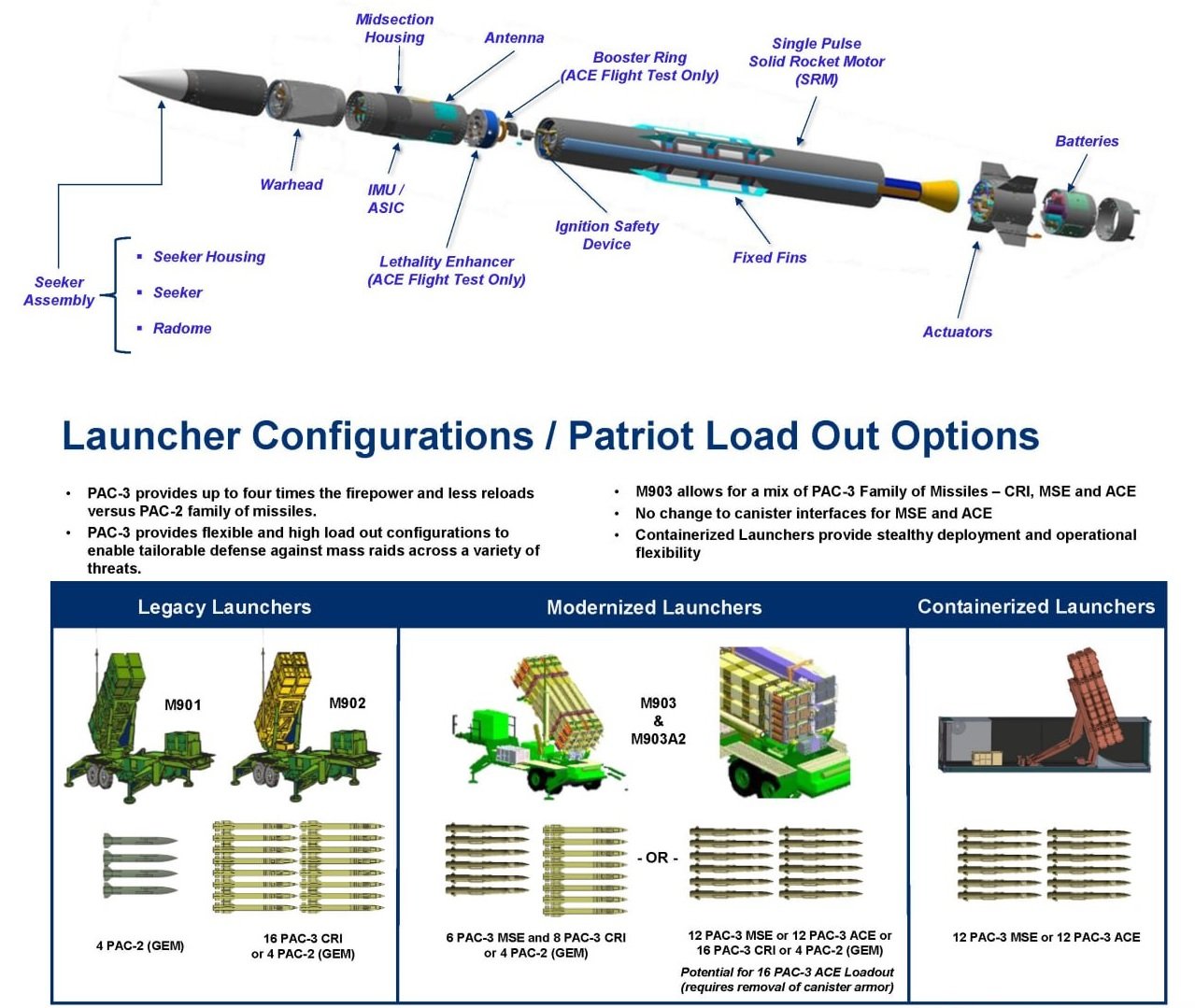
The PAC-3 ACE replaces the MSE’s hit-to-kill interception method with a conventional blast-fragmentation warhead, similar in concept to the older PAC-2 Guidance Enhanced Missile-Tactical (GEM-T). The warhead is positioned in space previously occupied by aerodynamic fins.
Other changes include:
-
Removal of the Attitude Control Motors that provide the MSE with high terminal maneuverability.
-
Replacement of the dual-pulse solid rocket motor with a single-pulse motor.
-
A simplified missile midsection to reduce manufacturing complexity.
-
A less complex seeker, while retaining established PAC-3 guidance software and fire-control integration.
Reduced Range but a Complementary Role
The design changes give the PAC-3 ACE a shorter engagement range and lower maximum interception altitude than the PAC-3 MSE. Its ballistic-missile interception capability is also more limited than that of both the MSE and PAC-2 GEM-T.
The ACE is intended primarily to engage aircraft, cruise missiles, and close- and short-range ballistic missiles. The higher-performance MSE will remain available for more demanding threats.
Compatibility with Existing Patriot Launchers
Despite its internal changes, the ACE retains the MSE’s external dimensions and is designed to use the same missile canisters, M903 and M903A2 launchers, and existing Patriot fire-control systems. It is also designed to work with the Integrated Battle Command System (IBCS).
A standard M903A2 launcher can accommodate 12 ACE missiles. Some reports suggest that the number could increase to 16 if certain canister armor is removed. The configuration is intended to increase the number of available interceptors without requiring a new launcher system.
Production Plans and European Cooperation
Lockheed Martin plans to manufacture the ACE on production lines separate from those used for the MSE. The company is exploring partnerships with American and European industry, including potential European production and supply of rocket motors and guidance electronics, subject to U.S. government approval.
The proposed cooperation aims to expand production capacity, strengthen local supply chains and help European allies field a common, interoperable interceptor.
Flight Testing Scheduled for 2028
The PAC-3 ACE remains under development and is not yet ready for operational deployment. First flight testing is scheduled for early 2028, followed by initial limited production. Serial production is expected to begin around 18 months after flight testing starts, with manufacturing capacity increasing in subsequent years.
Lockheed Martin presents the PAC-3 ACE as a complement to, rather than a replacement for, the PAC-3 MSE. Its lower-cost design is intended to help Patriot operators address selected aerial threats with more affordable interceptors while reserving higher-performance missiles for more demanding engagements.
——— End of Article ———