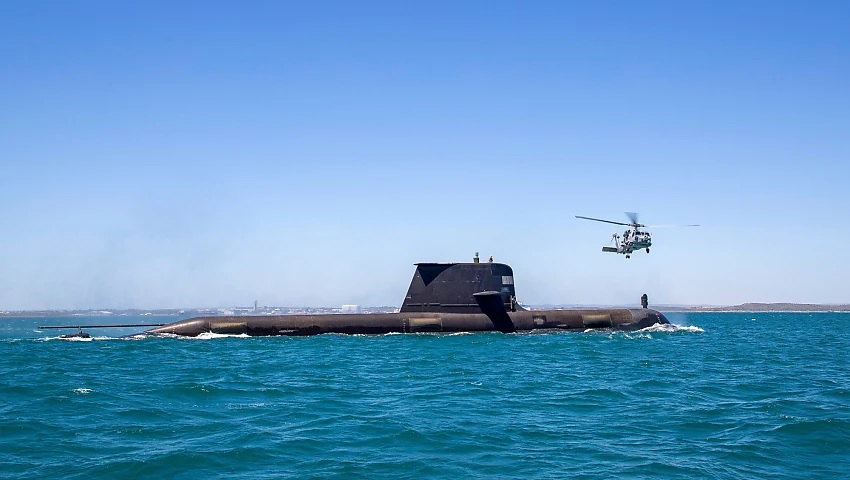
CANBERRA, — May 22, 2026 : The Australian government has officially launched the Life of Type Extension (LOTE) program for the Royal Australian Navy’s six Collins-class submarines, committing up to A$11 billion (approximately US$7.8 billion) over the next ten years to sustain the fleet into the 2040s during Australia’s transition to nuclear-powered submarines under the AUKUS partnership.
The announcement was made on May 19 by Defence Minister Richard Marles and Minister for Defence Industry Pat Conroy. The program is intended to prevent a submarine capability gap before the future SSN-AUKUS fleet enters service and before the planned transfer of U.S. Virginia-class nuclear-powered submarines to Australia during the 2030s.
HMAS Farncomb to Begin Initial LOTE Work
The LOTE program will commence at the end of May with HMAS Farncomb, the second submarine of the Collins class, commissioned in 1998. Defence officials stated that the vessel will undergo a detailed engineering assessment period to determine the exact upgrade requirements and establish the baseline scope for the remaining submarines in the fleet.
Alongside Farncomb’s overhaul, the Department of Defence will prioritise sustainment work on the fleet’s youngest submarine, HMAS Rankin, as part of broader efforts to maintain operational availability across the class.
The work will be carried out by government-owned ASC at Osborne Naval Shipyard in South Australia and facilities in Henderson, Western Australia.
Conditions-Based Modernisation Approach
Despite the major funding commitment, the final scope and total cost of the complete LOTE effort remain uncertain. Defence has adopted what it describes as a “conditions-based sustainment approach,” meaning each submarine may receive a different level of modernisation depending on its condition and operational requirements.
Planned work could include overhaul or replacement of diesel engines, battery arrays, generators, propulsion systems, electrical power conversion equipment, and distribution systems. Defence officials indicated that limiting major upgrades on some submarines to reduce engineering risks could result in operational restrictions or lower readiness levels for boats receiving reduced modifications.
Each submarine is expected to undergo docking and extension work lasting up to two years.
Wear, Corrosion, and Structural Challenges
The Collins-class submarines were built through cooperation between Swedish designer Kockums and Australian builder ASC and entered service between 1996 and 2003. The class was originally designed for an operational life of approximately 30 years, with retirement previously scheduled between 2026 and 2036.
However, prolonged operational use has created greater wear and structural fatigue than initially expected. In 2024, Defence disclosed severe corrosion issues aboard HMAS Farncomb and separate structural defects affecting HMAS Sheean, commissioned in 2001.
Officials have noted that the submarines were constructed under varying manufacturing conditions, meaning each vessel now presents different maintenance and engineering challenges. As a result, the full extent of required repairs and upgrades will only become clear after detailed inspections are completed during each docking cycle.
Previous Upgrade Reductions
The scope of the LOTE program has already undergone several reductions in recent years.
In 2024, Australia cancelled plans to install Safran-manufactured optronic sensor masts on the Collins-class fleet. Although contracts for the systems remain active, the equipment is now expected to remain in storage indefinitely.
Defence also abandoned a feasibility study examining the integration of torpedo-tube-launched Tomahawk cruise missiles on the submarines after determining that the capability was not viable for the class.
Years of Procurement Changes
The current extension effort follows more than a decade of changing Australian submarine procurement policies.
The 2009 Defence White Paper released under former Prime Minister Kevin Rudd proposed expanding Australia’s submarine fleet from six to twelve domestically built boats while modernising the Collins class throughout the 2010s with sonar and systems upgrades.
However, repeated government changes and shifting defence priorities delayed major modernisation work during that decade, leaving the submarines to accumulate additional operational stress without comprehensive structural renewal.
In 2016, Australia selected France’s Naval Group to build twelve conventionally powered Attack-class submarines under the SEA 1000 project. The accompanying Defence White Paper allocated up to A$3 billion for Collins-class upgrades, including sonar replacements, advanced satellite communication systems, and a new submarine escape-and-abandonment system.
Shift to AUKUS Nuclear Submarines
Australia’s submarine strategy changed again in 2021 when the government of former Prime Minister Scott Morrison cancelled the Attack-class program and joined the trilateral AUKUS partnership with the United States and the United Kingdom.
Under the 2023 “Optimal Pathway” arrangement, Australia will receive at least three U.S. Virginia-class nuclear-powered submarines between 2032 and 2037 as an interim capability before the future SSN-AUKUS submarines enter service in the early 2040s.
The revised timeline transformed the Collins LOTE from a conventional mid-life upgrade program into a long-term extension effort designed to keep the existing fleet operational for approximately 15 additional years.
Audit Highlights Rising Costs and Delays
The government announcement coincided with the release of an Australian National Audit Office (ANAO) report on May 22, 2026, examining Defence planning for the Collins-class extension program.
According to the audit, planning challenges emerged as Defence transitioned from the cancelled Attack-class project to the AUKUS submarine strategy. The report stated that the LOTE design contract increased from approximately A$125 million in 2022 to A$813 million.
The ANAO also noted accumulated delays and adjustments to project scope and delivery strategy, while Defence accepted recommendations aimed at strengthening project risk management and oversight.
Long-Term Transition Period
As the Royal Australian Navy moves into the 2030s, it will face the complex task of managing extended docking and sustainment work for the Collins-class fleet while simultaneously preparing infrastructure, workforce training, and support systems for the induction of Virginia-class nuclear-powered submarines.
The completion of HMAS Farncomb’s engineering assessment is expected to become a key decision point for Defence and the Australian government in determining the final scale of the LOTE program and how many submarines will ultimately undergo the full extension process.
——— End of Article ———