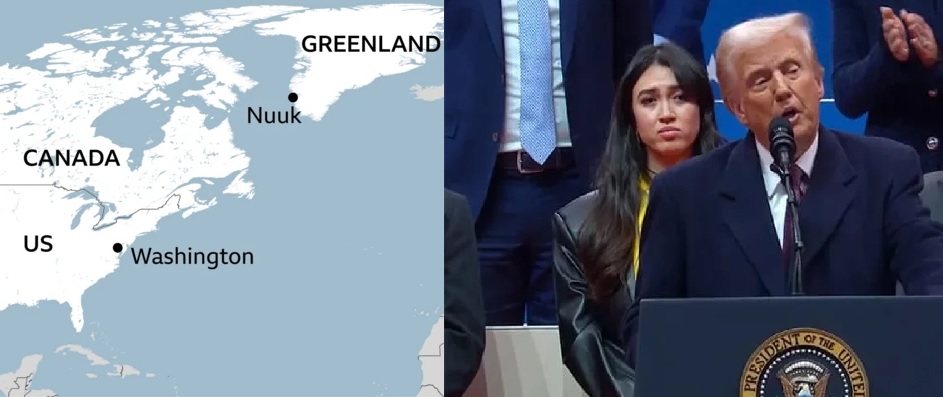
U.S / Greenland : The United States is examining whether a Compact of Free Association (COFA)—a legal framework under which Washington assumes responsibility for a partner’s external defense—could be applied to Greenland, a move that would represent an unprecedented extension of a Pacific-era security model into the Arctic. The discussions, first reported by The Economist on January 5, 2025, have gained renewed urgency in early 2026 amid heightened U.S. rhetoric on Arctic security and growing geopolitical competition in the High North.
Background: Greenland’s Status and Strategic Importance
Greenland, home to roughly 56,000–57,000 people, has exercised extensive self-government since 1979, controlling domestic policy, taxation, and natural resources. Formally, however, it remains part of the Denmark, which retains authority over foreign affairs and defense. Its geographic position—bridging North America and Europe and overlooking key Arctic sea lanes—has long made it strategically significant for early warning systems, missile defense, and transatlantic security.
The island already hosts critical U.S. military infrastructure, including the Thule space and missile-warning facilities, underscoring Washington’s long-standing security footprint. As Arctic ice recedes, opening new shipping routes and exposing mineral and energy resources, Greenland’s strategic value has only increased.
Washington’s Latest Signals
The debate intensified in January 2026 following unusually explicit statements from Washington. On January 4, 2026, U.S. President Donald Trump publicly stated that the United States “needs Greenland” from a national security perspective. Two days later, on January 6, 2026, the White House confirmed that it was examining “a range of options” regarding Greenland’s future security arrangements—remarks that, according to officials, did not exclude even the use of military force. These comments propelled Greenland’s status from a theoretical policy discussion into a live diplomatic and strategic issue.
What a Compact of Free Association Means
A Compact of Free Association is a legally binding but asymmetric partnership. Under existing COFA arrangements, the associated state remains internationally recognized and self-governing in domestic affairs, while the United States assumes full responsibility for external defense and security. Washington gains the right to deploy forces, control strategic access, and manage defense matters on behalf of the partner.
Currently, COFA agreements exist only with three Pacific states: the Federated States of Micronesia, the Marshall Islands, and the Palau. In return for defense guarantees, these states receive economic aid, development funding, and trade privileges, including duty-free access to U.S. markets. Applying this model to Greenland would be a significant departure from precedent, shifting a framework designed for small Pacific island nations into the heart of the Arctic and Europe.
Implications for Denmark and NATO
Any COFA-style arrangement for Greenland would fundamentally alter the relationship between Nuuk and Copenhagen. Denmark’s constitutional responsibility for Greenland’s defense would effectively be transferred to Washington, raising complex legal and political questions within the Danish realm. For Europe and NATO, the proposal challenges long-standing assumptions about allied sovereignty and burden-sharing.
Greenland sits within NATO territory by virtue of Denmark’s membership, meaning a bilateral U.S.–Greenland defense arrangement could blur the lines between alliance obligations and unilateral American control. European allies have privately expressed concern that such a move could set a precedent for U.S. dominance over strategic territories within allied states, potentially weakening collective decision-making.
Greenlandic Perspectives and Domestic Sensitivities
Within Greenland itself, reactions are likely to be mixed. While some policymakers view closer ties with Washington as a potential source of economic investment and security guarantees, others see the idea as a threat to self-determination and a step toward de facto U.S. control. Greenlandic politics have long balanced aspirations for eventual independence against economic reliance on Denmark, and a COFA arrangement could reshape that debate entirely.
Public opinion is further complicated by Greenland’s Indigenous identity and historical sensitivities to external control, making any transfer of defense authority politically delicate.
A Test of U.S. Power in the Arctic
The consideration of a Compact of Free Association with Greenland reflects a broader shift in U.S. strategy toward the Arctic, driven by intensifying competition with Russia and China, climate-driven accessibility, and renewed emphasis on homeland defense. From Washington’s perspective, a COFA could provide maximum strategic control with minimal formal annexation, avoiding the political and legal fallout of outright territorial acquisition.
For Europe, however, the proposal raises alarms about the limits of U.S. power within allied territory and the erosion of multilateral norms. If pursued, it would test NATO cohesion, Denmark’s sovereignty, and Greenland’s autonomy simultaneously. Whether the idea evolves into formal negotiations or remains a pressure tactic, it has already succeeded in one respect: placing Greenland at the center of global debates over Arctic security, sovereignty, and the future architecture of U.S. alliances.
——— End of Article ———