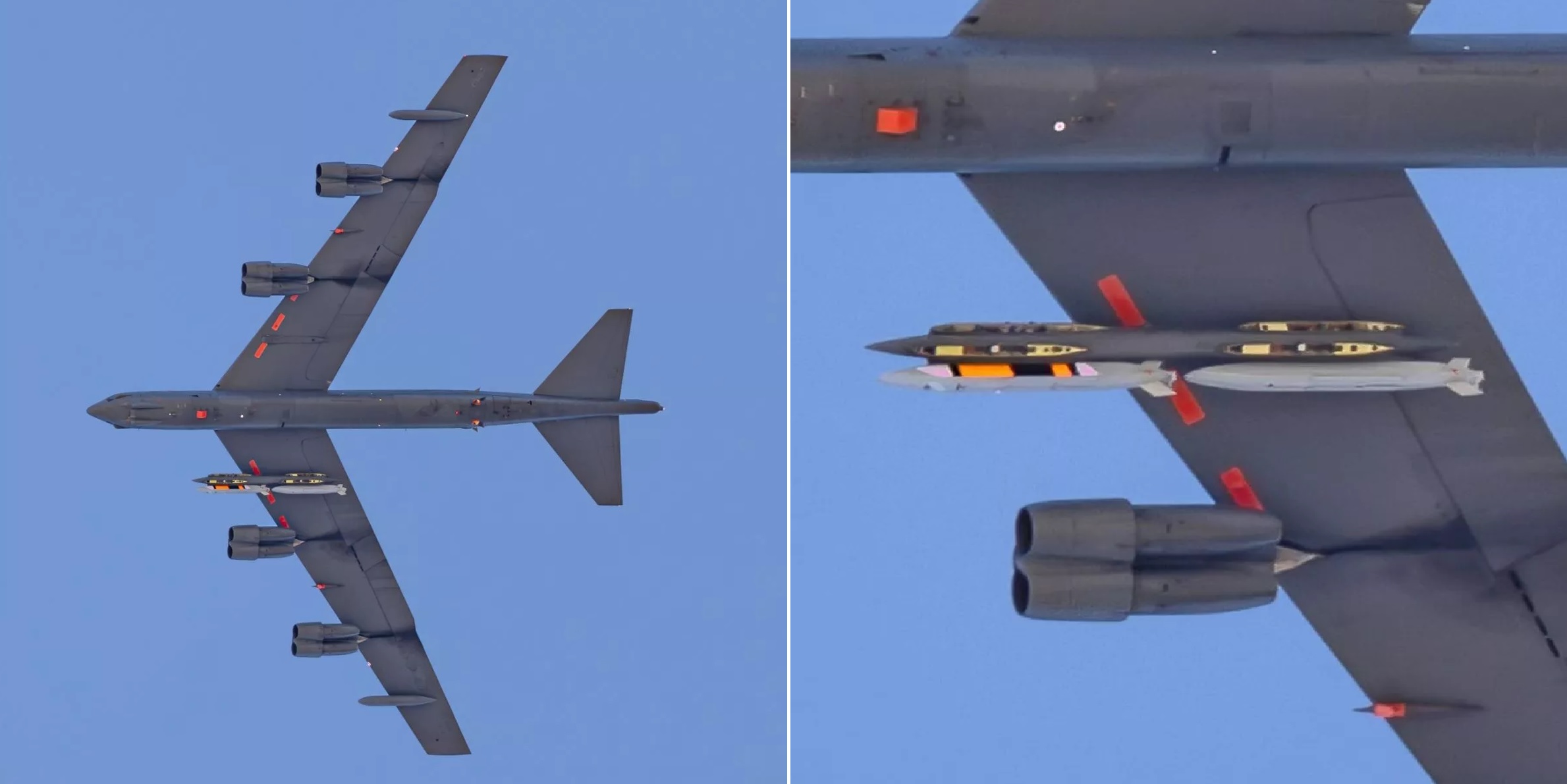
For years, it was a rumor — a whispered secret in classified budgets and closed-door Pentagon meetings. But now, the AGM-181 Long-Range Stand-Off (LRSO) missile, America’s newest stealth nuclear cruise missile, has been seen for the first time.
A U.S. Air Force B-52 bomber has been photographed over California carrying what appears to be the first visible prototype of the LRSO, marking a rare glimpse of one of the most secretive projects in the U.S. nuclear modernisation programme.
The sighting, captured by aviation photographer Ian Recchio and reported by The Aviationist, showed a B-52H Stratofortress flying over Owens Valley on October 29, with two unusual weapons mounted beneath its right wing. The aircraft, call sign Torch52, bore orange test markings, the hallmark of experimental Air Force flights.
As Recchio’s images circulated online, analysts immediately noticed something extraordinary. The bomber’s payload featured wedge-shaped missiles with fold-out wings and inverted-T tails—exactly matching renderings of the AGM-181 LRSO released earlier in June 2025. The resemblance was too close to dismiss.
America’s Silent Deterrent Takes Shape
Developed by Raytheon Technologies, the LRSO is the successor to the AGM-86 Air-Launched Cruise Missile (ALCM)—a weapon that has served for more than four decades. The new missile represents a leap into the next era of strategic nuclear deterrence, designed to be smaller, stealthier, and far deadlier than its predecessor.
Unlike the Cold War-era ALCM, the AGM-181 is built from the ground up for low-observability. Its smooth trapezoidal body, recessed engine intake, and radar-absorbent coating allow it to vanish into the background of enemy radar. The LRSO flies subsonically, hugging the terrain to avoid detection, and carries the W80-4 variable-yield thermonuclear warhead, capable of delivering between 5 and 150 kilotons of destruction — up to ten times the power of Hiroshima.
With a range estimated to exceed 2,400 kilometers (1,500 miles), it gives U.S. bombers the ability to strike from beyond the reach of even the most advanced air-defense systems.
A Shadow in the Sky
According to Recchio’s account, the B-52 was first spotted entering a low-level training route, before climbing to about 5,000 feet — giving observers a clear view of the payload. The orange test markings on the fuselage confirmed that this was part of an official flight evaluation, not a training sortie.
Defense observers quickly connected the dots. The test’s timing came just days after Russian President Vladimir Putin publicly announced new trials of the Burevestnik, a nuclear-powered cruise missile touted as a key part of Moscow’s deterrent arsenal. The coincidence was unlikely to be accidental.
Strategic analysts believe the public sighting of the LRSO prototype was a calculated signal — a subtle reminder that the United States is completing its own modernization of the nuclear triad. In an era of growing nuclear brinkmanship, simply allowing the world to glimpse such a weapon can be as powerful as a formal announcement.
Inside the LRSO Program
The AGM-181 program, valued at approximately $16 billion, aims to replace more than 1,000 aging ALCMs by 2030. The missile will equip both the venerable B-52 Stratofortress and the futuristic B-21 Raider stealth bomber, ensuring the U.S. nuclear bomber fleet remains capable of penetrating next-generation air defenses.
Each missile is expected to cost around $14 million, with low-rate production beginning in 2027. The first test launches from operational bombers could take place before the end of the decade.
Stealth, Silence, and Strategy
The LRSO isn’t meant to dazzle with speed — it’s built to disappear. Its purpose is to slip through radar networks, evade electronic warfare, and strike without warning. Where ballistic missiles announce their presence with fiery trails across the sky, the LRSO glides quietly under the radar, a ghost in the air.
It gives U.S. commanders an unmatched flexible deterrent — a weapon that can be launched, recalled, or redeployed without crossing red lines. It’s the modern embodiment of credible, controlled deterrence — visible enough to send a message, invisible enough to survive.
A Message to Moscow and Beijing
The timing of this public reveal couldn’t be clearer. As Russia flaunts its exotic Burevestnik missile and China accelerates its own nuclear modernization, the United States is demonstrating that its deterrent edge remains very much intact.
The AGM-181 LRSO isn’t just another warhead — it’s a message. A message that if the world ever comes to the brink, the first sign of war might be the last sound anyone hears.
In the skies over California, the “invisible” nuke became visible — just long enough to remind the world that silence can be the deadliest weapon of all.
——— End of Article ———